
Understand the business before the numbers
What the company actually sells, how it makes money, who it competes with and where it sits in its industry — the context that stops a ratio from being read wrongly.
Free learning initiative
Equity research is the discipline behind analyst, investment and portfolio roles. Jobaaj Learnings is making this crash course free for every student — financial statements, ratios and forecasting, market data, technical analysis, and the report that ties it together.
No payment step. Open the first lesson straight away.
Our learners now work at





What you'll learn
Anyone can quote a P/E. The work is knowing which comparison is fair, which assumption is doing the heavy lifting, and how to write it down so someone else can challenge it.
What the company actually sells, how it makes money, who it competes with and where it sits in its industry — the context that stops a ratio from being read wrongly.
Balance sheet, P&L and cash flow, and how the three interlink — including the difference between profit reported and cash actually received.
Margins, returns, leverage and growth rates, plus how to compare them against a company’s own history and against its peers rather than in isolation.
Build historical trends into a forward view, interlink the statements so a change flows through correctly, and sanity-check what your assumptions imply.
Where exchange and corporate data comes from, the difference between live, snapshot, end-of-day and historical feeds, and how to assess whether data is trustworthy.
Trend, support and resistance, momentum and indicators across different horizons — then the report itself: structure, language, and turning analysis into a defensible view.
Why it's free
We built this to be learned from, not sold.
A lot of people who need a skill like this are exactly the people least able to pay for it — students between semesters, freshers before a first job, anyone rebuilding after a break. So we took the fee off.
Every lesson is open from the start. There's no locked second half and no upgrade waiting three modules in.
This isn't a promotional price or a trial. There's no clock on it and no fee arriving later.
Nothing was trimmed to make it free. It is the same material, at the same depth, as everything else we teach.
Come back to a lesson next month or next year. Access doesn't expire and nothing gets pulled behind a paywall.
Where it takes you
Reading a company and putting a number on it is the common requirement across research, investing, credit and risk. These are the roles it most often opens up.
Cover a sector, build the models behind it, and publish a view your desk and clients act on.
Screen opportunities and pressure-test the case for each one before capital moves.
Assess whether a borrower can service its debt — the same statements, read for a different risk.
Support allocation decisions, monitor holdings, and explain why a position moved.
Quantify exposure across positions and flag where a portfolio is more concentrated than it looks.
Research names for a fund that holds them for years, not quarters — depth over coverage.
Salary bands are indicative market ranges for these roles in India, not an outcome promised by this course.
Sixty-second check
Five questions on the things that actually trip people up. Answer them and you'll get a read on where you stand — and which part of the course to start from.
Certificate
Submit your assignment and Jobaaj Learnings issues a verifiable certificate you can share anywhere.
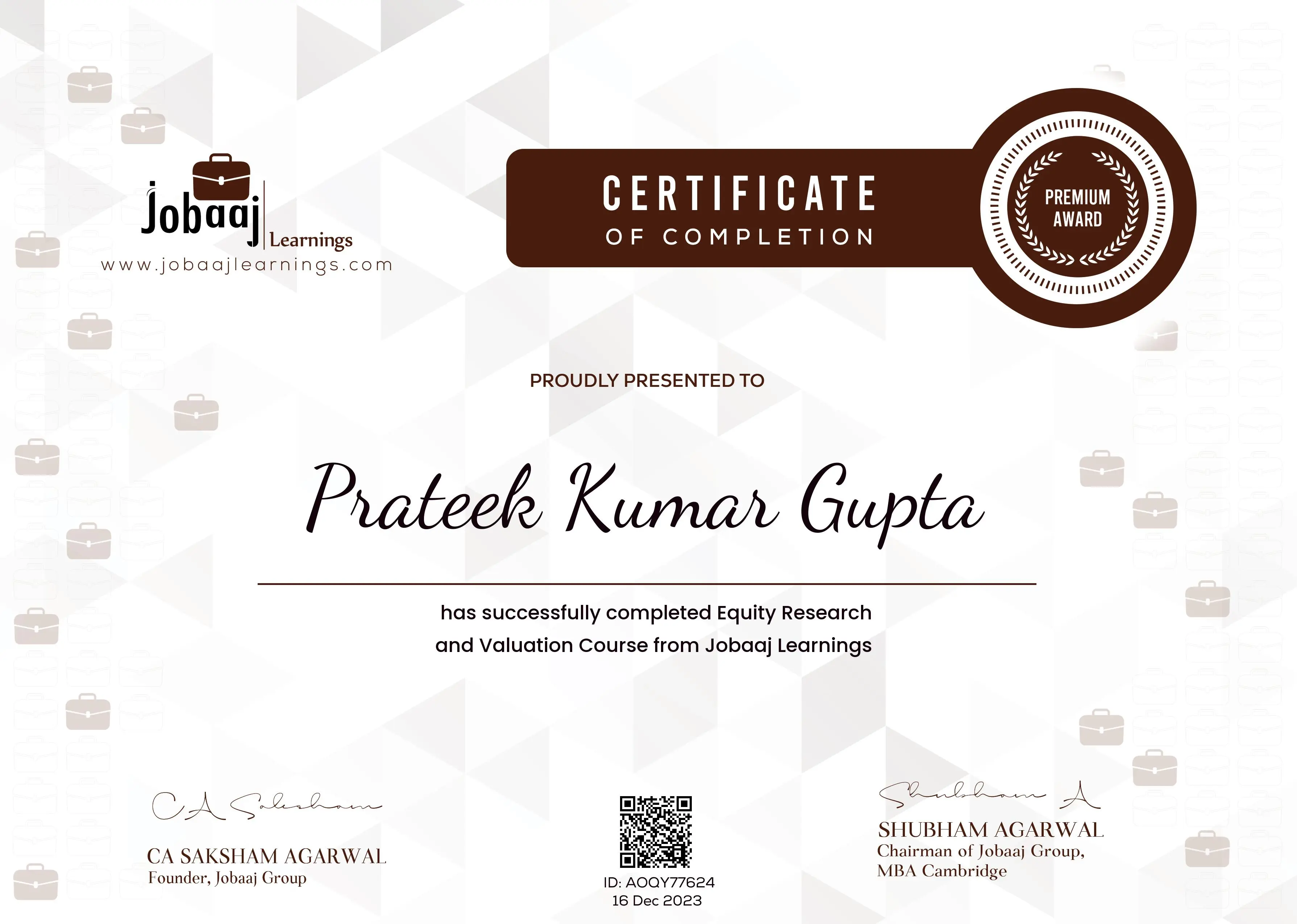
Issued and signed by Jobaaj Learnings, with a record an employer can check.
Add it to your résumé or post it to LinkedIn the day it's issued.
It says you finished the work and submitted the assignment — which is what it's worth showing for.
Learner journeys
A few of the moves made by learners who upskilled with Jobaaj Learnings.
Moved from studying for CFA Level 2 into an asset management analyst role.
Started as a fresher with no industry experience and moved into a research analyst role.
Went from MBA fresher to an analyst seat at a multinational investment bank.
Moved from MBA fresher into ESG and investment research.
Switched from an operations background into a valuations role.
Returned to work after time away and moved into an assistant manager consulting role.
Individual journeys shared by Jobaaj Learnings alumni. Outcomes vary and are not promised by this course.
Keep going
Equity research sits in the middle of these. All free from Jobaaj Learnings.
Build the three-statement model and DCF that sit underneath a research view.
ExploreGo deeper on the ratios — what each one hides, and when a good number is misleading.
ExploreMove from valuing one company to holding many: allocation, diversification and risk.
ExploreExtend the charting layer this course introduces — trends, indicators and setups.
ExploreIf the market mechanics are new, start here: instruments, exchanges and how trades settle.
ExploreDerivatives on top of the equities you can now analyse — payoffs, pricing and risk.
ExploreFAQ
Yes. Jobaaj Learnings provides it free of cost. There’s no fee to start, no trial period that ends, and no payment step anywhere in the flow.
None. The course starts from the very beginning and builds up from there, so you can begin with no prior experience in the subject.
Yes. Every lesson is recorded, so you can pause, rewind and come back whenever it fits around classes or work. There’s no schedule to keep up with.
Neither. The course is built for people coming from any stream and starts with what the financial statements are before using them. A CFA covers far more ground and takes years — this is a practical introduction to the analysis itself.
No. Everything is taught using sources you can reach for free — company annual reports and filings, and publicly available exchange data. Paid terminals are faster, not different.
Yes. Fundamentals are the core, but the course also covers trend, support and resistance, momentum and indicators, and how to combine both into a single written view.
Read a set of financial statements and see how they interlink, screen a company on ratios against its own history and its peers, build a simple forward forecast, source and sanity-check market data, and write a structured research report that states a view and supports it.
Write to training@jobaaj.com and we’ll get back to you.
Free · Jobaaj Learnings
This crash course is completely free. Open the first lesson and start reading a company properly today.
Start learning free