
Why a portfolio, not a stock
What portfolio management is for — investor objectives, constraints and horizon, and why return and risk only make sense when measured for the whole holding rather than one position.
Free learning initiative
Owning good stocks is not the same as owning a good portfolio. Jobaaj Learnings is making this crash course free for every student — how portfolios are constructed, why diversification works in numbers rather than slogans, and how risk and return are traded off.
No payment step. Open the first lesson straight away.
Our learners now work at





What you'll learn
A portfolio is not a list of favourites. It is a set of weights chosen for a return target and a risk you can live with. This course teaches how that choice is made — the approaches, the arithmetic behind diversification, and the line every expected return is measured against.
What portfolio management is for — investor objectives, constraints and horizon, and why return and risk only make sense when measured for the whole holding rather than one position.
The traditional approach and the modern one — allocation before selection, top-down against bottom-up, and how the same set of stocks can make two very different portfolios.
Expected return, variance and standard deviation, then covariance and correlation — the numbers that decide whether two holdings cancel each other’s swings or amplify them.
Portfolio theory as Markowitz set it out — the efficient frontier, dominance, and the portfolio that gives the highest return for a level of risk you have chosen.
Unsystematic risk that spreads away across holdings, and systematic risk that stays — the reason beta, not variance, is the risk a well-diversified investor is paid for.
Expected return plotted against beta — what a security should return for its risk, why a plot above the line reads as underpriced, and where the CAPM comes from.
Why it's free
We built this to be learned from, not sold.
A lot of people who need a skill like this are exactly the people least able to pay for it — students between semesters, freshers before a first job, anyone rebuilding after a break. So we took the fee off.
Every lesson is open from the start. There's no locked second half and no upgrade waiting three modules in.
This isn't a promotional price or a trial. There's no clock on it and no fee arriving later.
Nothing was trimmed to make it free. It is the same material, at the same depth, as everything else we teach.
Come back to a lesson next month or next year. Access doesn't expire and nothing gets pulled behind a paywall.
Where it takes you
Most people take this to manage their own money better. It is also the foundation of every research, advisory and fund-management role, and a fixture of CFA and MBA finance syllabi.
The most common reason people take this. Hold a portfolio with a reason for each weight, not just a list of stocks you like.
Support fund managers with allocation, risk and performance analysis.
Evaluate funds and managers on risk-adjusted return, not headline return.
Build and explain allocations for clients at a bank, broker or advisory.
Match a portfolio to a client’s objectives and horizon — the first lesson of this course, applied.
Measure and report the risk a portfolio is carrying — variance, correlation and beta are the toolkit.
Salary bands are indicative market ranges for these roles in India, not an outcome promised by this course. Nothing on this page is investment advice, and investing carries risk of loss.
Sixty-second check
What’s your portfolio sense, really?Five questions on the things that actually trip people up. Answer them and you'll get a read on where you stand — and which part of the course to start from.
Certificate
Submit your assignment and Jobaaj Learnings issues a verifiable certificate you can share anywhere.
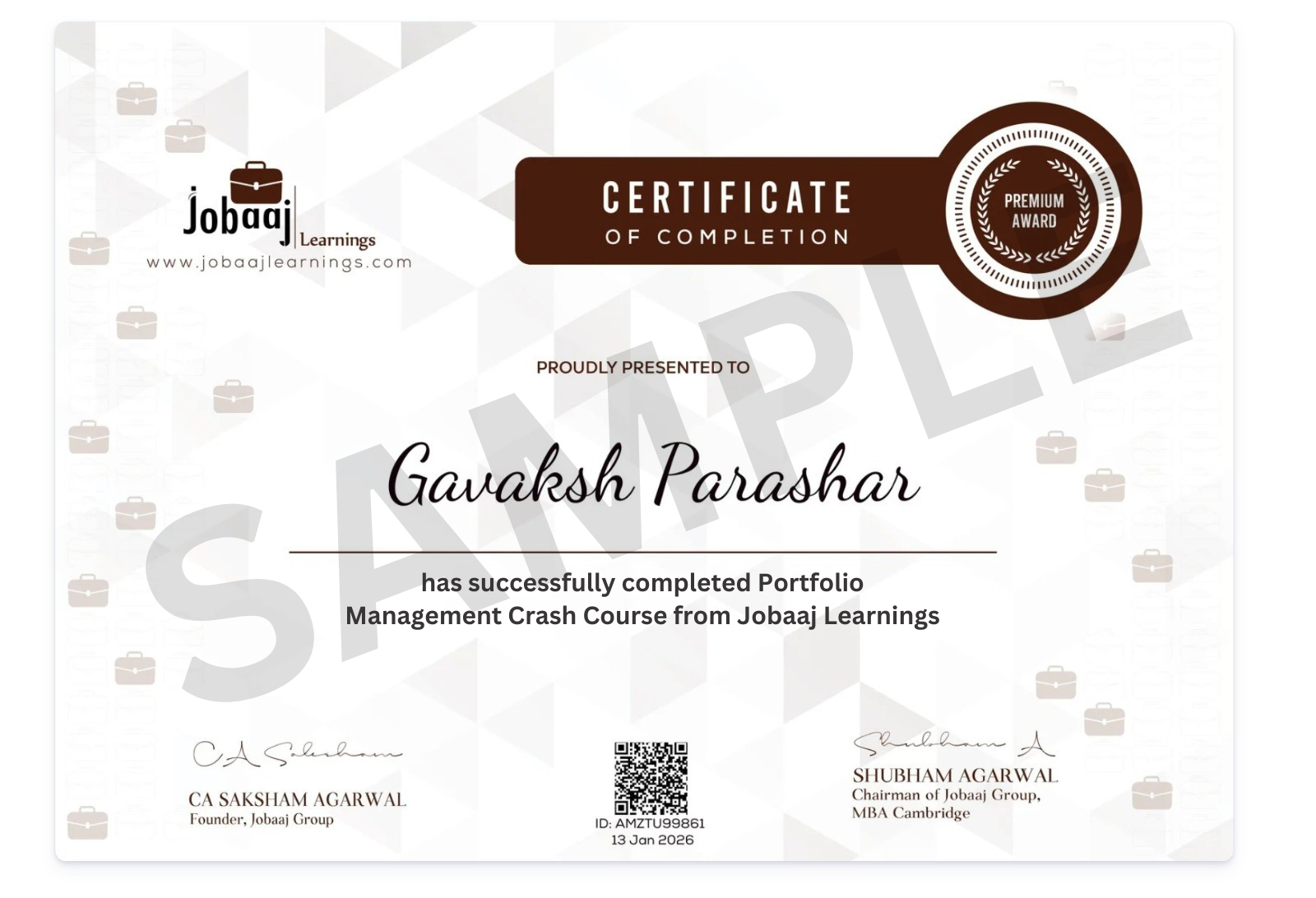
Issued and signed by Jobaaj Learnings, with a record an employer can check.
Add it to your résumé or post it to LinkedIn the day it's issued.
It says you finished the work and submitted the assignment — which is what it's worth showing for.
Learner journeys
A few of the moves made by learners who upskilled with Jobaaj Learnings.
Moved from studying for CFA Level 2 into an asset management analyst role.
Placed as a stock market analyst after completing the programme.
Started as a fresher with no industry experience and moved into a research analyst role.
Moved from MBA fresher into ESG and investment research.
Moved into a financial analyst role after building out his modelling skills.
Went from an MBA outside the metro campuses to an investment banking seat.
Individual journeys shared by Jobaaj Learnings alumni. Outcomes vary and are not promised by this course.
Keep going
A portfolio is built from views on individual companies and instruments. These are the courses that teach those views. All free from Jobaaj Learnings.
Form a view on a single company — the input every portfolio weight depends on.
ExploreLiquidity, solvency and profitability, read straight from the accounts.
ExploreBuild the three-statement model and DCF behind a fundamental valuation.
ExploreExchanges, indices and order types, if the market itself is new.
ExploreTiming a position with price and volume, once the allocation is set.
ExploreOptions as a way to hedge or shape a portfolio’s risk.
ExploreFAQ
Yes. Jobaaj Learnings provides it free of cost. There’s no fee to start, no trial period that ends, and no payment step anywhere in the flow.
None. The course starts from the very beginning and builds up from there, so you can begin with no prior experience in the subject.
Yes. Every lesson is recorded, so you can pause, rewind and come back whenever it fits around classes or work. There’s no schedule to keep up with.
Only the ideas of an average, a spread and a correlation — and each is explained as it is used, with the arithmetic shown step by step. There is nothing beyond school-level maths.
The principles apply to any mix of assets. The examples use listed shares because the numbers are easy to see, but the same logic is what fund managers use to build a fund.
It helps but is not required — the course opens with what a portfolio is for before any theory. If you want more ground on that first, the stock market basics crash course is also free.
No, and that’s deliberate. The course teaches method, not tips. Nothing in it is investment advice, and investing in the markets carries real risk of loss — including of your full capital.
State a portfolio objective and the constraints around it, describe the traditional and Markowitz approaches to construction, compute expected return and risk for a two-asset mix, and read the Security Market Line to judge whether a security’s expected return compensates for its beta.
Write to training@jobaaj.com and we’ll get back to you.
Free · Jobaaj Learnings
This crash course is completely free. Open the first lesson and start with how a portfolio is built.
Start learning free