
What the markets are, and why they exist
Equity, commodity, currency and derivative markets — what each one is for, who uses it, and the routes through which trades actually reach them.
Free learning initiative
Most people meet the market through tips and headlines. Jobaaj Learnings is making this crash course free for every student — how exchanges, IPOs, indices and corporate actions actually work, so you understand what you are looking at before any money is involved.
No payment step. Open the first lesson straight away.
Our learners now work at





What you'll learn
This is the groundwork: what the instruments are, who the participants are, and what the numbers on a screen actually mean. No strategies, no tips — the vocabulary and mechanics everything else is built on.
Equity, commodity, currency and derivative markets — what each one is for, who uses it, and the routes through which trades actually reach them.
NSE and BSE, primary versus secondary markets, IPOs and FPOs, market timings, the pre-open session, and what a gap-up or gap-down opening tells you.
Face value, market value and book value, market capitalisation, EPS and the P/E ratio, and the indices — Sensex, Nifty, Bank Nifty — that summarise the whole market.
Upper and lower circuits, why they exist, and what a circuit hit means for someone holding the stock. Plus the calendar quirks, including Muhurat trading.
Splits, bonus issues, rights issues, buybacks and dividends — why the price moves on the ex-date and why that movement is not a loss.
Trader versus investor, long and short, intraday versus delivery, and the terminal itself: market and limit orders, bid and ask, the order book, and why bracket orders exist.
Why it's free
We built this to be learned from, not sold.
A lot of people who need a skill like this are exactly the people least able to pay for it — students between semesters, freshers before a first job, anyone rebuilding after a break. So we took the fee off.
Every lesson is open from the start. There's no locked second half and no upgrade waiting three modules in.
This isn't a promotional price or a trial. There's no clock on it and no fee arriving later.
Nothing was trimmed to make it free. It is the same material, at the same depth, as everything else we teach.
Come back to a lesson next month or next year. Access doesn't expire and nothing gets pulled behind a paywall.
Where it takes you
Most people take this to manage their own money better. It is also the entry requirement for roles where market literacy is assumed from day one.
The most common reason people take this. Understand what you own and why, instead of acting on someone else’s tip.
Execute client orders on the terminal, where knowing order types and market mechanics cold is the job.
Support an analyst with data gathering and screening — market literacy is the prerequisite, not the differentiator.
The back office that makes trades actually settle. Understanding instruments is the entry requirement.
Sit between clients and products, and be able to explain what a client is actually buying.
Write and explain markets for a broker, media outlet or fintech — you cannot explain what you have not understood.
Salary bands are indicative market ranges for these roles in India, not an outcome promised by this course. Nothing on this page is investment advice.
Sixty-second check
Five questions on the things that actually trip people up. Answer them and you'll get a read on where you stand — and which part of the course to start from.
Certificate
Submit your assignment and Jobaaj Learnings issues a verifiable certificate you can share anywhere.
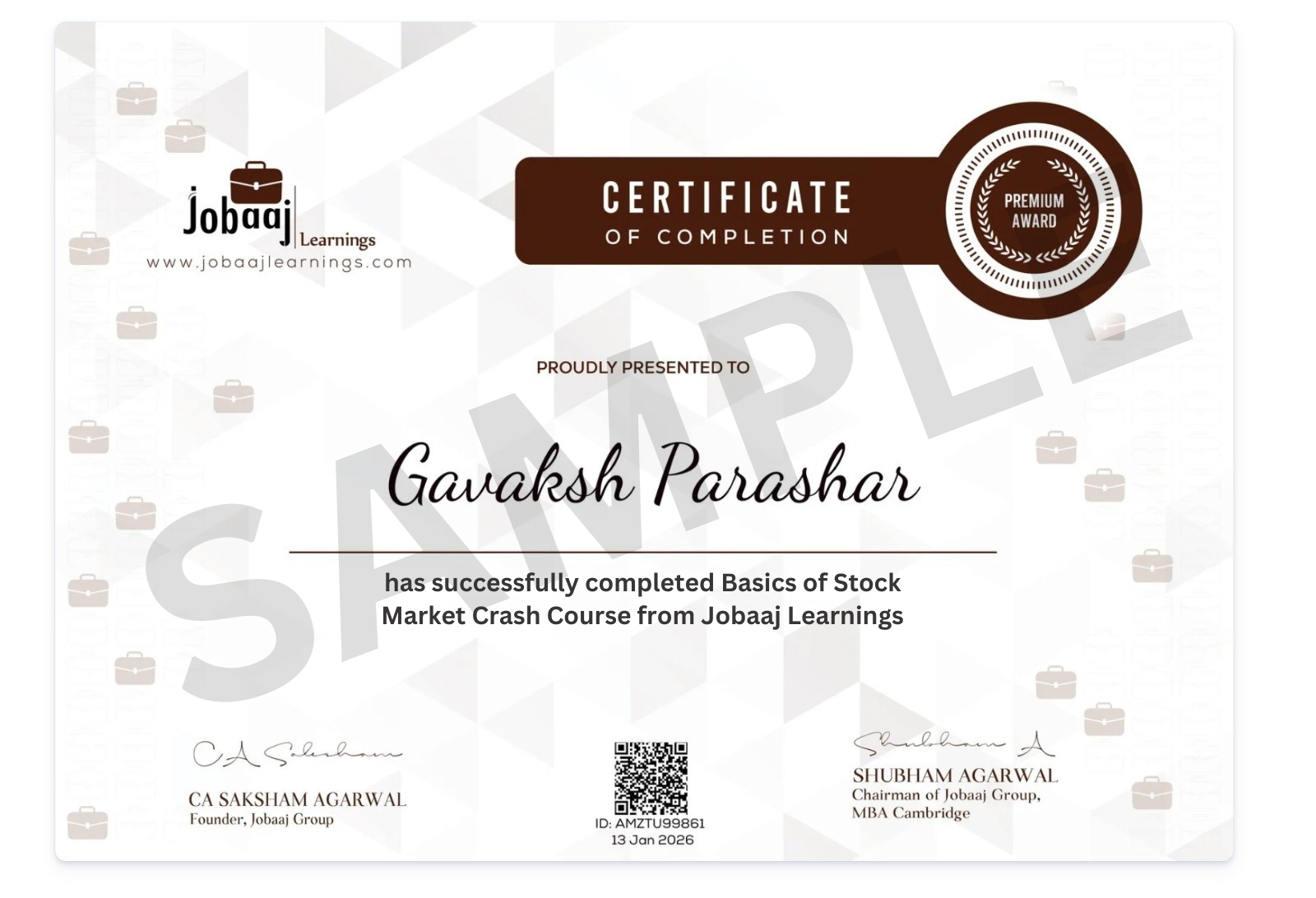
Issued and signed by Jobaaj Learnings, with a record an employer can check.
Add it to your résumé or post it to LinkedIn the day it's issued.
It says you finished the work and submitted the assignment — which is what it's worth showing for.
Learner journeys
A few of the moves made by learners who upskilled with Jobaaj Learnings.
Placed as a stock market analyst after completing the programme.
Returned from a period out of work and secured a role in her target field.
Launched her own business with support from the Jobaaj community.
Re-entered work after a break away and moved into a finance role.
Started as a fresher with no industry experience and moved into research.
Went from an MBA outside the metro campuses to an investment banking seat.
Individual journeys shared by Jobaaj Learnings alumni. Outcomes vary and are not promised by this course.
FAQ
Yes. Jobaaj Learnings provides it free of cost. There’s no fee to start, no trial period that ends, and no payment step anywhere in the flow.
None. The course starts from the very beginning and builds up from there, so you can begin with no prior experience in the subject.
Yes. Every lesson is recorded, so you can pause, rewind and come back whenever it fits around classes or work. There’s no schedule to keep up with.
No. Nothing in this course requires you to place a trade or open a broking account. It is about understanding the market first — which is the right order, and the whole point of learning it before any capital is at stake.
No, and that’s deliberate. The course teaches method, not tips. Nothing in it is investment advice, and trading in the markets carries real risk of loss — including of your full capital.
It introduces both — candlestick charts, technical indicators, and the basics of futures and options contracts. Each has its own free crash course if you want to go deeper afterwards.
Read a stock quote and know what every number means, follow market news without being lost, understand how an IPO, split, bonus or buyback affects a price, tell a future from an option, and place an order on a terminal knowing what each order type does.
Write to training@jobaaj.com and we’ll get back to you.
Keep going
Once the basics are in place, these are the natural next steps. All free from Jobaaj Learnings.
Read the charts this course introduces — trend, support and resistance, candlesticks and indicators.
ExploreDerivatives properly: calls, puts, premium, the Greeks and what actually drives an option’s price.
ExploreMove from market mechanics to valuing a company and writing a defensible view on it.
ExploreBuild the three-statement model and DCF that sit under a professional valuation.
ExploreGo deeper on the ratios this course introduces, and what a good-looking number can hide.
ExploreFrom single stocks to a whole portfolio: allocation, diversification and risk.
ExploreFree · Jobaaj Learnings
This crash course is completely free. Open the first lesson and start from the beginning.
Start learning free