

 Categories



































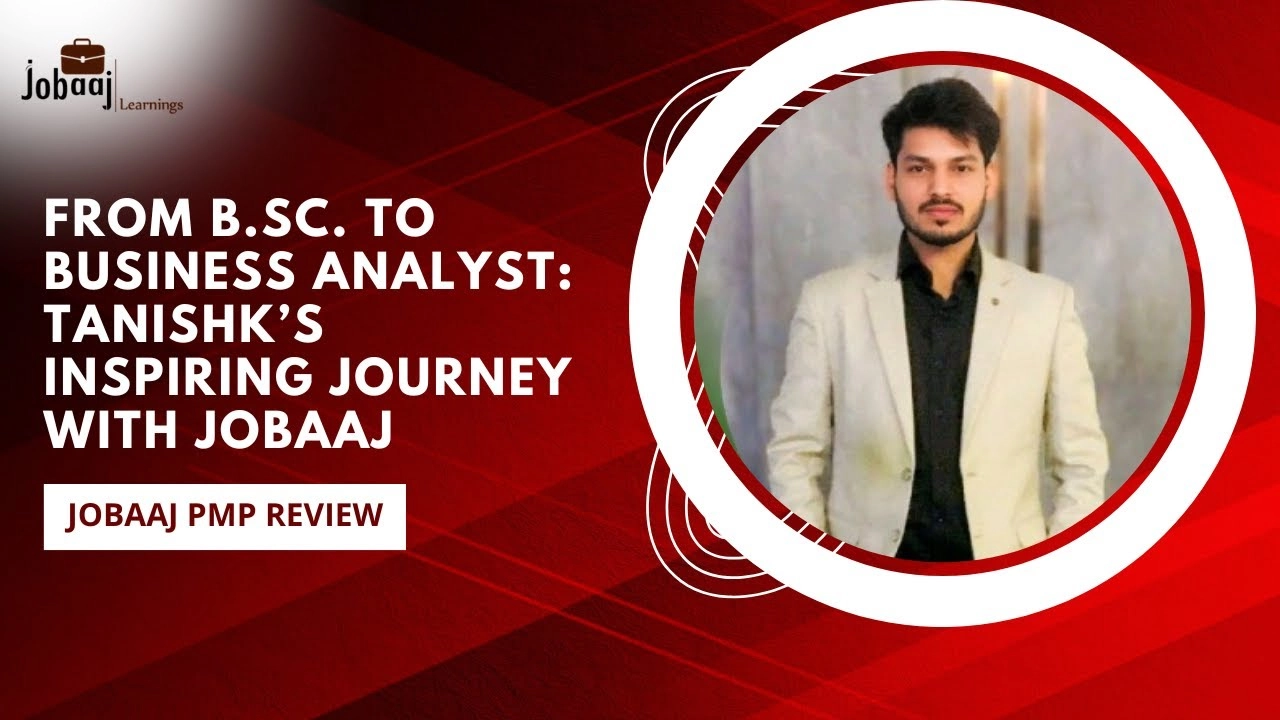
Tanishk Jaiswal's Jobaaj Learnings Review: From Project Coordinator to Business Analyst at Techbridge Consulting

"My journey has been very smooth overall, without facing any major challenges." — Tanishk Jaiswal
Tanishk Jaiswal is from Prayagraj and completed his B.Tech in Computer Science there before working as a Project Coordinator for a year. Wanting to move into a more product-focused career, he enrolled in Jobaaj Learnings' Product Manager Nano Degree Program. He is now working as a Business Analyst at Techbridge Consulting Private Limited.
If you are trying to work out whether Jobaaj Learnings is worth it — reading reviews, checking whether the placement support is real, or just wanting an honest account before you enrol — this breakdown of Tanishk's experience, in his own words, should help you decide. Two things to weigh: he ended up with a Business Analyst title rather than Product Manager, and he reports no problems at all, which is a limit on what the review can tell you. Read it alongside the other conversations in our Interview Series and the wider feedback on the reviews page.
Key Takeaways: Tanishk's Jobaaj Learnings Review
- Profile: B.Tech in Computer Science, Prayagraj, followed by about a year as a Project Coordinator.
- How he researched it: found the platform on LinkedIn, then read student feedback and watched podcasts on YouTube before contacting the sales team.
- What he studied: the Product Manager Nano Degree Program, covering Python, product roadmaps, management consulting and more.
- Timeline: about three months of coursework, then two months on projects and interview preparation — described as a 7–8 month journey overall.
- The module he names: Product Strategy, which reshaped how he thinks about product development, user attraction and “product triangles”.
- Live case study: analysing WhatsApp — market research, defining the USP, and feature analysis.
- The game-changer, in his words: mock interviews — not for knowledge, but for communication and analytical delivery.
- Placement support: applications and referrals, LinkedIn and Naukri profile work, and introductions to working Product Managers in IT.
- Outcome: Business Analyst at Techbridge Consulting Pvt. Ltd. Salary not disclosed.
Tanishk's Background
Tanishk completed his B.Tech in Computer Science at a college in Prayagraj. After graduating, he worked as a Project Coordinator for about a year. During that time, he found himself drawn to how products are built and managed — from early market research through to a product's eventual removal from the market — rather than just coordinating the projects around them.
That interest in the technical and strategic side of building products is what pushed him to look for a structured way to move from project coordination into product management. His own framing of the two roles is measured: “While both roles are similar, I felt more drawn to the technical aspects of improving and delivering products.”
How He Researched the Programme Before Enrolling
Tanishk's due diligence is worth copying regardless of which provider you choose:
- He explored various platforms offering educational services.
- He found Jobaaj Learnings on LinkedIn.
- He browsed the platform and read student feedback.
- He watched podcasts on YouTube — the same series this page belongs to.
- Only then did he contact the sales team for details.
Four independent checks before a sales conversation. If you are reading this page as part of your own research, you are at step four of his process.
The Role: Business Analyst at Techbridge Consulting
Tanishk now works as a Business Analyst at Techbridge Consulting Private Limited. While his title is Business Analyst rather than Product Manager, the role draws heavily on product management fundamentals — understanding user needs, translating them into requirements, and working across teams to move a product forward.
In his own words, he connected his Project Coordinator background to product management responsibilities when interviewing, which is part of what helped him land the role.
How Jobaaj Learnings Helped Him Get There
A few specific parts of the programme stand out in Tanishk's account:
- Product Strategy module: He calls this one out specifically as reshaping how he thinks about product development, user attraction, and “product triangles”.
- Practical case study work: Rather than staying purely theoretical, the programme had him analyse real products — including a live case study on WhatsApp covering market research, USP definition, and feature analysis.
- Mock interviews: Tanishk repeatedly calls this the “game-changing factor” in his journey — not just for testing his product management knowledge, but for building the communication and analytical delivery that actually gets used in a real interview.
- Direct placement support: The team helped him apply to organisations, provided referrals, improved his LinkedIn and Naukri profiles, and connected him with working Product Managers in IT for networking.
Why He Says Mock Interviews Mattered Most
Asked to pinpoint the single game-changing factor, Tanishk does not name a module:
"Without a doubt, the mock interviews were a game-changer. They helped me solidify my product management knowledge and improve my communication and analytical skills. Though I learned a lot through the course, the mock interviews ensured that I remembered key concepts and could communicate them effectively."
Note the mechanism he describes: the course taught him the material; the mocks made it retrievable and sayable under pressure. Those are different problems, and candidates across this series keep pointing at the second one as the binding constraint.
The Timeline
| Stage | Duration |
|---|---|
| Completing the courses | About three months |
| Projects and interview preparation | About two months |
| His stated total | 7–8 months |
The arithmetic does not quite close — three months plus two is five, not seven or eight. The gap is most likely the job search itself, which he does not break out separately. We are reporting the figures he gave rather than reconciling them for him. If you are planning, budget closer to his seven-to-eight-month total than to the five months of study.
Pros & Cons, Based on Tanishk's Experience
What worked well:
- Balanced mix of theory and hands-on project work
- Mock interviews specifically prepared him for real interview scenarios, not just theoretical knowledge
- Genuine placement support beyond just course content — referrals, profile optimisation, mentor introductions
- A live case study on a product everyone knows, which makes the analysis concrete rather than abstract
- Smooth process overall, with no major challenges reported
Where He Wants to Be in Three to Five Years
Tanishk's stated ambition is modest and specific: “a senior position in product management, with a deeper understanding of the field and better skills in delivering innovative products.”
Worth noting that the plan is to move into product management properly — the Business Analyst role is a step on that path rather than the destination.
Tanishk's Tips If You're Considering Jobaaj Learnings
- Connect your current role to your target role. Tanishk's advice: when interviewing, explicitly link your existing experience to the responsibilities of the role you're moving into. Interviewers respond to that bridge.
- Don't skip the mock interviews. He specifically credits these — not just the course content — for his placement.
- Use the case study work seriously. Treating practical assignments as real work gave him something concrete to talk about in interviews.
- Research before the sales call. He read student feedback and watched podcasts before speaking to anyone.
- Be open to adjacent titles. He trained in product management and entered through a Business Analyst role.
Product Management Interview Questions to Prepare For
How would you analyse a product like WhatsApp?
Model answer: Start with who it is for and what job it does for them, then the market it competes in. Define the USP honestly — for a messaging product, that is usually reliability and network effect rather than features. Then work through the feature set asking which features serve retention, which serve acquisition, and which serve neither. The output should be a view on what to build next, not a description of what exists.
Why move from project coordination into product management?
Model answer: Project coordination is about delivering what has already been decided; product management is about deciding it. Having coordinated delivery, I found the questions I cared about were upstream — why this feature, for which user, and what happens to the product over its whole lifecycle rather than one release.
What is product strategy, and how does it differ from a roadmap?
Model answer: Strategy is the reasoning — who you are serving, what problem you are solving, and why you will win. A roadmap is the sequence that follows from it. A roadmap without a strategy is a list of commitments nobody can defend when priorities change.
How do you translate user needs into requirements?
Model answer: Start from the observed problem rather than the requested solution, because users describe fixes rather than needs. Write the requirement as the outcome the user should be able to achieve, with the acceptance criteria that would prove it, then work with engineering on how — not before.
How does a technical background help in product roles?
Model answer: It shortens the conversation with engineering and makes feasibility estimates something you can reason about rather than accept on trust. It does not replace user understanding — the failure mode of a technical PM is building what is interesting to build instead of what someone needs.
What would you do in your first 90 days?
Model answer: Learn the product and the data before proposing anything — how users actually behave, where they drop off, what support hears most. Talk to the teams who own each part. Then pick one small, measurable improvement and ship it, because credibility comes from a delivered change rather than a plan.
Frequently Asked Questions
Is the Jobaaj Learnings Product Management program worth it?
Based on Tanishk's experience, yes — he credits the Product Strategy module and mock interviews specifically for helping him transition from Project Coordinator to Business Analyst in about 7–8 months. He reports no criticisms, and no salary figure, both of which limit what the review can tell you.
Does Jobaaj Learnings actually help with placements, or is it just course content?
Tanishk describes direct placement support: LinkedIn and Naukri profile optimisation, referrals to companies, and introductions to working Product Managers — not just recorded lessons.
How long does it take to get placed after the Jobaaj Learnings program?
For Tanishk, roughly three months of coursework followed by about two months of project work and interview preparation — 7–8 months in total from enrolment to job offer, on his own summary.
Why is his title Business Analyst rather than Product Manager?
He trained in product management and was hired into an adjacent role that uses the same fundamentals. His stated plan is to move into a senior product management position over the next three to five years.
What was the most useful part of the course?
The mock interviews, by his own account — ahead of any module. They are what made the knowledge retrievable and communicable under interview conditions.
Is Jobaaj Learnings genuine?
Tanishk researched the platform via LinkedIn, student feedback, and YouTube podcasts before enrolling, and describes his overall experience as smooth. He names his employer on camera. See more verified reviews across all Jobaaj Learnings programmes on our reviews page, and other placed-candidate accounts in the Interview Series.
Full Podcast Transcript
The complete conversation, unedited.
Podcaster: Welcome, everyone! We are back with another podcast featuring one of our successful placements. Today, we have Tanishk Jaiswal with us. Hi, Tanishk! How are you?
Tanishk: Yeah, I'm fine.
Podcaster: Great! So, Tanishk, can you introduce yourself and share a bit about your education background?
Tanishk: Sure! Before I start, I'd like to wish everyone a Happy Independence Day! My name is Tanishk Jaiswal, and I'm from Prayagraj. Currently, I'm working as a Business Analyst at Techbridge Consulting Private Limited. I completed my B.Tech in Computer Science at the College of Engineering and Research Program, Prayagraj. Besides this, I've completed various certification courses from Jobaaj Learnings, including a Product Manager Nano Degree Program. The program covered several certifications like Python, Product Roadmaps, Management Consulting, and more, combining both theoretical and practical knowledge in product management.
Podcaster: That's great! So, what made you choose the product management domain?
Tanishk: As I mentioned, I completed my B.Tech in Computer Science and later worked as a Project Coordinator for a year. During that time, I developed a keen interest in managing the product lifecycle – from market research to its removal from the market. This fascination with product development led me to switch from Project Coordination to Product Management. While both roles are similar, I felt more drawn to the technical aspects of improving and delivering products, which is why I made the transition.
Podcaster: That's an interesting shift! How did you come to know about Jobaaj Learnings and our program?
Tanishk: Last year, I explored various platforms offering educational services. I found Jobaaj Learnings through LinkedIn, where I gathered more information about the courses. After browsing the platform, reading student feedback, and watching podcasts on YouTube, I got in touch with the sales team for further details. They helped me understand the various courses, which made me decide to enroll.
Podcaster: Can you tell us more about your journey with Jobaaj Learnings? What challenges did you face and how did you overcome them?
Tanishk: My journey has been very smooth overall, without facing any major challenges. Before starting my career, I couldn't have imagined that my experience would be so fulfilling. The courses offered a balanced mix of theory and practical knowledge, and I learned a lot throughout the journey.
Podcaster: That's good to hear! How much time did it take for you to complete the entire course?
Tanishk: It took me approximately three months to complete the courses. Then, I spent about two months working on projects and preparing for interviews. In total, it was a 7-8 month journey.
Podcaster: Was there a specific module or topic that stood out to you during the course?
Tanishk: Yes, the Product Strategy module was particularly impactful. It helped me understand how to think about product development, improve products, and how to attract users to choose our products. The module also introduced me to product triangles, which made me rethink how products are managed and delivered.
Podcaster: Now, let's discuss how the mock interviews, assignments, and projects helped you during your journey.
Tanishk: While the courses provided both theoretical and some practical knowledge, the hands-on projects helped me explore real-life products. For example, I worked on analyzing WhatsApp as a case study. By conducting market research, defining the product's USP, and studying its features, I gained deeper insights into product management. The mock interviews also played a crucial role in helping me prepare for real-world scenarios.
Podcaster: Can you walk us through the interview process at the company where you got placed?
Tanishk: The Jobaaj Learnings team helped me apply to different organizations and even provided referrals. They also worked with me to enhance my LinkedIn and Naukri profiles. Additionally, they connected me with experienced Product Managers in the IT sector, which provided valuable networking opportunities and referrals.
Podcaster: Now, looking ahead, where do you see yourself in the next 3 to 5 years?
Tanishk: In the next 3 to 5 years, I hope to be in a senior position in product management, with a deeper understanding of the field and better skills in delivering innovative products.
Podcaster: Lastly, do you have any advice for students currently preparing for a role in product management or business analysis?
Tanishk: My advice to anyone transitioning into product management is to connect your current role with product management responsibilities. For example, when I interviewed for a Business Analyst role, I linked my experience as a Project Coordinator with the responsibilities of a product manager. This connection helped me during the interview process.
Podcaster: And if you could pinpoint one game-changing factor in your journey, what would it be?
Tanishk: Without a doubt, the mock interviews were a game-changer. They helped me solidify my product management knowledge and improve my communication and analytical skills. Though I learned a lot through the course, the mock interviews ensured that I remembered key concepts and could communicate them effectively.
Join 5,00,000+ Subscribers
Be a part of our ever growing community.
Related reads

Riyaz Mohammad's Jobaaj Learnings Review: From BBA Graduate to Product Manager at Illusion Consultants

Shruti's Jobaaj Learnings Review: From Chartered Accountant to Product Manager






