Categories














/content/learnings/assets/header/ManagementConsulting.svg)
/content/learnings/assets/header/InvestmentBanking.svg)


























Top Product Manager Interview Questions and Answers (15 Essential Questions 2026 Guide)

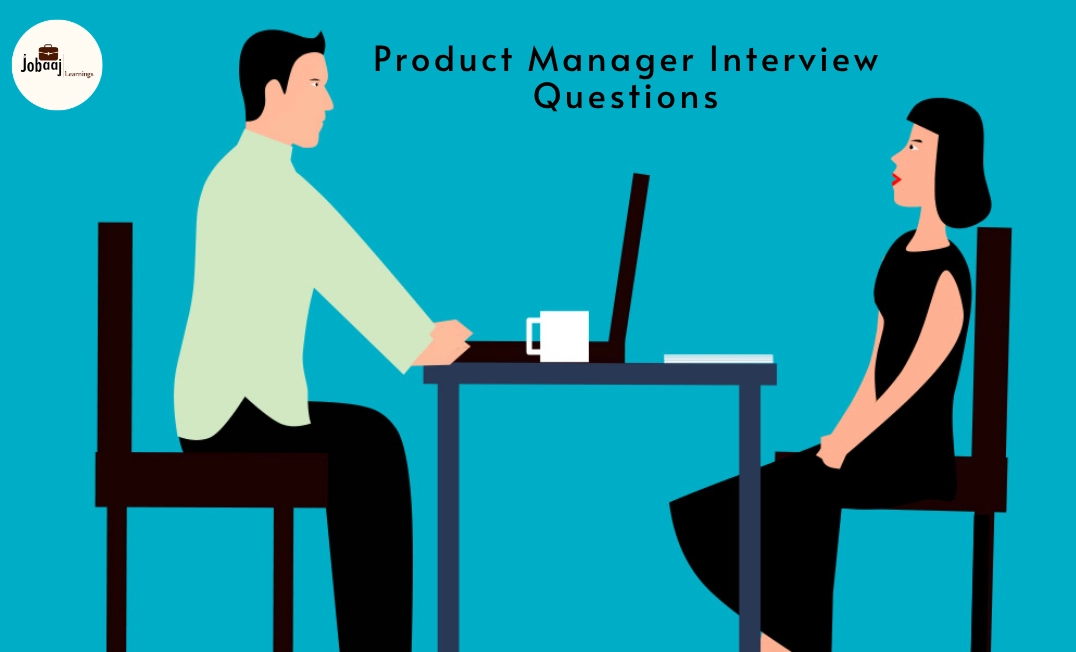
Product manager interviews are not about memorizing definitions. Companies are testing how you think when you face uncertainty, incomplete information, and business trade-offs.
A strong PM candidate is not someone who gives perfect textbook answers. Instead, it is someone who can:
- break problems into structured parts
- think from user + business + tech perspective
- justify decisions logically
- communicate clearly under pressure
Dreaming of a Product Management Career? Start with Product Management Certificate with Jobaaj Learnings.
So instead of random questions, we will focus on the most important and frequently asked PM interview questions that actually decide selection in real interviews.
1. How would you define product management?
They want to check if you understand the real role, not just a memorized definition.
Think in 3 layers:
- user problem
- business outcome
- cross-functional execution
Sample Answer:
Product management is the role responsible for identifying user problems and turning them into successful products by coordinating between engineering, design, and business teams. A product manager ensures that what is being built is not only technically feasible but also valuable for users and aligned with business goals. In simple terms, a PM decides what to build, why to build it, and how it should succeed in the market.
2. How do you decide what features to build first?
Your prioritization logic and decision-making clarity
Always use:
- user impact
- business value
- effort
- urgency
Sample Answer:
I prioritize features based on their impact on users and business goals while considering development effort. I usually start by identifying which features solve the most critical user problems. Then I evaluate business impact such as revenue, retention, or engagement. Finally, I compare it with engineering effort to ensure we are building high-impact features efficiently. This helps in focusing on what delivers maximum value in minimum time.
3. How do you understand user needs?
Whether you think like a user-first product thinker
Mention:
- qualitative research
- quantitative data
- behavioral observation
Sample Answer:
To understand user needs, I rely on a combination of user feedback, behavioral data, and direct observation. I look at how users interact with the product, where they drop off, and what features they use most. I also collect qualitative insights through surveys or interviews to understand pain points. Combining both helps me identify not just what users are doing, but why they are doing it.
4. How do you handle conflicting stakeholder opinions?
Your communication + decision authority thinking
- listen first
- align with data
- explain trade-offs
- focus on user outcome
Sample Answer:
When stakeholders have conflicting opinions, I first understand each perspective in detail. Then I bring in user data, product metrics, and business goals to evaluate which direction aligns best with the product vision. Instead of forcing agreement, I focus on explaining trade-offs clearly so everyone understands why a decision is being made. My goal is always to choose what is best for the user and long-term product success.
5. How would you improve a product like Instagram?
This is a product sense + creativity + structure test
- define user group
- identify problem
- propose solution
- define metric
Sample Answer:
I would first segment Instagram users into creators, casual users, and businesses. One common issue is content overload, where users struggle to find relevant content. To improve this, I would enhance personalization in the feed using better recommendation signals and give users more control over what they want to see. I would measure success through increased engagement time, higher retention rates, and improved user satisfaction.
6. What makes a good product manager?
Your understanding of PM mindset
Focus on traits:
- user obsession
- data thinking
- communication
- execution mindset
Sample Answer:
A good product manager is someone who deeply understands user problems, makes decisions based on data, and communicates clearly across teams. They are able to balance business priorities with technical constraints while keeping user value at the center. A strong PM is not just a planner but also a problem solver who ensures execution leads to real impact.
7. How do you measure product success?
Your metrics thinking ability
- define metrics based on goal
- short-term vs long-term metrics
- business + user metrics
Sample Answer:
Product success depends on the goal of the product, but I usually evaluate it using a combination of user and business metrics. For example, engagement rate, retention, conversion rate, and revenue are key indicators. A successful product not only attracts users but also retains them and delivers consistent value over time.
8. What is your approach to solving a product problem?
Your structured thinking under ambiguity
Use a flow:
- understand user
- define problem
- explore solutions
- validate with data
- iterate
Sample Answer:
When solving a product problem, I start by clearly understanding the user and the problem they are facing. Then I break the problem into smaller parts and identify possible causes. After that, I explore multiple solution options and evaluate them based on impact and feasibility. Finally, I validate the solution using data or testing before scaling it.
9. Tell me about a product you like and why
Your product thinking + observation skills
Sample Answer:
One product I really like is Google Maps. The reason is not just its accuracy but how it solves multiple user problems in one place. It doesn’t only provide directions but also real-time traffic updates, alternate routes, and estimated arrival times. What makes it strong is its ability to use data in real time to improve user experience. It simplifies a very complex problem — navigation — into a smooth and reliable experience.
10. How do you decide if a product feature is successful?
Your metrics-driven thinking
Sample Answer:
I decide feature success based on predefined success metrics aligned with the feature goal. For example, if the feature is designed to improve user engagement, I would track metrics like time spent, interaction rate, or retention. If it is a revenue-driven feature, I would focus on conversion rate or revenue impact. A feature is successful only if it improves the intended metric without negatively impacting user experience.
11. How do you deal with unclear or incomplete requirements?
Your ability to handle ambiguity
Sample Answer:
When requirements are unclear, I first try to understand the user problem behind the request rather than focusing only on the feature description. I ask clarifying questions to stakeholders, look at user data if available, and try to define the problem in simple terms. Once the problem is clear, I create assumptions, validate them, and then move forward with a structured solution approach.
12. What is MVP and why is it important?
Understanding of product lifecycle thinking
Sample Answer:
MVP stands for Minimum Viable Product, which is the simplest version of a product that solves the core user problem. It is important because it allows teams to test ideas quickly with minimal resources. Instead of building a full product, an MVP helps validate assumptions and gather real user feedback before scaling.
13. How do you balance user needs and business goals?
Product trade-off thinking
Sample Answer:
Balancing user needs and business goals requires finding overlap between value creation for users and outcomes for the business. I focus on solutions that improve user experience while also contributing to business metrics like retention, engagement, or revenue. If there is a conflict, I prioritize long-term user value because that usually leads to sustainable business growth.
14. What would you do if a product metric suddenly drops?
Problem-solving under pressure
Sample Answer:
If a product metric drops suddenly, I would first identify which metric has dropped and isolate the time period when the change happened. Then I would break down possible causes such as product changes, technical issues, or external factors. I would analyze user behavior data to pinpoint where the drop is occurring and then work with relevant teams to fix the issue.
15. How do you think like a product manager?
Overall PM mindset
Sample Answer:
Thinking like a product manager means constantly focusing on user problems, business impact, and execution feasibility. It involves asking the right questions instead of jumping to solutions. A PM mindset is about prioritizing what matters most, validating ideas with data, and continuously improving the product based on user feedback and market changes.
Conclusion
Product manager interviews are designed to test how you think, not how much you memorize. The strongest candidates are those who stay structured, communicate clearly, and make decisions based on users and data.
Across all questions, one pattern remains consistent:
- understand the user
- define the problem clearly
- evaluate options logically
- communicate simply and confidently
If you develop this thinking approach, you will naturally perform well in PM interviews, regardless of the question complexity.
Ready to Take the Next Step in Your Career? Apply Now!
Frequently asked questions
What are the most important product manager interview questions?
The most important PM interview questions include product sense questions, prioritization questions, behavioral questions, and case study-based scenarios.
How should I prepare for PM interviews?
Focus on structured thinking, product sense, user understanding, data interpretation, and practicing real-world case studies.
Are PM interviews difficult?
Yes, PM interviews are challenging because they test thinking ability, communication, and decision-making rather than memorized answers.
Do I need technical skills for product manager interviews?
Basic technical understanding helps, but coding is not required for most product manager roles.
How do I answer product sense questions?
Use a structured approach: understand user, define problem, propose solutions, and explain success metrics clearly.
Join 5,00,000+ Subscribers
Be a part of our ever growing community.