Categories








































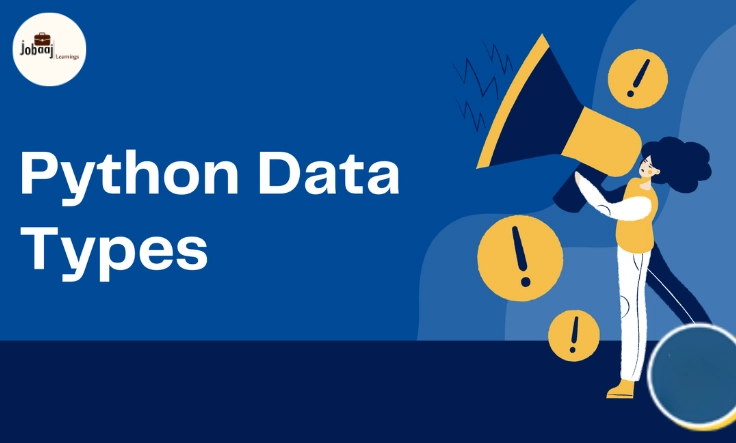
Ever played with LEGO bricks? Python data types are a lot like those colorful pieces — each one has its own shape and purpose, and together, they can build anything from a simple toy house to a sprawling castle.
Python is loved for being both powerful and easy to read, and part of that magic comes from its rich set of built-in data types. They’re the core building blocks of every Python program. Mastering them is like learning your ABCs before writing your first novel — once you know them, the possibilities are endless.
Exploring a career in Data Analytics? Apply Now!
Numeric Types: The Foundation of Calculations
Numbers are everywhere, and Python handles them gracefully. We have integers (whole numbers like 10, -5, 0), floating-point numbers (decimals like 3.14, -2.5), and complex numbers (for more advanced mathematical operations).
Imagine calculating the area of a circle. You'll use floating-point numbers for pi and the radius. Integers are perfect for counting things, like the number of apples in a basket.
Textual Data: Strings
Words, sentences, entire paragraphs – these are all strings in Python. Enclosed within single or double quotes, they're how we represent and manipulate textual data.
Think about analyzing a tweet. You might want to extract hashtags or count the number of characters. Strings make this possible.
Python's string manipulation capabilities are powerful. You can slice and dice them, combine them, search within them – the possibilities are endless.
Boolean: True or False?
Booleans represent truth values: True or False. They're the cornerstone of logical operations and control flow in programming.
Imagine checking if a user is logged in. The result is a boolean – either they are (True), or they aren't (False). This simple concept empowers complex decision-making within your programs.
Lists: Ordered Collections
Lists are like ordered shopping lists. They hold a sequence of items, and you can access them by their position (index). What's more, they can even contain different data types!
Imagine storing the names of students in a class. A list would be ideal. Need to add a new student? No problem, lists are mutable, meaning you can change them after creation.

Tuples: Immutable Collections
Tuples are similar to lists, but with a key difference: they're immutable. Once created, you can't change them. This immutability offers certain advantages in terms of data integrity and performance.
Think of coordinates on a map. These are best represented as tuples, as they shouldn’t change. Tuples are often used when data consistency is paramount.
Sets: Unordered Collections of Unique Items
Sets are like collections of unique stamps. They don't care about order, and each item can only exist once. This makes them perfect for tasks like removing duplicates or checking for membership.
Imagine you need to find the unique words in a document. Sets are tailor-made for this kind of task.
Dictionaries: Key-Value Pairs
Dictionaries are like phone books. They store information in key-value pairs. You access values using their associated keys, like looking up a phone number using a person's name.
Think about storing user information. You could use keys like "username", "email", and "password" to retrieve the corresponding values.
Still stuck Googling Python basics? It’s time to fix that.
Join our crash course and master core Python concepts the smart way.
Start learning today
Conclusion
Python's diverse data types provide the flexibility to represent and manipulate information in countless ways. Mastering these fundamental building blocks is essential for writing effective and efficient Python code. From numbers and text to complex data structures, each type plays a vital role in bringing your programs to life.
As you continue your Python journey, explore these data types further, experiment with them, and discover how they unlock the power of this versatile language. The possibilities are as vast as your imagination.
Dreaming of a Data Analytics Career? Start with Data Analytics Certificate with Jobaaj Learnings.
Frequently asked questions
What are the main numeric data types in Python?
Python's main numeric types are integers (whole numbers), floats (decimal numbers), and complex numbers (numbers with real and imaginary parts). Each type supports different operations.
How do I define strings in Python?
Strings in Python are sequences of characters enclosed in single (' ') or double (" ") quotes. You can perform various operations like concatenation and slicing on them.
What's the difference between integers and floats?
Integers represent whole numbers (e.g., 10, -5), while floats represent numbers with decimal points (e.g., 3.14, -2.5). Floats have higher precision but can introduce rounding errors.
How can I convert between data types in Python?
Python offers built-in functions like `int()`, `float()`, and `str()` to explicitly convert between data types. Type conversion can be crucial for certain operations.
What are some common string manipulation techniques in Python?
Common string manipulations include concatenation (+), slicing ([start:end]), methods like `upper()`, `lower()`, `split()`, and more. These allow you to modify and extract parts of strings.

Join 5,00,000+ Subscribers
Be a part of our ever growing community.