Categories








































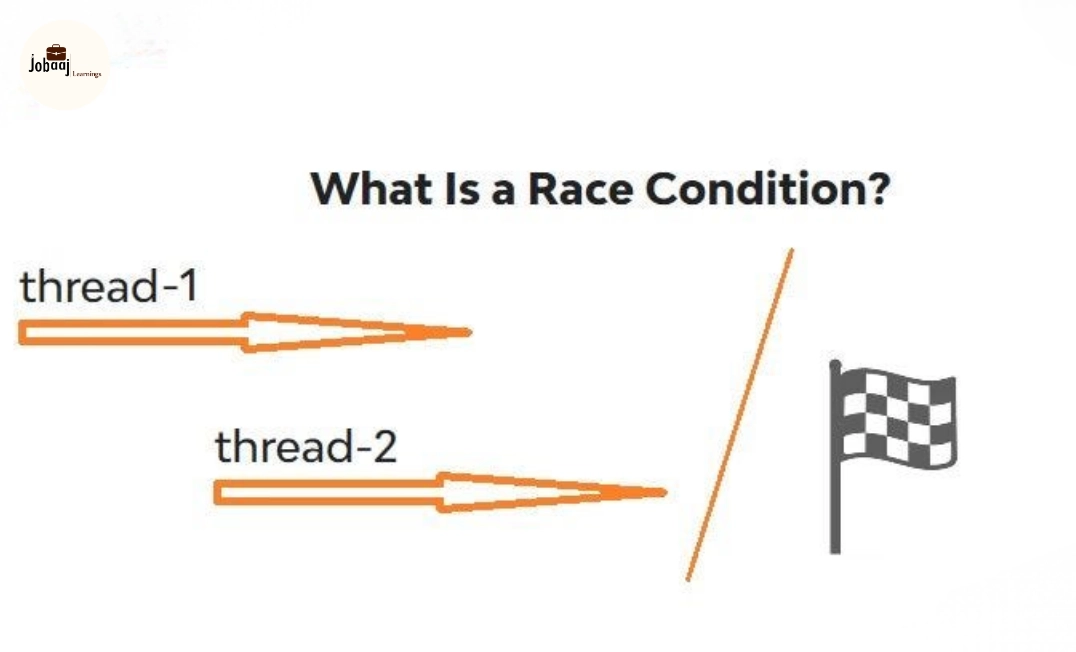
When multiple threads or processes attempt to access shared data or resources at the same time, issues can arise. One of the most common problems is a race condition. It occurs when two or more threads try to change or access shared data at the same time in an unpredictable manner, leading to unexpected results. Think of it like two people racing to fill out the same form at the same time whoever finishes first gets their way, and the result depends on the order in which things happen.
What Is a Race Condition?
In a multithreading environment, a race condition happens when the outcome of an operation depends on the timing or order of execution of threads. These conditions can cause unpredictable behavior, where different runs of the same program may lead to different results.
For example, if two threads try to update the same value in a variable at the same time without proper synchronization, one of the updates may be lost, or the result might be incorrect.
Example of a Race Condition
Imagine you have a simple program where two threads are incrementing a counter:
" counter = 0
def increment():
global counter
for _ in range(100000):
counter += 1 "
If two threads execute the increment() function at the same time, both threads will read the current value of counter, increment it, and then write it back. However, the threads do not know about each other, so they might both read the same value, increment it, and write it back, resulting in a lost update.
This means the counter won't be incremented correctly, and you'll get a value less than 200,000, even though the increment should have happened 200,000 times.
How to Avoid Race Conditions
There are several techniques to prevent race conditions in a multithreaded program. The key idea is to ensure that shared data or resources are accessed in a synchronized way, meaning only one thread can access the data at a time.
Here are some common techniques:
1. Locks/Mutexes
A lock (or mutex short for mutual exclusion) is a synchronization mechanism that ensures only one thread can access a shared resource at a time. When a thread acquires a lock, it blocks other threads from entering the critical section of the code until it releases the lock.
In Python, you can use the threading.Lock to prevent race conditions:
" import threading
counter = 0
lock = threading.Lock()
def increment():
global counter
for _ in range(100000):
with lock: # Acquire lock before updating counter
counter += 1 "
In this example, the lock ensures that only one thread can increment the counter at a time. When a thread is done, it releases the lock, allowing the next thread to enter.
2. Atomic Operations
In some cases, operations on shared data can be made atomic, meaning they are performed as a single, indivisible operation. Many programming languages and libraries provide atomic operations for simple tasks like incrementing a counter.
For example, Python's threading module includes a Thread-safe version of a counter in the queue.Queue class, which handles the synchronization internally. Alternatively, you can use atomic variables if your language or framework supports it.
3. Semaphores
A semaphore is another synchronization tool that controls access to a shared resource. Unlike locks, which allow only one thread at a time, semaphores allow a set number of threads to access the resource simultaneously. Semaphores are useful when you want to limit access to a resource without completely locking it.
Exploring a career in Web Development? Apply now!
4. Condition Variables
A condition variable allows threads to communicate with each other. It is typically used when a thread must wait for some condition to be true before proceeding. You can use condition variables in scenarios where you need to synchronize threads based on certain events (e.g., a thread might wait until another thread completes its task before proceeding).
5. Avoid Shared Resources
One of the best ways to avoid race conditions is to reduce the use of shared resources. Instead of having multiple threads modify the same variable, try to design your program in a way that each thread works on its own data. If threads don't share resources, race conditions become a non-issue.
For example, instead of updating a shared counter, you can have each thread maintain its own counter, and then combine the results later.
Best Practices for Avoiding Race Conditions
- Minimize Shared Data: Try to design your program so that threads don’t need to access shared data as much as possible.
- Use Locks Wisely: While locks are essential for preventing race conditions, excessive use can lead to performance issues like deadlocks or bottlenecks.
- Consider the Performance Impact: Locks and other synchronization methods can slow down your program, so it's essential to use them only when necessary.
- Test and Debug Carefully: Race conditions are often intermittent, making them difficult to detect. Use logging or debugging tools to track the execution order of threads and ensure they don't interfere with each other.
Conclusion
Race conditions are a significant challenge in multithreading, but they can be effectively managed with the right synchronization mechanisms. By using locks, atomic operations, semaphores, and condition variables, you can ensure that your threads work harmoniously without conflicting over shared resources.
In 2026, as software systems continue to scale and become more complex, understanding how to avoid race conditions will be a fundamental skill for developers working with concurrent or parallel processing. By mastering these techniques, you’ll be able to build reliable, efficient, and thread-safe applications.
Frequently asked questions
What is a race condition in multithreading?
A race condition occurs when multiple threads try to access or modify shared data at the same time, leading to unpredictable results. The outcome depends on the order in which the threads execute, making it a significant issue in multithreading.
How can I avoid race conditions in multithreading?
Race conditions can be avoided by using synchronization mechanisms like locks, semaphores, atomic operations, and condition variables. These ensure that only one thread can access shared data at a time or synchronize threads based on specific conditions.
What is the difference between locks and semaphores?
Locks allow only one thread to access a resource at a time, while semaphores can allow a set number of threads to access a shared resource simultaneously. Semaphores are useful when you need to limit the number of threads accessing a resource, not just one.
Can race conditions be avoided without using locks?
Yes, race conditions can sometimes be avoided by reducing the use of shared data altogether. If each thread works with its own data, no synchronization is needed, which can eliminate the risk of race conditions.
How can I detect a race condition in my program?
Race conditions can be difficult to detect because they are often intermittent. To catch them, use logging, debugging tools, and thread synchronization techniques to track the execution order and access patterns of threads.

Join 5,00,000+ Subscribers
Be a part of our ever growing community.
Related reads
Python for Data Analytics: Complete Beginner Guide (Step-by-Step 2026 Roadmap)

Software Engineer Salary in India 2026: Fresher Salary, Experience and Highest Paying Roles