Categories






























































ATS Resume Format for Indian Freshers (With Sample) 2026

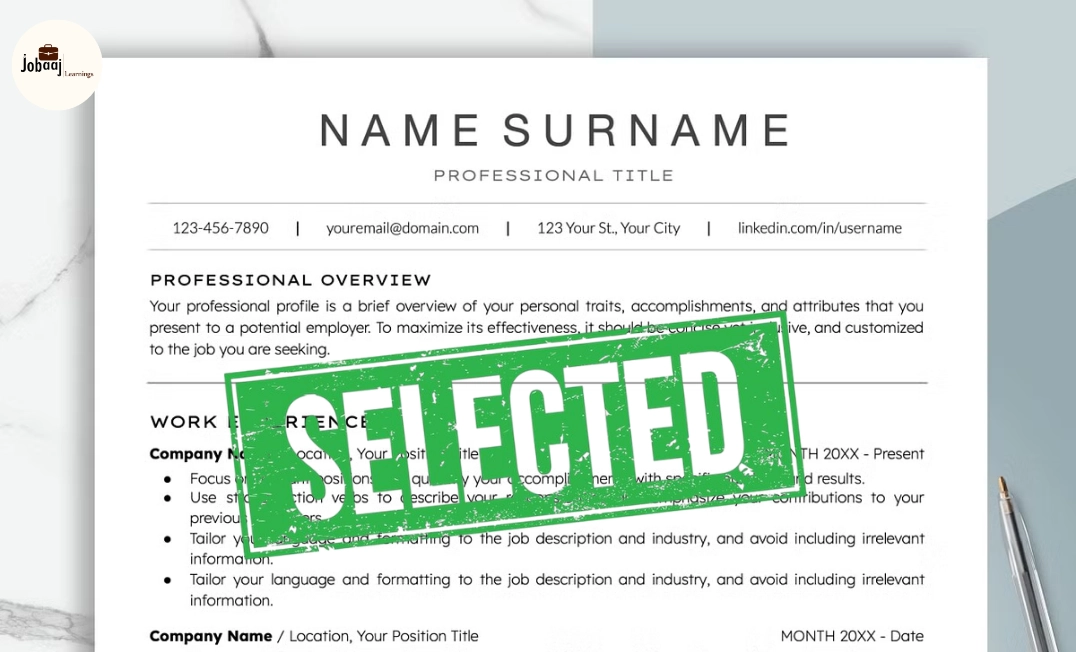
You applied to forty companies. You heard back from two.
The usual explanation is that the market is brutal, and it is. But there is a quieter reason that costs Indian freshers more interviews than anything else, and it has nothing to do with your marks or your projects.
Your resume went into the company's system and came out mangled. Your name landed in the wrong field. Your B.Tech ended up filed as work experience. Your skills section, the one you built so carefully into a neat two-column table, was read as a single line of nonsense.
Nobody rejected you. A recruiter searching for "Python" simply never saw your name in the results.
This guide covers the ATS resume format that actually works for Indian freshers, the specific habits in Indian resumes that break parsing, and a complete sample you can copy and adapt today.
Want to check your current resume first? Run it through our free ATS resume checker before you read on. It will show you exactly what a system sees when it reads your file.
What an ATS Actually Does (And What It Does Not)
An Applicant Tracking System is the software companies use to receive, store, search and manage job applications. Almost every large Indian employer uses one, and most mid-sized ones do too.
Here is where most advice online gets it wrong.
The myth: an ATS scans your resume, gives it a score, and automatically rejects you if you fall below some threshold.
The reality: for the overwhelming majority of roles, the ATS does not reject anyone. It parses your resume into structured fields, stores it in a database, and lets a recruiter search and filter that database. A human still makes the decision.
So the danger is not a robot judging you harshly. The danger is far more boring: your information gets stored in the wrong place, or not at all, and you become invisible to the searches that would have found you.
That changes what you should optimise for. You are not trying to please an algorithm. You are trying to make sure a piece of software can read your document correctly, so that a human recruiter can find you.
Which means the goal is a resume that is simultaneously easy for a machine to parse and pleasant for a person to read. Those two goals conflict far less than people assume.
The Indian Resume Habits That Break ATS Parsing
This is the section that matters most, and it is the one that generic international advice skips entirely. Several conventions taught in Indian schools and colleges actively hurt you.
Remove these completely
Your photograph. Standard on Indian resumes, harmful on a parsed one. Images carry no readable text, they inflate file size, and in some parsing systems an image at the top of the page pushes your contact details into a region the parser handles badly. They also raise bias concerns that many employers now actively screen against.
Date of birth, age, gender, marital status, nationality, father's or husband's name. None of these belong on a modern resume. They occupy space that should hold your skills, and for multinational employers they can create legal awkwardness the recruiter would rather avoid.
The declaration and signature block. "I hereby declare that the above information is true to the best of my knowledge" followed by your name, place and date. This is a legacy of government application forms. It adds nothing, and it takes up the bottom of a page where a project could have been.
The heading "Curriculum Vitae" or "Resume" at the top. The document is obviously a resume. That space belongs to your name. Some parsers will read that heading as your name, which is exactly the failure mode you want to avoid.
Your full postal address. City and state is enough. "House No. 42, Gali No. 7, near the water tank" is not information a recruiter needs at application stage, and long addresses parse unpredictably.
Roll numbers, registration numbers, and the names of the schools you attended before Class X.
Fix these
Percentage or CGPA, but give the reader both where you can. Indian institutions vary and recruiters filter on marks. Write it as CGPA: 8.4/10 (84.0%). Recruiters searching for a percentage cutoff will find you, and so will those working in CGPA.
Objective statements that say nothing. "Seeking a challenging position in a reputed organisation where I can utilise my skills and grow with the company." Every fresher writes this. It is not a summary, it is a filler paragraph. Either write a real two-line summary of what you can do, or cut the section entirely and start with education.
Vague technical claims. "Well versed with Java" tells a recruiter nothing and matches no search. "Java" as a clean entry in a skills section does.
The Format Rules
File type and name
Submit a .docx unless the application specifically asks for PDF. Modern parsers handle PDF well, but .docx remains the most reliably parsed format across the older systems still in use at many Indian companies. If you export a PDF, export it from a text document rather than scanning or screenshotting anything.
Never submit a scanned or image-based PDF. It contains no machine-readable text at all. Your resume will parse as an empty document.
Name the file properly. Priya_Sharma_Resume.docx, not resume_final_v3_updated.docx. Recruiters download hundreds of these into one folder.
Layout
One column. Always. Two-column resumes are the single most common cause of scrambled parsing. Parsers read left to right across the page, so a two-column layout interleaves your sidebar with your main content and produces gibberish. Those attractive templates with a coloured sidebar are actively working against you.
No tables, no text boxes, no images, no icons, no charts. A skills matrix in a table looks organised to you and reads as broken text to a parser. Little envelope and phone icons next to your contact details often parse as junk characters or vanish entirely.
Nothing in the header or footer. Many parsers ignore header and footer regions completely. Put your name and contact details in the body of the document, at the top.
No graphics-based rating bars. Those five-dot "proficiency" indicators next to each skill carry no text. A parser sees a skill with no context, and a recruiter cannot tell what the dots mean anyway.
Typography and length
Use a standard font: Calibri, Arial, Helvetica, Georgia, Garamond or Times New Roman. Body text at 10 to 12 points, your name at 16 to 20.
Keep it to one page. You are a fresher. A recruiter spends six to eight seconds on the first pass, and a second page dilutes rather than adds. Two pages is acceptable only if you have genuine, substantial internships or publications.
Use standard bullet characters. Fancy symbols, arrows and emoji do not parse reliably.
Section headings
Use the names parsers expect. This sounds trivial and it is not.
|
Use this |
Not this |
|
Education |
Academic Journey, Scholastic Record |
|
Work Experience or Internships |
Where I've Been, Professional Voyage |
|
Skills or Technical Skills |
My Toolkit, Superpowers |
|
Projects |
Things I've Built |
|
Certifications |
Credentials Earned |
Parsers are trained on conventional headings. Creative ones are how a real internship ends up filed under nothing at all.
Section Order for Indian Freshers
Order matters, because a recruiter reads top down and stops when they lose interest.
- Name and contact details
- Professional summary (optional, two lines, only if it says something real)
- Education
- Technical skills
- Projects
- Internships or work experience
- Certifications
- Achievements and positions of responsibility
- Languages (only if relevant to the role)
Education comes before projects for a fresher, because Indian recruiters screen on degree, branch, institution and marks first. Once you have a year or more of real work experience, that flips and experience moves up.
If you have a strong internship, move it above projects. Real work beats coursework every time.
What Goes in Each Section
Contact details
Name, phone with country code, a professional email address, city and state, LinkedIn URL, and GitHub if you write code.
Your email should be priya.sharma27@gmail.com, not cutie_priya_143@.... This still costs people interviews.
Write your LinkedIn as a full plain URL rather than a hyperlinked word, because the underlying link often does not survive parsing.
Skills
Group them, keep them plain, and only list what you can be questioned on.
Languages: Python, Java, SQL
Web: HTML, CSS, React
Tools: Git, VS Code, Power BI, Excel
Databases: MySQL, MongoDB
Do not add proficiency labels like "Expert" or "Intermediate". They are unverifiable and every fresher inflates them.
Projects
This is the most important section on a fresher's resume, and most freshers waste it.
The weak version:
Built a hostel complaint management system using Java and MySQL.
The strong version:
Hostel Complaint Management System | Java, MySQL, HTML/CSS | github.com/username/project
- Built a web application replacing a paper-based complaint process used by 400+ residents
- Designed the database schema and complaint routing logic; implemented a 48-hour auto-escalation rule to the warden
- Reduced average complaint resolution time from 6 days to under 2 in a two-month pilot
Three things changed. The technologies are named explicitly, so keyword searches match. Your specific contribution is clear. And there is a number, which is what makes a recruiter believe the rest.
You do not need a huge number. "400 residents" and "6 days to 2" are small, honest, checkable figures, and they beat vague grandeur every time.
Need project ideas that stand up in an interview? Browse our guides to data analytics projects, Java project ideas with source code and web development project ideas.
Education
Reverse chronological. Degree, institution, city, years, marks.
Include Class XII and Class X with percentages, since many Indian recruiters still filter on them. Skip anything before Class X.
Achievements
Be specific and put a number on it. "Won a coding competition" is weaker than "Ranked 3rd of 240 teams in the college hackathon, 2025."
How to Use Keywords Without Sounding Like a Robot
Recruiters search their ATS database using terms from the job description. If those terms are not on your resume, you do not appear in the results.
The method takes ten minutes per application:
- Open the job description and pull out the nouns: tools, languages, frameworks, certifications, degree requirements.
- Check which of those you honestly have.
- Make sure each one appears on your resume in plain language, ideally in your skills section and once in context in a project or internship bullet.
- Match their exact phrasing. If the JD says "Power BI", write "Power BI", not "PowerBI" or "MS BI tools".
- Spell out an acronym once alongside its expansion, since recruiters search both ways. "Structured Query Language (SQL)" in the skills line covers you either way.
Two warnings.
Do not list a skill you cannot discuss for two minutes. Keywords get you found; the interview finds you out.
And never use white text, hidden keywords, or a keyword block stuffed at the bottom of the page. Parsers extract hidden text perfectly well, recruiters see it in the parsed output, and it reads as dishonesty rather than cleverness.
Tailor per application. Not a rewrite, just twenty minutes reordering your skills line and adjusting two project bullets to match the language of the role.
Sample ATS Resume for an Indian Fresher (Engineering)
Copy this structure exactly. Replace the content with yours.
PRIYA SHARMA
Bengaluru, Karnataka | +91 98765 43210 | priya.sharma27@gmail.com
linkedin.com/in/priyasharma27 | github.com/priyasharma27

SUMMARY
Computer Science graduate with hands-on experience building full-stack web
applications in Java and Python. Completed a 3-month backend internship
delivering production bug fixes. Seeking a software engineering role.

EDUCATION
B.E. Computer Science and Engineering
RV College of Engineering, Bengaluru | 2022 - 2026
CGPA: 8.4/10 (84.0%)

Class XII (CBSE), Delhi Public School, Bengaluru | 2022 | 89.2%
Class X (CBSE), Delhi Public School, Bengaluru | 2020 | 92.4%

TECHNICAL SKILLS
Languages: Java, Python, Structured Query Language (SQL), JavaScript
Web: HTML, CSS, React, Node.js
Databases: MySQL, MongoDB
Tools: Git, GitHub, VS Code, Postman, Power BI

INTERNSHIP
Backend Development Intern
Trilogy Systems, Bengaluru | May 2025 - July 2025
- Resolved 23 backend defects in a live logistics application used by 12 clients
- Built a data deduplication routine that removed a recurring reporting error
  affecting 3 client accounts
- Wrote unit tests for 4 API endpoints, raising module coverage from 40% to 78%

PROJECTS
Hostel Complaint Management System | Java, MySQL, HTML/CSS
github.com/priyasharma27/hostel-complaints
- Built a web application replacing a paper-based process used by 400+ residents
- Designed the database schema and complaint routing logic, including a 48-hour
  auto-escalation rule to the warden
- Reduced average resolution time from 6 days to under 2 in a two-month pilot

College Event Registration Portal | Python, Flask, SQLite
github.com/priyasharma27/event-portal
- Developed a registration system handling 1,200 sign-ups across 8 events
- Automated confirmation emails, removing roughly 6 hours per day of manual work
  previously done by 3 volunteers

CERTIFICATIONS
Oracle Certified Associate, Java SE 8 Programmer | 2025
Google Data Analytics Professional Certificate | 2024

ACHIEVEMENTS
- Ranked 3rd of 240 teams, RVCE Hackathon 2025
- Solved 400+ problems on LeetCode; peak contest rating 1650
- Class Representative, CSE Department, 2024-2025
That is one page in a standard font, single column, no tables, no images, and every section heading is one a parser recognises.
Sample Section Variant (Commerce and Non-Technical Freshers)
The structure is identical. Only the content of the skills and projects sections changes.
SKILLS
Accounting: Tally ERP 9, Zoho Books, financial statement preparation
Analysis: Advanced Excel (VLOOKUP, pivot tables, Power Query), Power BI
Taxation: GST return filing, Tax Deducted at Source (TDS) computation
Other: Structured Query Language (SQL), MS Office

INTERNSHIP
Audit Intern
Verma & Associates, Chartered Accountants, Jaipur | Jun 2025 - Aug 2025
- Performed vouching and ledger scrutiny for 3 SME clients with turnover
  up to Rs. 12 crore
- Identified a duplicated vendor entry carried forward across 3 quarters
- Prepared GST reconciliation workings for 2 clients ahead of filing deadlines

ACADEMIC PROJECT
Retail Sales Margin Analysis | Excel, Power BI
- Analysed 2 years of sales data for a local retailer covering 4,800 transactions
- Found that weekend promotions raised revenue 18% but reduced gross margin 6%,
  indicating demand shifting rather than demand creation
- Presented findings and a revised promotion calendar to the owner
Notice that the non-technical version still carries numbers, still names tools explicitly, and still expands acronyms once. The rules do not change by stream.
Before You Submit: A Checklist
- Is it one column, with no tables, text boxes, images or icons?
- Is anything important sitting in the header or footer? Move it into the body.
- Are the section headings conventional?
- Is the file named
Firstname_Lastname_Resume.docx? - Does every project name its technologies explicitly?
- Does at least half of your bullets contain a number?
- Have you removed photo, date of birth, marital status, father's name and the declaration?
- Are the key terms from this specific job description present in plain language?
- Have you copied the whole document into a plain text editor to see what survives? If it reads as a jumble there, it will parse as a jumble.
- Can you discuss every single line for two minutes?
Faster than doing it manually: run the finished file through our free ATS resume checker to see how it parses before you send it anywhere.
Common Mistakes That Cost Indian Freshers Interviews
- Using a designer template with a coloured sidebar. It looks professional and parses terribly. If you want visual polish, keep a separate designed version for direct email to a person, and send the plain version through portals.
- One resume for every application. Twenty minutes of tailoring beats twenty untailored applications.
- Listing every course you ever watched. Three relevant certifications beat eleven.
- Claiming skills you cannot defend. This is the fastest way to lose an interview you had already won.
- Spelling and grammar errors. For a one-page document that represents you, there is no excuse. Read it aloud once, backwards once for spelling.
- A generic objective at the top. Cut it or make it specific.
- Leaving the page dense. White space helps a human read quickly. Margins of 0.5 to 1 inch, and space between sections.
Final Thoughts
Most resume advice tells you to stand out. For an Indian fresher applying through portals, that advice is close to backwards.
Your resume does not need to be distinctive. It needs to be readable: by a parser first, then by a tired recruiter who has forty more to get through before lunch. The distinctiveness belongs in the content, in the specific thing you built and the specific number it moved, not in the sidebar or the colour scheme or the little skill-rating dots.
Take the sample above. Put your own work into it. Add a number to at least half your bullets. Delete your photo and your declaration.
Then send it, and let the content do the work it was always supposed to do.
Ready to test it? Run your resume through our free ATS resume checker, and explore our crash courses to build the skills that make those bullets worth reading.
Join 5,00,000+ Subscribers
Be a part of our ever growing community.