

 Categories














/content/learnings/assets/header/ManagementConsulting.svg)
/content/learnings/assets/header/InvestmentBanking.svg)



























/content/learnings/assets/header/programs/1.png)
/content/learnings/assets/header/programs/4.png)

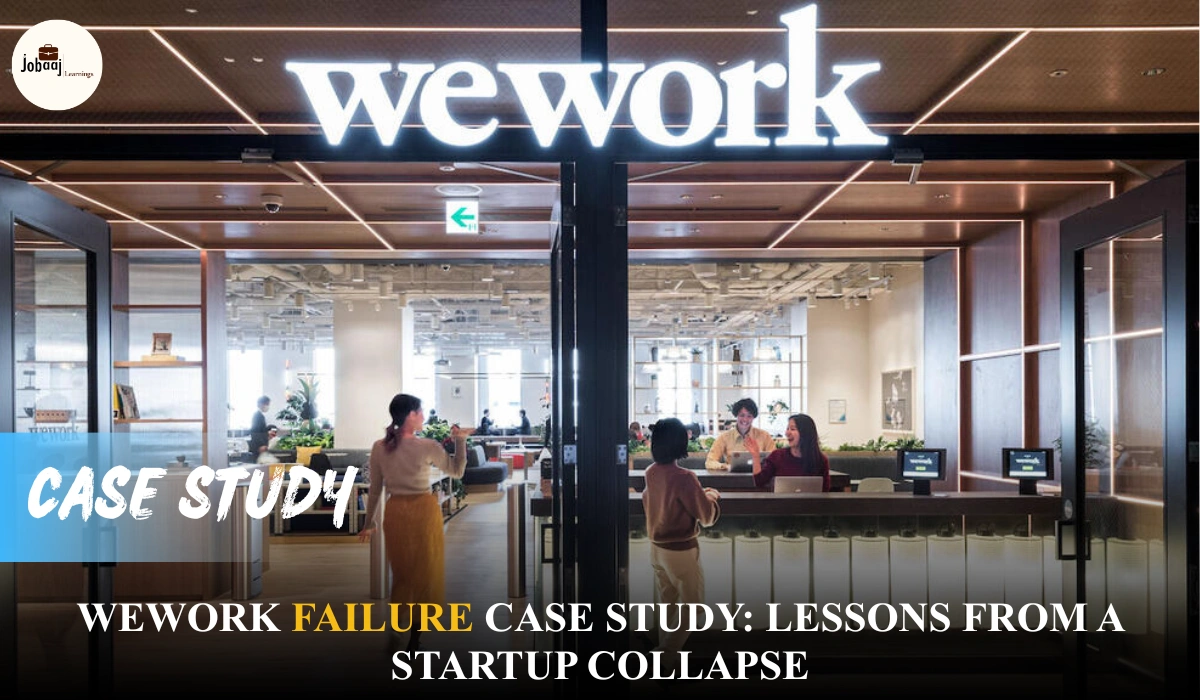
WeWork is one of the most talked-about startup stories in modern business history. At first glance, it looked like the perfect success story a company that redefined office spaces, built a global brand, and attracted billions of dollars from top investors.
The idea was simple and attractive. Instead of traditional offices, WeWork offered flexible, shared workspaces where freelancers, startups, and even large companies could work in a more collaborative environment. The branding was modern, energetic, and positioned almost like a “tech revolution” in real estate.
At its peak, WeWork was valued at around $47 billion, and many believed it was on its way to becoming one of the biggest workplace transformation companies in the world.
But behind this rapid rise, serious cracks were forming in the business model, financial structure, and leadership decisions. What looked like unstoppable growth slowly turned into one of the most famous startup collapses in recent years.
This case study breaks down how WeWork rose so fast, where it went wrong, and what real lessons the business world can learn from its downfall.
Company Background
WeWork was founded in 2010 by Adam Neumann and Miguel McKelvey. The vision was to create shared office spaces that felt more like communities than traditional workplaces.
The company targeted a growing shift in work culture. Startups were increasing, freelancing was becoming common, and companies were looking for flexible office solutions instead of long-term lease commitments.
WeWork positioned itself as a solution to this change. It signed large commercial real estate properties on long-term leases and then rented them out as smaller flexible workspaces to customers.
This model allowed fast expansion because once a building was leased, it could be quickly converted into multiple revenue-generating office spaces. As demand increased, WeWork expanded aggressively across cities like New York, London, Bangalore, and other global business hubs.
For a while, everything looked perfect on the surface occupancy was growing, branding was strong, and investor interest was extremely high.
Problem Statement
Despite rapid expansion and increasing popularity, WeWork had deep structural issues that were not visible in its early growth phase.
The company was generating revenue, but it was also burning massive amounts of cash. Its growth strategy depended heavily on continuous expansion, which created long-term financial pressure.
Some of the core problems included:
- Continuous financial losses despite growing revenue
- Extremely high lease commitments across global properties
- Heavy dependence on constant expansion to stay stable
- Weak path to profitability even at large scale
- Overvaluation driven by investor hype rather than fundamentals
- Governance and leadership concerns
The biggest issue was simple but dangerous: WeWork was growing fast, but not sustainably.
Business Model Breakdown
On the surface, WeWork’s business model looked modern and scalable. But when analyzed deeply, it was structurally risky.
The company signed long-term fixed leases with property owners. These leases were expensive and legally binding. At the same time, WeWork offered flexible monthly or short-term memberships to customers.
This created a major mismatch:
- Fixed long-term costs from landlords
- Unstable short-term income from customers
This means WeWork had to constantly keep its spaces filled to cover lease payments and operational expenses. If occupancy dropped even slightly, financial pressure increased immediately.
The model only worked efficiently under one condition rapid and continuous growth. If expansion slowed, the financial structure started to break down.
Key Issues Behind the Collapse
1. Growth Without Profitability
WeWork focused heavily on expansion rather than profitability. New offices were opened rapidly across global markets without ensuring existing locations were stable or profitable.
While revenue increased, losses increased even faster. This imbalance created long-term instability.
2. Heavy Financial Losses
Even at peak scale, WeWork was losing billions of dollars. Operational costs, lease payments, renovations, staffing, and marketing expenses were extremely high.
Instead of moving toward profitability, the company relied on raising more funding to sustain operations.
3. Overvaluation and Market Hype
One of the biggest turning points was how the market perceived WeWork. Investors treated it like a high-growth tech company instead of a real estate leasing business.
This led to an extremely high valuation of around $47 billion at one point.
However, when financial details were reviewed more carefully during IPO preparation, the reality looked very different. Losses were large, governance was weak, and long-term sustainability was unclear.
4. Leadership and Governance Problems
Leadership decisions also played a major role in the collapse. Reports highlighted concerns around spending patterns, decision-making style, and internal governance.
The company was often criticized for aggressive expansion without financial discipline. There were also concerns about transparency and conflict of interest at the leadership level.
These issues reduced investor confidence significantly.
5. Failed IPO Attempt
In 2019, WeWork attempted to go public. This was supposed to be a major milestone that would unlock even more capital.
However, during the IPO review process, financial documents were made public. Investors and analysts quickly noticed:
- Large and increasing losses
- Weak business fundamentals
- Questionable governance structure
- Unrealistic valuation expectations
As a result, investor confidence dropped sharply, and the IPO was withdrawn. Shortly after, the company’s valuation collapsed dramatically.
Findings from the Case
When analyzing WeWork’s journey as a whole, several important insights become clear.
1.The first finding is that rapid growth does not automatically mean business strength. A company can grow in size but still fail financially if its model is weak.
2.The second finding is that business models built on heavy fixed costs and unstable revenue need extremely careful scaling. Without balance, even small disruptions can create large losses.
Another key insight is that investor perception can sometimes be disconnected from actual financial reality. When hype drives valuation more than fundamentals, correction becomes inevitable.
Finally, leadership and governance are just as important as innovation. Even strong ideas can fail if execution and decision-making are weak.
Impact of WeWork Collapse
The downfall of WeWork had a wide impact beyond just the company itself.
- For investors, it became a reminder that valuation should always be backed by real financial performance, not just growth potential.
- For startups, it became a case study in how aggressive scaling without profitability can lead to long-term failure.
- For the coworking industry, it raised questions about how sustainable large-scale flexible office models actually are.
And for founders, it highlighted the importance of financial discipline, transparent governance, and controlled expansion.
Key Lessons from WeWork Failure
One of the most important lessons from WeWork is that growth alone is not enough. A business must also be financially sustainable.
Another key lesson is that business models need to be stress-tested before scaling. If the model depends entirely on continuous expansion, it becomes fragile in uncertain conditions.
WeWork also shows that leadership behavior and governance can directly impact investor trust and company survival.
Most importantly, it highlights that hype can temporarily inflate success, but fundamentals always decide long-term outcomes.
Conclusion
WeWork’s journey is a powerful reminder of how quickly a promising startup can rise and fall. The company had a strong idea, strong branding, and strong investor interest. But underneath that success was a fragile business model that could not support its own scale.
The collapse was not caused by a single mistake. It was the result of multiple factors aggressive expansion, weak profitability, governance issues, and overvaluation.
For students, entrepreneurs, and business professionals, WeWork remains one of the most important modern case studies. It clearly shows that in business, sustainable growth, financial discipline, and strong governance matter far more than hype and rapid expansion.
Was that difficult?
Think being a Management Consultant is too hard?? Fear not.
Click on the link here to join our program where Shubham Agarwal, a professional management consultant, will teach you all about the exciting field of Management Consultancy and make sure simple case studies like these never scare you!
Join our latest cohort NOW!!
[Disclaimer: This case study is entirely hypothetical and unrelated to real-world situations. It's designed for educational purposes to illustrate theoretical concepts and potential scenarios within a given context. Any similarities to actual events or individuals are purely coincidental.]







