Categories








































Imagine you're trying to bake a cake for the first time. You pull out a recipe (that’s your algorithm) — step-by-step instructions to ensure you get the perfect cake. But as you begin, you realize that the oven settings and the mixing process need to be adjusted for it to bake properly. This adjustment is similar to the program, where you bring the instructions to life, making sure everything is correctly implemented in real life. Just like the recipe guides the process, an algorithm outlines the solution to a problem, and the program is the tool that turns this plan into an executable action.
Exploring a career in Web Development? Apply now!
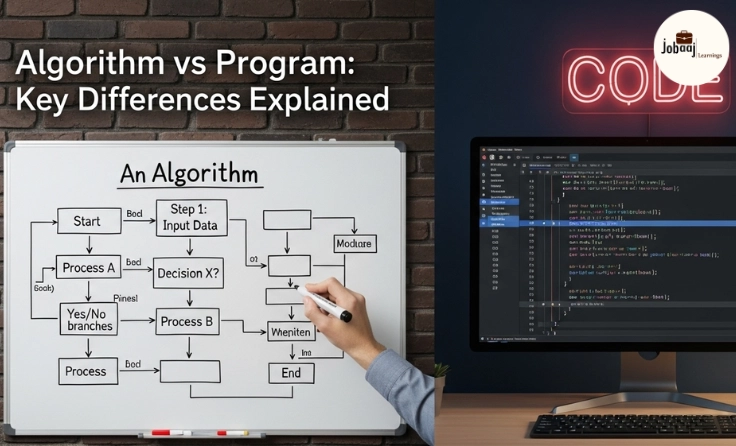
In the world of computer science and programming, algorithms and programs are both vital components of software development. They work hand in hand, but they aren’t the same. In this blog, we’ll dive into the algorithm vs program debate, understand the key differences, and explore how they complement each other in the development of software solutions.
What is an Algorithm?
An algorithm is a step-by-step procedure or formula for solving a problem. It is a conceptual solution that describes the sequence of steps required to perform a task or solve a problem. Algorithms are used across many fields, not just in computer science, to improve efficiency and ensure accuracy.
Key Characteristics of an Algorithm:
-
Definiteness: Each step in the algorithm is clearly defined and unambiguous.
-
Finiteness: An algorithm must always terminate after a finite number of steps.
-
Input: An algorithm may take inputs that affect its process.
-
Output: After following the steps, an algorithm should produce an output or result.
-
Effectiveness: Every step must be basic enough to be carried out, ideally by a person with basic resources or a computer.
Example of an Algorithm:
If you were to sort a list of numbers, the Bubble Sort algorithm might involve these steps:
-
Compare each number with the next one.
-
Swap them if they are in the wrong order.
-
Repeat this process until no swaps are needed, meaning the list is sorted.
What is a Program?
A program, on the other hand, is a complete, executable set of instructions that can be run by a computer. It’s the actual implementation of an algorithm using a programming language. While an algorithm describes a solution in a language we can understand, a program brings that solution to life and makes it actionable by the machine.
Key Characteristics of a Program:
-
Execution: A program is something that a computer can run, and it will execute the instructions provided by the programmer.
-
Language: Programs are written in programming languages such as Python, Java, C++, etc., which are then compiled or interpreted to create a machine-readable form.
-
Structure: A program has a specific structure, including variables, data types, functions, and loops that control the flow of execution.
-
Interactivity: Programs often require interaction with the user or other systems, enabling dynamic input and output.
Example of a Program:
The Bubble Sort algorithm we described earlier could be implemented in Python as a program:
def bubble_sort(arr): n = len(arr) for i in range(n): for j in range(0, n-i-1): if arr[j] > arr[j+1]: arr[j], arr[j+1] = arr[j+1], arr[j] return arr
This program not only describes the logic of sorting (like the algorithm) but also has to be run on a computer to function.
Algorithm vs Program: Key Differences
Now, let’s compare an algorithm and a program to highlight their core differences:
1. Nature
-
Algorithm: Conceptual and abstract, describing a solution without execution.
-
Program: Concrete and executable; it’s a sequence of instructions that can be run by a computer.
2. Purpose
-
Algorithm: To solve a problem step by step.
-
Program: To implement an algorithm in a programming language so that the computer can execute it.
3. Dependency
-
Algorithm: Does not depend on hardware or software.
-
Program: Requires hardware (computer) and software (operating system, compiler, interpreter).
4. Flexibility
-
Algorithm: The same algorithm can be implemented in different programming languages.
-
Program: A program is written in a specific programming language and is often tailored to the environment where it runs.
5. Complexity
-
Algorithm: Typically simpler, focusing on the logical flow of problem-solving.
-
Program: Can be complex, as it includes the actual coding, handling errors, memory management, and more.
How Algorithms and Programs Work Together
While algorithms provide the theoretical solution to a problem, programs are the practical tools that make those solutions work on a computer. To put it simply, an algorithm is the blueprint, and a program is the building constructed from that blueprint.
For instance, you can have a well-defined algorithm for sorting data, but to actually perform the sorting on a computer, you need to write a program that implements that algorithm in a specific programming language. The program is what actually gets executed to produce the result you want.
Conclusion
In conclusion, algorithms and programs are two sides of the same coin in the world of computer science. Algorithms are the logical, conceptual solutions to problems, while programs are the actual implementations of those solutions, making them tangible and executable by machines. As a software developer or aspiring computer scientist, mastering both is crucial — understanding algorithms helps you solve problems efficiently, and mastering programming languages lets you bring those solutions to life.
If you're starting your journey in tech, focus on learning algorithms first, as they provide the foundation for effective programming. Once you’re comfortable with algorithms, diving into programming will allow you to create real, executable applications that solve actual problems.
Dreaming of a Web Development Career? Start with Web Development Certificate with Jobaaj Learnings.
Frequently asked questions
What is the main difference between an algorithm and a program?
An algorithm is a step-by-step procedure or formula for solving a problem, whereas a program is an implementation of an algorithm in a specific programming language that can be executed by a computer.
Do algorithms depend on programming languages?
No, algorithms are language-independent and can be implemented in any programming language. They focus on the logic of the solution, not the syntax of a particular language.
Can a program exist without an algorithm?
No, a program cannot exist without an algorithm. A program is the execution of an algorithm; without an algorithm, a program would have no logical basis to function.
What skills are required to create algorithms?
Creating algorithms requires strong problem-solving skills, an understanding of logic, and familiarity with mathematical concepts. It’s also important to think abstractly and understand how problems can be broken down into smaller, manageable steps.
Can an algorithm be too complex?
Yes, algorithms can be complex. The goal is to create efficient algorithms that solve problems in the least amount of time and space. Complex algorithms may require optimizations to improve performance.
Why are algorithms important in programming?
Algorithms are essential because they provide a clear, step-by-step process to solve problems. They help programmers write more efficient and effective programs that can handle large amounts of data or complex tasks.

Join 5,00,000+ Subscribers
Be a part of our ever growing community.