Categories














/content/learnings/assets/header/ManagementConsulting.svg)
/content/learnings/assets/header/InvestmentBanking.svg)


























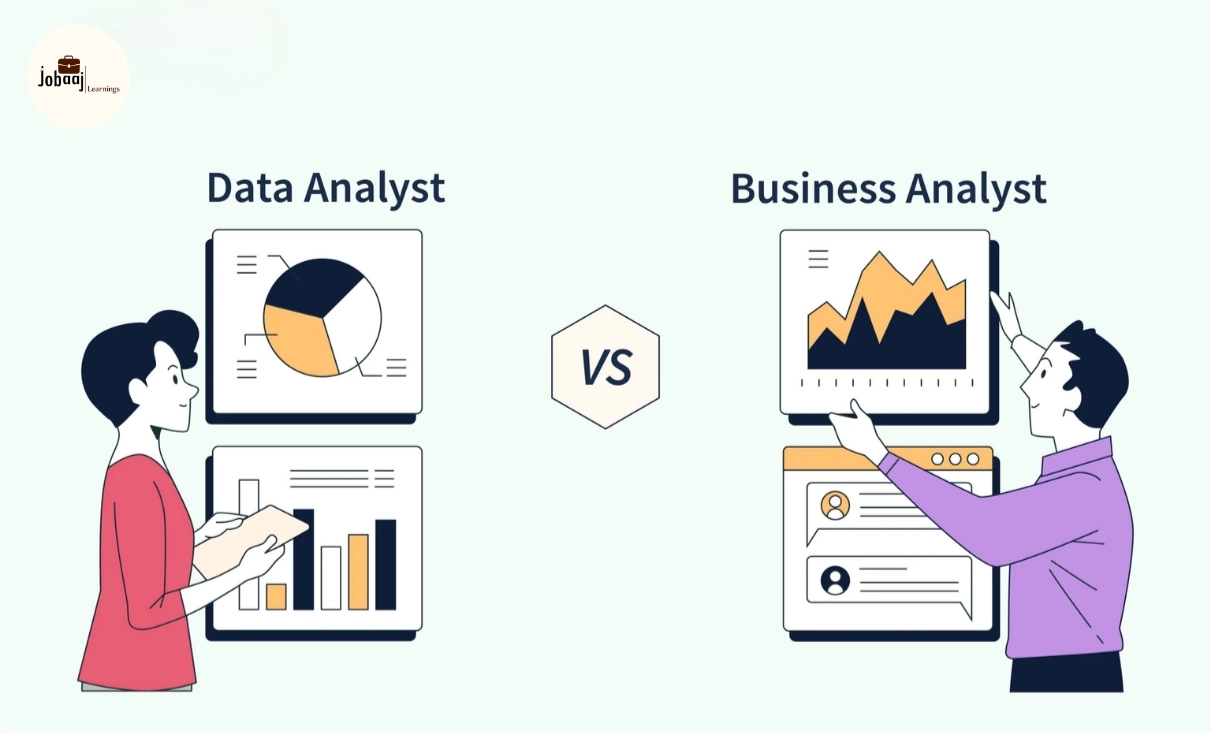
Choosing between a Business Analyst and a Data Analyst career can feel confusing because both roles work with data, solve business problems, and support decision-making.
But they are not the same job.
A Business Analyst focuses more on business problems, processes, requirements, stakeholders, and solutions. A Data Analyst focuses more on data collection, cleaning, analysis, dashboards, patterns, and insights.
The simple difference is this:
A Business Analyst asks, “What does the business need, and how can we solve it?”
A Data Analyst asks, “What does the data show, and what decision should we take from it?”
Both roles are valuable. Both are growing. Both can lead to high-paying careers.
But the better choice depends on your strengths, interests, and long-term career direction.
This guide explains Business Analyst vs Data Analyst in a clear, practical, and career-focused way.
What Is a Business Analyst?
A Business Analyst is a professional who understands business problems and converts them into clear requirements, solutions, workflows, and documentation.
They act as a bridge between business teams and technical teams.
For example, a company may want to build a new mobile banking feature. The Business Analyst will speak to stakeholders, understand the requirement, document the feature, prepare user stories, define acceptance criteria, and coordinate with developers, testers, product managers, and clients.
A Business Analyst does not only work with numbers. They work with people, processes, systems, business goals, and product requirements.
Common Responsibilities of a Business Analyst
A Business Analyst usually handles work like:
- Understanding business problems
- Gathering requirements from clients or internal teams
- Preparing BRD, FRD, SRS, user stories, and process documents
- Creating workflow diagrams and process maps
- Coordinating with developers, testers, product managers, and stakeholders
- Supporting UAT and implementation
- Identifying process gaps and suggesting improvements
- Explaining business needs in simple technical language
A good Business Analyst should understand both business logic and technology basics.
They do not always need to code, but they should understand how software, data, and systems work.
What Is a Data Analyst?
A Data Analyst is a professional who collects, cleans, analyzes, and visualizes data to help businesses make better decisions.
They work more directly with datasets, databases, reports, dashboards, and metrics.
For example, an e-commerce company may want to know why sales dropped last month. The Data Analyst will pull sales data, clean it, compare trends, check product categories, analyze customer behavior, and build a dashboard or report explaining the reason.
A Data Analyst turns raw data into useful insights.
Common Responsibilities of a Data Analyst
A Data Analyst usually handles work like:
- Collecting data from databases, Excel sheets, CRM tools, or APIs
- Cleaning and transforming messy data
- Writing SQL queries
- Creating dashboards in Power BI, Tableau, Looker, or Excel
- Tracking KPIs and business metrics
- Finding patterns, trends, and anomalies
- Preparing reports for managers and leadership
- Supporting decision-making with data-backed insights
A Data Analyst needs stronger technical skills than a traditional Business Analyst.
They should be comfortable with SQL, Excel, data visualization, statistics, and sometimes Python or R.
Business Analyst vs Data Analyst: Main Difference
The biggest difference between Business Analyst and Data Analyst is their main focus.
- A Business Analyst focuses on business needs and solutions.
- A Data Analyst focuses on data insights and reporting.
Both roles may use data, but they use it differently.
A Business Analyst uses data to understand business problems and support solution design.
A Data Analyst uses data to find trends, measure performance, and explain what is happening.
Business Analyst vs Data Analyst Comparison Table
|
Factor |
Business Analyst |
Data Analyst |
|
Main focus |
Business problems, requirements, processes, solutions |
Data cleaning, analysis, dashboards, insights |
|
Core question |
What does the business need? |
What does the data show? |
|
Main output |
BRD, FRD, user stories, workflows, process maps |
Reports, dashboards, SQL analysis, insights |
|
Technical level |
Moderate |
Higher |
|
Coding requirement |
Usually not mandatory |
Often useful, especially SQL and Python |
|
Stakeholder interaction |
Very high |
Medium to high |
|
Best for |
People who like communication, business logic, processes |
People who like numbers, data, tools, and analysis |
|
Common tools |
Jira, Confluence, Visio, Lucidchart, Figma, Excel |
SQL, Excel, Power BI, Tableau, Python, R |
|
Career growth |
Product Manager, Project Manager, Consultant, Product Owner |
Senior Data Analyst, BI Analyst, Data Scientist, Analytics Manager |
|
Salary growth |
Strong in consulting, product, fintech, ERP, payments |
Strong in tech, product companies, finance, e-commerce, analytics |
Business Analyst vs Data Analyst: Day-to-Day Work
A Day in the Life of a Business Analyst
A Business Analyst’s day usually involves meetings, documentation, requirement discussions, and coordination.
They may start the day by joining a stakeholder call. Then they may update a requirement document, clarify doubts from developers, review test cases, and check whether the delivered feature matches the business expectation.
A Business Analyst spends a lot of time asking questions.
They need to understand what the business wants, why it matters, who will use it, what can go wrong, and how success will be measured.
A Day in the Life of a Data Analyst
A Data Analyst’s day usually involves working with data, building reports, writing queries, and explaining insights.
They may start by refreshing a dashboard, checking data quality issues, writing SQL queries, analyzing weekly sales, and preparing a report for the business team.
A Data Analyst spends a lot of time finding patterns.
They need to understand what changed, why it changed, whether the change is important, and what action should be taken.
Top Skills Required for Business Analyst
A Business Analyst needs a mix of business, communication, analytical, and documentation skills.
1. Requirement Gathering
This is one of the most important Business Analyst skills.
You should know how to ask the right questions, understand stakeholder needs, identify gaps, and convert unclear ideas into structured requirements.
2. Documentation
Business Analysts prepare important documents such as:
- Business Requirement Document
- Functional Requirement Document
- Software Requirement Specification
- User stories
- Acceptance criteria
- Process flow documents
- Use cases
Clear documentation reduces confusion between business and technical teams.
3. Communication Skills
A Business Analyst must explain business needs to technical teams and technical limitations to business teams.
This role needs strong written and verbal communication.
4. Process Mapping
Business Analysts often create process flows to show how a system or business process works.
Common formats include flowcharts, BPMN diagrams, swimlane diagrams, and user journey maps.
5. Stakeholder Management
A Business Analyst works with clients, managers, developers, testers, product teams, and operations teams.
You should know how to handle different opinions, clarify expectations, and keep everyone aligned.
6. Business Domain Knowledge
Domain knowledge can increase your value.
Popular domains include:
- Banking
- Insurance
- Healthcare
- E-commerce
- Fintech
- Payments
- Retail
- Logistics
- SaaS
- Telecom
- ERP
A Business Analyst with strong domain knowledge can grow faster than someone who only knows documentation.
7. Basic Data Understanding
Modern Business Analysts should understand data basics.
You do not need to become a full Data Analyst, but you should know KPIs, reports, dashboards, SQL basics, and how data supports business decisions.
Top Skills Required for Data Analyst
A Data Analyst needs stronger technical and analytical skills.
1. Excel
Excel is still one of the most used tools in analytics.
You should know:
- Pivot tables
- Lookup formulas
- Conditional formatting
- Charts
- Power Query
- Basic automation
- Data cleaning
For many entry-level Data Analyst jobs, strong Excel is the first requirement.
2. SQL
SQL is one of the most important Data Analyst skills.
It helps you extract data from databases.
You should know:
- SELECT queries
- WHERE conditions
- GROUP BY
- JOINS
- Subqueries
- Window functions
- Common table expressions
- Date functions
If you want a serious data career, SQL is not optional.
3. Data Visualization
Data Analysts must present insights clearly.
Popular visualization tools include:
- Power BI
- Tableau
- Looker Studio
- Excel dashboards
- Qlik Sense
A dashboard should not only look good. It should help people take decisions.
4. Statistics
A Data Analyst should understand basic statistics.
Important topics include:
- Mean, median, mode
- Standard deviation
- Correlation
- Regression basics
- Sampling
- Hypothesis testing
- Percentages and ratios
You do not need advanced mathematics for every job, but basic statistics helps you avoid wrong conclusions.
5. Python or R
Python is useful for data cleaning, automation, advanced analysis, and machine learning basics.
Important Python libraries include:
- Pandas
- NumPy
- Matplotlib
- Seaborn
- Scikit-learn
R is also useful, especially in research, statistics, healthcare, and academic analytics.
6. Business Understanding
A Data Analyst should not only know tools.
They should understand the business question behind the data.
For example, a dashboard showing sales decline is not enough. The analyst should explain whether the decline came from fewer customers, lower order value, poor conversion, seasonal demand, or product issues.
Tools and Software Used by Business Analysts
Business Analysts use tools for documentation, collaboration, workflow mapping, project tracking, and communication.
|
Tool |
Purpose |
|
Microsoft Excel |
Basic analysis, tracking, reports |
|
Microsoft Word |
Documentation |
|
PowerPoint |
Presentations |
|
Jira |
Agile project tracking |
|
Confluence |
Documentation and knowledge base |
|
Trello |
Task tracking |
|
Microsoft Visio |
Process mapping |
|
Lucidchart |
Flowcharts and diagrams |
|
Free process diagrams |
|
|
Figma |
Wireframes and UI collaboration |
|
Balsamiq |
Wireframing |
|
Miro |
Workshops and brainstorming |
|
SQL |
Basic data extraction |
|
Power BI |
Dashboard understanding |
A modern Business Analyst does not need to master every tool, but they should be comfortable with documentation, agile tools, and process mapping.
Tools and Software Used by Data Analysts
Data Analysts use tools for data extraction, cleaning, analysis, visualization, and reporting.
|
Tool |
Purpose |
|
Excel |
Data cleaning and quick analysis |
|
SQL |
Database querying |
|
Power BI |
Business intelligence dashboards |
|
Tableau |
Data visualization |
|
Looker Studio |
Web and marketing dashboards |
|
Python |
Data analysis and automation |
|
R |
Statistical analysis |
|
Google Sheets |
Collaborative reporting |
|
BigQuery |
Cloud data warehouse |
|
Snowflake |
Cloud data platform |
|
PostgreSQL |
Database management |
|
MySQL |
Database management |
|
Jupyter Notebook |
Python-based analysis |
|
Google Colab |
Cloud Python notebooks |
The most common beginner stack is Excel, SQL, and Power BI or Tableau.
After that, Python can help you move toward advanced analytics, automation, and data science.
Business Analyst Salary
Business Analyst salary depends on experience, industry, location, company size, domain knowledge, and technical skills.
|
Experience Level |
Approximate Salary Range |
|
Fresher |
₹3 LPA to ₹6 LPA |
|
1 to 3 years |
₹5 LPA to ₹10 LPA |
|
3 to 6 years |
₹8 LPA to ₹18 LPA |
|
6+ years |
₹15 LPA to ₹30 LPA or more |
Business Analysts can earn more in areas like consulting, fintech, banking, payments, product companies, ERP implementation, SaaS, and digital transformation.
A Business Analyst with strong domain knowledge and stakeholder handling can grow into high-paying roles like Product Owner, Product Manager, Consultant, Program Manager, or Business Architect.
Data Analyst Salary
Data Analyst salary also depends on tools, experience, industry, location, and the complexity of work.
|
Experience Level |
Approximate Salary Range |
|
Fresher |
₹2.5 LPA to ₹6 LPA |
|
1 to 3 years |
₹4.5 LPA to ₹10 LPA |
|
3 to 6 years |
₹8 LPA to ₹18 LPA |
|
6+ years |
₹15 LPA to ₹30 LPA or more |
Data Analysts can earn more when they build strong skills in SQL, Python, Power BI, Tableau, statistics, experimentation, product analytics, and cloud data tools.
Higher salaries are common in product companies, fintech, e-commerce, SaaS, consulting, banking, and global capability centers.
Job Roles for Business Analysts
Business Analyst career paths can lead to many roles.
Entry-Level Business Analyst Roles
- Junior Business Analyst
- Business Analyst Trainee
- Associate Business Analyst
- Process Analyst
- Functional Analyst
- Project Coordinator
- Product Analyst
Mid-Level Business Analyst Roles
- Business Analyst
- Senior Business Analyst
- IT Business Analyst
- Functional Consultant
- Product Owner
- Agile Business Analyst
- Business Systems Analyst
Senior Business Analyst Roles
- Lead Business Analyst
- Business Architect
- Product Manager
- Program Manager
- Digital Transformation Consultant
- Strategy Consultant
- Domain Consultant
Business Analysts who understand both business and technology can move into leadership roles faster.
Job Roles for Data Analysts
Data Analyst careers also offer multiple growth options.
Entry-Level Data Analyst Roles
- Junior Data Analyst
- MIS Executive
- Reporting Analyst
- Business Data Analyst
- Data Operations Analyst
- Excel Analyst
- BI Trainee
Mid-Level Data Analyst Roles
- Data Analyst
- Senior Data Analyst
- BI Analyst
- Product Analyst
- Marketing Analyst
- Risk Analyst
- Operations Analyst
- Financial Data Analyst
Senior Data Analyst Roles
- Analytics Manager
- BI Developer
- Data Scientist
- Data Engineer
- Product Analytics Manager
- Decision Scientist
- Analytics Consultant
- Data Strategy Lead
Data Analysts can grow toward data science, business intelligence, analytics leadership, or data engineering depending on their skills.
Which Role Is Better for Freshers?
Both roles can be good for freshers, but the better option depends on your strengths.
Choose Business Analyst If You Like:
- Talking to people
- Understanding business problems
- Writing documents
- Explaining requirements
- Coordinating with teams
- Working on software projects
- Understanding processes
- Asking questions
- Solving practical business issues
Business Analyst is a better fit if you are strong in communication and business logic.
Choose Data Analyst If You Like:
- Working with numbers
- Finding patterns
- Using Excel, SQL, and dashboards
- Cleaning data
- Creating reports
- Solving logic-based problems
- Measuring performance
- Learning technical tools
- Explaining insights through charts
Data Analyst is a better fit if you enjoy tools, data, numbers, and analysis.
Which Role Is More Technical?
Data Analyst is usually more technical.
A Data Analyst is expected to work with SQL, Excel, dashboards, databases, and sometimes Python or R.
A Business Analyst is less coding-heavy, but modern Business Analysts still need technical awareness.
They should understand APIs, databases, system flows, user stories, agile development, testing, and basic analytics.
The best career option today is not purely non-technical.
Even Business Analysts should become tech-aware.
Business Analyst Portfolio Ideas
If you want to become a Business Analyst, build a portfolio that shows business thinking and documentation skills.
Portfolio Project Ideas for Business Analysts
- Food delivery app requirement document
- Banking loan application process improvement
- E-commerce return management workflow
- CRM system BRD and user stories
- Payment gateway failure analysis
- Hospital appointment booking system
- HR onboarding process automation
- Travel booking app user journey
- Inventory management process map
For each project, include:
- Problem statement
- Stakeholders
- Requirements
- User stories
- Acceptance criteria
- Process flow
- Wireframes
- Risks
- Success metrics
Data Analyst Portfolio Ideas
If you want to become a Data Analyst, build a portfolio that shows your ability to clean, analyze, and explain data.
Portfolio Project Ideas for Data Analysts
- Sales dashboard
- Customer churn analysis
- E-commerce revenue analysis
- HR attrition dashboard
- Marketing campaign performance dashboard
- Financial expense tracker
- Product funnel analysis
- Retail inventory analysis
- Customer segmentation project
- Loan default risk analysis
For each project, include:
- Dataset source
- Business question
- Data cleaning steps
- SQL queries
- Dashboard screenshots
- Key insights
- Business recommendations
A good portfolio should not only show visuals. It should show your thinking.
Frequently asked questions
What is the main difference between Business Analyst and Data Analyst?
A Business Analyst focuses on business problems, requirements, processes, and solutions. A Data Analyst focuses on data cleaning, analysis, dashboards, and insights. Both roles support decision-making, but a Business Analyst works more with stakeholders and systems, while a Data Analyst works more with datasets, SQL, reports, and visualization tools.
Which is better: Business Analyst or Data Analyst?
Neither role is automatically better. Business Analyst is better if you enjoy communication, documentation, business logic, and process improvement. Data Analyst is better if you enjoy numbers, SQL, dashboards, and finding insights from data. The best choice depends on your skills, interests, and long-term career goals.
Who earns more: Business Analyst or Data Analyst?
Both can earn well. Business Analysts may earn more in consulting, fintech, ERP, banking, and product roles. Data Analysts may earn more in product analytics, BI, fintech, e-commerce, and advanced analytics. Salary depends more on skills, domain knowledge, company type, and experience than on the job title alone.
Can a non-technical person become a Data Analyst?
Yes, a non-technical person can become a Data Analyst by learning Excel, SQL, Power BI or Tableau, basic statistics, and data storytelling. Python can be learned later. The journey takes practice, but many commerce, business, economics, and management students successfully move into data analytics roles.
Is Business Analyst a good career in the future?
Yes, Business Analyst is a strong future career, especially as companies continue digital transformation, automation, and software adoption. The role will grow stronger for people who understand business processes, stakeholder management, data basics, AI tools, and technology systems. Basic documentation-only Business Analyst roles may become less competitive over time.

Join 5,00,000+ Subscribers
Be a part of our ever growing community.
Related reads

Best Government Jobs for Women in India 2026: Salary, Benefits and Career Growth

Business Analyst Salary in India 2026: Fresher Salary, Experience and Career Growth