Categories








































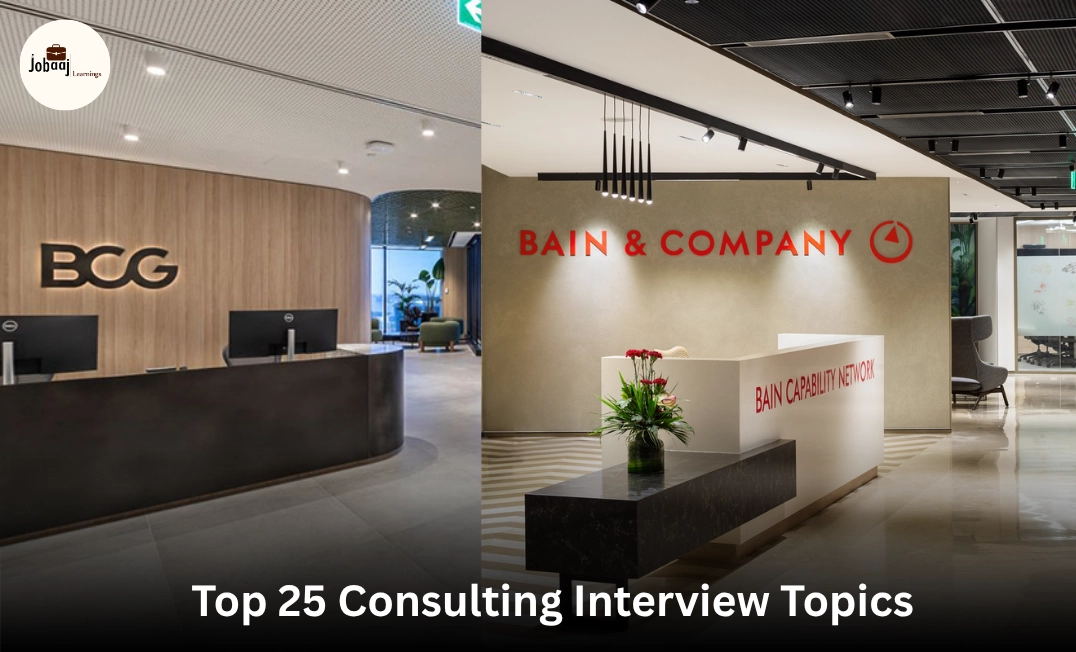
Landing an interview at Boston Consulting Group (BCG) or Bain & Company is one of the most significant milestones for any aspiring consultant. These firms, part of the prestigious "MBB" trio, are known for their rigorous selection processes that test not just your business acumen, but your ability to think structurally under pressure.
To help you navigate this journey, this blog covers the 25 most critical topics you will encounter in both Case and Fit (Behavioral) interviews. We provide practical advice on how to approach these high-stakes discussions along with sample answers to sharpen your preparation.
1. Profitability Optimization
This is a staple in BCG and Bain interviews. You are asked to identify why a company's profits are declining and how to fix it. Use the basic framework: $Profit = Revenue - Costs$.
Sample Answer:
"To diagnose the profit decline, I would first segment the revenue into price and volume to see if we are losing market share or facing pricing pressure. On the cost side, I’d analyze fixed vs. variable costs. For example, if sales are steady but profits are down, I would investigate if a recent hike in raw material costs or an increase in SG&A expenses is the culprit."
2. Market Entry Strategy
Bain often uses these to see how you evaluate risk and opportunity. You need to assess if a client should enter a new geography or product line.
Sample Answer:
"Before recommending entry into the Indian EV market, I would analyze the market size, growth rate, and competitive landscape. I would also look at the 'Barriers to Entry' like government regulations and infrastructure. Finally, I’d evaluate the client’s capabilities can they leverage local partnerships to scale faster than a solo launch?"
3. Mergers & Acquisitions (M&A)
These cases involve evaluating whether one company should acquire another. Focus on valuation, strategic fit, and synergies.
Sample Answer:
"The decision to acquire a competitor depends on whether the 1+1=3 effect is real. I would look for cost synergies, such as combining supply chains, and revenue synergies, like cross-selling products to a new customer base. I would also perform due diligence on the cultural fit to ensure a smooth post-merger integration."
4. Pricing Strategy
Interviewers want to see if you understand how to capture value. You should compare cost-based, competitor-based, and value-based pricing models.
Sample Answer:
"For a new life-saving drug, cost-based pricing is irrelevant. I would focus on value-based pricing by calculating the total savings to the healthcare system (shorter hospital stays, etc.) and price accordingly. I would also check competitor pricing for similar treatments to ensure we aren't priced out of the market."
5. Growth Strategy
How can a company double its revenue? This tests your creativity and ability to prioritize high-impact moves.
Sample Answer:
"To drive growth for a luxury hotel chain, I’d look at three levers: increasing the 'share of wallet' from existing guests, geographic expansion into emerging markets, and launching sub-brands to target a younger demographic. I would prioritize these based on the expected ROI and ease of implementation."
6. "Tell me about yourself."
This is your "Fit" interview hook. Microsoft and BCG both look for a "Spike" something extraordinary you’ve achieved.
Sample Answer:
"I am a finance graduate with a passion for data-driven problem solving. In my last internship, I identified a bottleneck in our reporting process that saved the team 10 hours a week. I’ve always been drawn to consulting because I want to solve these types of efficiency puzzles at a global scale for firms like BCG."
7. "Why Bain / Why BCG?"
Don't give a generic answer. Mention specific firm values, like Bain's "Results, not Reports" or BCG’s focus on provocative, creative strategy.
Sample Answer:
"I want to work at Bain because of its 'Bain Alliance' culture and the heavy emphasis on driving tangible results for clients. I’ve spoken with several Bainies who highlighted the firm's 'home-office' model, which fosters a tight-knit community that I’m eager to contribute to."
8. Handling Conflict in a Team
Consultants work in high-pressure teams. They need to know you can handle friction professionally.
Sample Answer:
"During a university project, a teammate wasn't contributing. Instead of escalating immediately, I had a 1-on-1 to understand if they were struggling with the material. We re-allocated tasks to suit their strengths, which improved the team’s output and morale, leading to an 'A' grade."
9. Overcoming a Professional Failure
They want to see resilience and a "Growth Mindset." Take full ownership of a mistake and explain the lesson learned.
Sample Answer:
"Early in my career, I missed a deadline on a client report because I didn't ask for help when I hit a technical snag. It was a tough lesson in transparency. Now, I always set internal 'buffer' deadlines and communicate roadblocks to my manager immediately to ensure project success."
10. Market Sizing (Guesstimates)
How many tennis balls are sold in London annually? They don't need a perfect number; they need a logical process.
Sample Answer:
"To estimate this, I’d start with the population of London, estimate the percentage of people who play tennis, and then look at the frequency of play. I’d then factor in 'institutional' sales like clubs and tournaments. By applying reasonable assumptions to each step, I can arrive at a structured estimate."
11. Digital Transformation Cases
In 2026, every "traditional" company is trying to become a tech company. These cases ask how a legacy business (like a bank or a 50-year-old manufacturer) can integrate AI or automation.
Sample Answer: "To lead a digital transformation for a traditional bank, I wouldn’t just look at the software. I’d analyze the customer journey to see where friction exists. Then, I’d evaluate the ROI of automating back-office tasks versus launching a customer-facing mobile app. The goal is to ensure the tech investment actually drives customer retention or lowers operational costs."
12. Supply Chain Optimization
With global logistics becoming more complex, BCG and Bain frequently ask how to make a supply chain more resilient or cost-effective.
Sample Answer: "If a global retailer is facing frequent stockouts, I would first map the entire supply chain to identify the bottleneck is it the raw material supplier, the shipping route, or the last-mile delivery? I’d suggest a 'China + 1' strategy to diversify suppliers and perhaps implement predictive analytics to better forecast demand surges."
13. Product Launch Frameworks
You are helping a company launch a new product, like a foldable smartphone or a premium organic soda. This tests your understanding of the 4Ps (Product, Price, Place, Promotion).
Sample Answer: "For a premium soda launch, my focus would be on 'Place' and 'Promotion.' Since it's a high-end product, we should target niche health stores rather than mass-market supermarkets initially. We need to create a brand story around the organic ingredients to justify the premium price point and build a loyal early-adopter base."
14. Competitive Response Strategy
What happens when a new competitor enters the market and slashes prices by 30%? This tests your ability to protect market share without necessarily starting a "race to the bottom" price war.
Sample Answer: "Before matching a competitor’s price cut, I’d analyze our customer loyalty. If our brand is strong, we might be better off adding value like an extended warranty or a loyalty program rather than cutting prices. However, if the product is a commodity, we must look for immediate operational efficiencies to protect our margins while staying competitive."
15. Private Equity Due Diligence
In these cases, you are advising a PE firm on whether they should buy a company. You need to assess the target's "exit potential" in 5 years.
Sample Answer: "In due diligence, I am looking for the 'hidden gems' within the target company. I’d evaluate the stability of their cash flow and their market position. Most importantly, I’d look for 'quick wins' areas where the PE firm can cut costs or optimize pricing immediately after the acquisition to drive up the company’s valuation for a future sale."
16. Cost Reduction & Lean Operations
This is about finding "waste." Interviewers want to see if you can be surgical about cutting costs without hurting the core product quality.
Sample Answer: "I’d start by benchmarking the client's departmental spending against industry standards. If their R&D spend is significantly higher but innovation is slow, I’d investigate their project management efficiency. The goal is 'Lean' operations eliminating non-value-added steps in the manufacturing or service delivery process."
17. Sustainability & ESG Strategy
Environmental, Social, and Governance (ESG) is no longer optional. BCG, in particular, focuses heavily on how "Green" initiatives can also be profitable.
Sample Answer: "I’d argue that a sustainability strategy is actually a risk-management strategy. By switching to renewable energy now, the client can hedge against future carbon taxes and appeal to the growing demographic of eco-conscious consumers. It’s about finding the intersection where 'doing good' meets the bottom line."
18. Business Model Pivots
This involves shifting from one way of making money to another, such as a software company moving from one-time licenses to a subscription (SaaS) model.
Sample Answer: "The challenge in a SaaS pivot is managing the temporary dip in cash flow. I would recommend a hybrid model during the transition to keep existing customers comfortable while incentivizing new users to join the subscription plan. We’d need to focus heavily on 'Customer Success' to ensure high renewal rates."
19. Capacity Expansion Decisions
Should a factory build a new wing? Should a airline buy more planes? This tests your ability to handle "NPV" (Net Present Value) concepts and long-term forecasting.
Sample Answer: "Before investing millions in a new factory, I’d look at our current capacity utilization. If we are only at 70%, we should optimize our current shifts first. If we truly are at a ceiling, I’d compare the cost of building a new facility against the cost of outsourcing production to a third party."
20. Influencing Difficult Stakeholders (Fit)
As a consultant, you will deal with clients who don't want you there. This question tests your EQ (Emotional Intelligence).
Sample Answer: "In my last role, I had a senior manager who was skeptical of my data. Instead of arguing, I invited them to a 'pre-meeting' to get their input on the methodology. By making them feel like a co-author of the solution, they became my biggest advocate when the final results were presented to the Board."
21. Handling Ambiguity in Projects (Fit)
Consulting is rarely clear-cut. Interviewers want to know if you freeze up when the "path forward" isn't visible.
Sample Answer: "I thrive in ambiguity by creating a 'working hypothesis.' In a previous project where we had zero market data, I looked at 'proxy' industries to make an educated guess. This allowed the team to start moving while we gathered more specific data, ensuring we didn't lose momentum."
22. Leadership under Pressure (Fit)
Tell a story where the stakes were high and the clock was ticking. Focus on how you kept the team calm and focused.
Sample Answer: "During a high-stakes competition, our lead presenter fell ill two hours before the pitch. I stepped in, re-organized our talking points to play to the remaining members' strengths, and led a 30-minute intensive rehearsal. We ended up winning because we stayed focused on the solution rather than the crisis."
23. Greatest Professional Achievement (Fit)
Don't just say what you did say what the impact was. Use hard numbers.
Sample Answer: "My greatest achievement was leading a small team to redesign our inventory tracking system. By implementing a simple barcode solution, we reduced human error by 40% and saved the company $50,000 in lost stock within the first six months."
24. Working under Tight Deadlines (Fit)
This tests your prioritization and "triage" skills.
Sample Answer: "When faced with an overnight deadline, I focus on the '80/20 rule.' I identify the 20% of the tasks that will provide 80% of the value. I communicate with my manager to ensure we are aligned on the priorities and then execute with high intensity, ensuring the most critical components are perfect."
25. Ethical Dilemma Resolution (Fit)
BCG and Bain value integrity. Choose a story where you chose the "hard right" over the "easy wrong."
Sample Answer: "I once noticed a small discrepancy in a financial report that made our team look better than we were. Even though it was minor, I brought it to my supervisor’s attention. We corrected it before the client saw it. It built a level of trust with that client that eventually led to a much larger contract later on."
Conclusion
To wrap things up, mastering the BCG and Bain interview process isn't about memorizing every business framework in existence it’s about developing a consulting mindset. Whether you are tackling a complex profitability case or sharing a personal story of resilience, these firms are looking for your ability to structure the unstructured and lead with empathy.
By focusing on the Top 25 topics we’ve outlined, you aren't just preparing for an interview; you are building the foundational skills of a world-class consultant. Remember to keep your "Growth Mindset" at the forefront, stay data-driven, and most importantly, let your authentic personality shine through.
Good luck on your journey to the MBB we can’t wait to see where your career takes you!
Frequently asked questions
How many case studies should I practice before my BCG or Bain interview?
Most successful candidates practice between 30 and 50 live cases with a partner. However, quality always beats quantity. It is better to deeply analyze 20 cases and understand the "why" behind the solutions than to skim through 100 cases without reflecting on your structural mistakes.
What is the "Bain Factor" and how do I demonstrate it?
The "Bain Factor" refers to the firm’s heavy emphasis on cultural fit and measurable results. To demonstrate this, focus your behavioral answers on collaboration and humility. Show that you are someone who works well in a "home-office" environment and is obsessed with delivering "results, not reports" for the client.
What should I do if my mental math goes wrong during a live case?
If you realize you’ve made a calculation error, don't try to hide it. Calmly tell the interviewer, "Actually, let me double-check that number; it doesn't seem to pass a sanity check." They value the ability to catch your own mistakes and stay composed under pressure more than they value being a human calculator.
How do BCG and Bain view non-business backgrounds?
Both firms highly value "non-traditional" backgrounds, such as engineers, doctors, or lawyers. They look for your ability to apply your unique logical training to business problems. The key is to demonstrate that you are comfortable with basic business concepts and can communicate complex ideas simply.
How do I answer "What is your greatest weakness?" for a consulting role?
Choose a genuine professional weakness such as "struggling to delegate" or "getting too caught up in the fine details" and explain the specific systems you have built to overcome it. This shows self-awareness and a "Growth Mindset," both of which are critical for the fast-paced consulting environment.

Join 5,00,000+ Subscribers
Be a part of our ever growing community.
Related reads

How to Break Into Consulting from Non-Consulting Backgrounds
Akash's Jobaaj Learnings Review: From Legal Associate to Market Research Associate in Gurgaon