Categories








































If you are starting your journey in web development, one of the first confusing decisions you will face is this should you go for front-end development or back-end development?
At first glance, both sound like technical roles in the same field. But once you go deeper, you realize they are completely different in terms of thinking, skillset, daily work, and even personality fit.
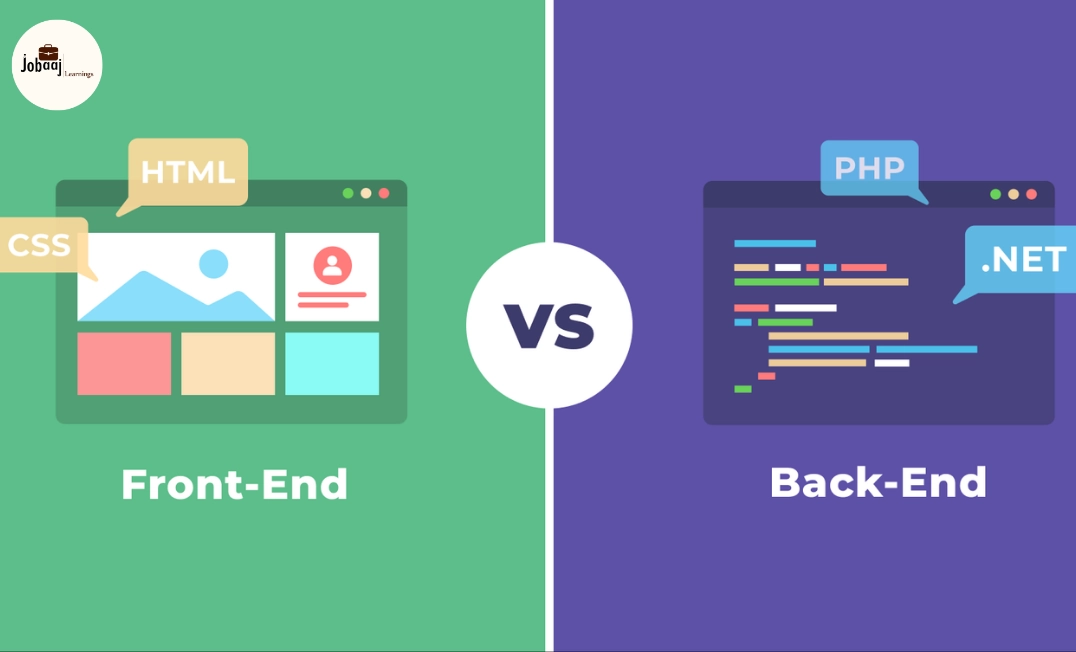
Front-end development is what users see. It is the design, layout, buttons, colors, animations, and everything that creates the first impression of a website or app.
Back-end development is what users never see. It is the system behind the screen the logic, databases, servers, APIs, and everything that makes the application actually work.
Both are equally important. Without front-end, users would see nothing. Without back-end, nothing would function.
Dreaming of a Web Development Career? Start with Web Development Certificate with Jobaaj Learnings.
So the real question is not which is better, but which one fits your mindset, interest, and long-term career goals.
What is Front-End Development?
Front-end development is all about building the visual and interactive part of websites and applications. It focuses on how users experience a product when they open it.
Whenever you open Instagram, scroll Netflix, or shop on Amazon, everything you visually interact with is created by a front-end developer.
A front-end developer’s job is to make sure the website is not only beautiful but also smooth, responsive, and easy to use across all devices.
How Front-End Development Actually Feels in Real Work
In real-world companies, front-end developers spend most of their time converting design files into working interfaces. They take UI designs and turn them into real websites using code.
A big part of their job is also fixing how things look on different screens, making sure buttons work correctly, and ensuring that the website feels fast and intuitive.
Sometimes even a small change in spacing or animation can improve user experience significantly, and that is where front-end developers play a major role.
Key Features of Front-End Development
Front-end development is centered around user experience and visual interaction.
Some important aspects include:
- building visually appealing interfaces
- making websites mobile and desktop responsive
- improving user experience through smooth interactions
- working closely with designers to match UI expectations
- ensuring performance and loading speed is optimized
At its core, front-end development is about making users feel comfortable while using a product.
Technologies Used in Front-End
Front-end developers use a combination of languages and frameworks to build modern interfaces.
The core technologies include HTML, CSS, and JavaScript. HTML structures the page, CSS handles design and styling, and JavaScript adds interactivity.
On top of this, modern frameworks like React, Angular, and Vue.js are widely used in companies because they make applications faster and more scalable.
Front-End Career Roles
Some common roles in this field include:
- Front-End Developer
- UI Developer
- React Developer
- UI/UX Engineer
These roles are heavily focused on product experience and visual development.
What is Back-End Development?
Back-end development is the backbone of every web application. It handles everything that happens behind the scenes — data processing, storage, authentication, and system logic.
When you log into a website, your username and password are verified by the back-end. When you place an order on an app, the back-end processes the payment and stores the data.
Without back-end systems, even the most beautiful website would not function.
How Back-End Development Works in Real Life
In real projects, back-end developers are responsible for building systems that handle large amounts of data securely and efficiently.
They create APIs that allow front-end applications to communicate with servers. They manage databases that store user information, and they ensure that everything runs smoothly even when thousands or millions of users access the system.
Back-end development often involves solving complex logic problems and designing scalable systems.
Key Features of Back-End Development
Back-end development focuses on functionality, performance, and data management.
Important aspects include:
- server-side logic and application flow
- database design and management
- API development and integration
- authentication and security systems
- handling large-scale data operations
At its core, back-end development is about making systems reliable, fast, and secure.
Technologies Used in Back-End
Back-end developers work with programming languages and frameworks like Java, Python, Node.js, PHP, and Go.
Databases like MySQL, PostgreSQL, and MongoDB are also essential parts of back-end systems.
APIs (especially REST and GraphQL) are used to connect front-end and back-end systems.
Back-End Career Roles
Some common job roles include:
- Back-End Developer
- API Developer
- Database Engineer
- Software Engineer (Backend)
These roles are more logic-heavy and system-oriented.
Front-End vs Back-End: Real Difference Explained
Instead of looking at definitions, it is better to understand how they differ in real work.
Front-end is like designing the interior of a house everything the user sees and interacts with.
Back-end is like building the foundation, plumbing, and electricity everything that keeps the system running.
|
Factor |
Front-End |
Back-End |
|
Work Focus |
User interface |
System logic |
|
Visibility |
Visible to users |
Hidden system |
|
Nature |
Creative + design |
Logical + structured |
|
Problem Type |
UI/UX issues |
Data and system issues |
|
Output |
What user sees |
What system does |
Both work together to build a complete product.
Salary Comparison
Salary in both fields is strong, especially as you gain experience.
Front-end developers usually start slightly lower but grow quickly if they master frameworks and UI/UX skills.
- Entry Level: $50,000 – $80,000
- Mid Level: $80,000 – $120,000
- Senior Level: $120,000 – $160,000+
Back-end developers often earn slightly higher due to system complexity.
- Entry Level: $60,000 – $90,000
- Mid Level: $90,000 – $140,000
- Senior Level: $140,000 – $200,000+
In real companies, full-stack and backend-heavy roles often get higher compensation due to system responsibility.
Career Growth and Future Scope
Both fields have extremely strong demand in 2026 and beyond.
Front-end is growing because companies care deeply about user experience. Even small improvements in UI can increase business conversions significantly.
Back-end is growing because modern applications require scalable systems, secure databases, and fast APIs to handle global traffic.
Most companies today require both skill sets working together, which is why full-stack developers are also in high demand.
Which Career Should You Choose?
Your decision should depend on your natural interest, not just salary.
Choose Front-End Development if:
- you enjoy creativity and design
- you like building visual experiences
- you want to see immediate results of your work
- you are interested in UI/UX
Choose Back-End Development if:
- you enjoy logic and problem-solving
- you like working with data and systems
- you prefer structured technical challenges
- you are interested in architecture and scalability
Both are excellent careers, but they suit different mindsets.
Conclusion
Front-end and back-end development are two sides of the same coin. One focuses on how things look, and the other focuses on how things work.
Instead of thinking which one is better, think about where you naturally fit.
If you like creativity and visuals, front-end will feel natural. If you enjoy logic, systems, and structure, back-end will suit you better.
And if you want both, full-stack development is always an option.
In the end, successful developers are not defined by the side they choose, but by how well they understand the complete system.
Ready to Take the Next Step in Your Career? Apply Now!
Frequently asked questions
Which is better Front-End or Back-End Development?
Both are equally important. Front-end is better for design-focused roles, while back-end is better for logic and system-based roles.
Which pays more Front-End or Back-End Developers?
Back-end developers often earn slightly higher salaries due to system complexity, but both roles offer strong pay.
Is Front-End Development easier than Back-End?
Yes, front-end is usually easier for beginners, while back-end requires stronger logic and programming skills.
Can I learn both Front-End and Back-End?
Yes, learning both leads to Full Stack Development, which has high demand in the industry.
Which career has better future scope?
Both have strong future scope, and demand will continue to grow with increasing digital platforms.

Join 5,00,000+ Subscribers
Be a part of our ever growing community.