Categories














/content/learnings/assets/header/ManagementConsulting.svg)
/content/learnings/assets/header/InvestmentBanking.svg)


























How to Become an AI Product Manager in India: Skills, Salary & 2026 Roadmap

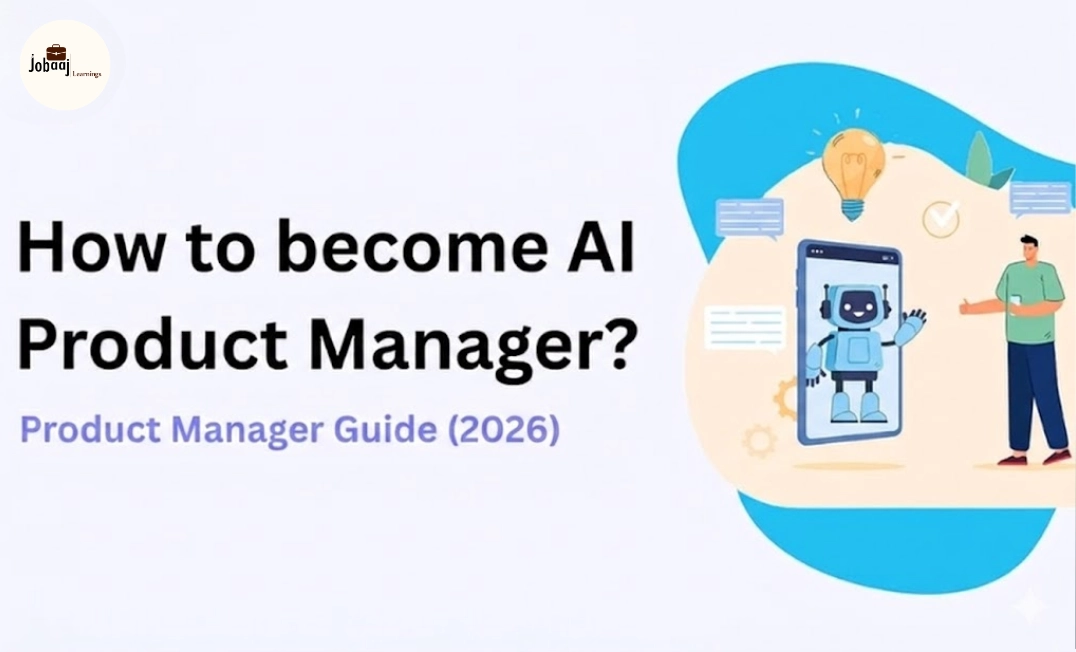
Imagine this: it's 2026, and you're leading the development of an AI product. You're making calls on which features ship, working through trade-offs with engineers and designers, and deciding what "good enough" looks like for a model that will never be perfect. Every decision you make shapes how thousands of people experience AI.
Exploring a career in Product Management? Apply Now!
The role of an AI Product Manager is more important than it has ever been. As artificial intelligence moves from a feature into the core of how products work, companies need people who can translate business goals into intelligent features and keep them useful, responsible and worth building.
If you're wondering how to become an AI product manager, this guide covers what the role actually involves, the skills that matter, a step-by-step path to get there, and how it differs from traditional product management.
What Does an AI Product Manager Do?
An AI Product Manager guides the development of AI-driven products, acting as the bridge between AI engineers, data scientists, designers and business stakeholders. The job is to make sure AI technology gets applied to problems worth solving, and that the resulting product actually works for the people using it.
Day to day, that breaks into three areas:
Strategy. Defining the vision and roadmap for the AI product, and making sure it aligns with both business goals and where the market is heading.
Lifecycle ownership. Taking the product from idea to launch and beyond, improving it continuously based on user feedback, model performance and new capabilities.
Cross-functional collaboration. Working with data scientists, engineers, designers, marketers and sales so the product ships smoothly and delivers real value.
In short, an AI PM sits between the technical and business sides of AI development and is accountable for the outcome on both.
How AI Product Management Differs from Traditional PM
The fundamentals carry over user research, prioritisation, roadmaps, stakeholder management. What changes is the nature of what you're building.
Outputs are probabilistic, not deterministic. A traditional feature either works or it doesn't. A model is right a certain percentage of the time, and part of your job is deciding what percentage is acceptable and what happens when it's wrong.
Data is a dependency, not an input. Model quality is bounded by data quality. Roadmaps that ignore data availability, labelling effort or pipeline readiness tend to slip badly.
Success metrics are harder to define. You're often measuring model performance and user outcomes at the same time, and they don't always move together.
Ethics is part of the spec. Bias, fairness, transparency and explainability aren't compliance checkboxes added at the end. They shape what you build and how you evaluate it.
This is why AI PM roles command a premium. An analysis of over 2,000 product management job postings found that roughly 61% now mention AI experience, and PMs who have shipped AI-powered products are consistently paid above their peers at the same level.
Key Skills Needed to Become an AI Product Manager
1. AI and Machine Learning Fundamentals
You don't need to be an AI expert or train models yourself. You do need enough grounding to know what AI can and cannot do, and to communicate that honestly to stakeholders.
Get familiar with neural networks, supervised and unsupervised learning, natural language processing and reinforcement learning. Understand how models are built, trained, evaluated and deployed. Most importantly, learn where they fail hallucination, drift, edge cases, brittleness under distribution shift.
Where to start: Coursera, edX and Udacity all offer AI and ML courses spanning beginner to advanced, covering both the theory and practical application.
2. AI Ethics and Responsible Design
Learn the ethical implications of AI bias, fairness, transparency, and the consequences of getting them wrong. An AI PM is often the person in the room who has to raise these questions before launch rather than after, and that judgement is increasingly what separates a senior AI PM from a junior one.
3. Product Management Expertise
AI product management is still product management. You need a solid command of the fundamentals: managing product lifecycles, building roadmaps that align with business goals and realistic timelines, defining requirements and managing releases. Familiarity with Jira, Trello or Asana helps you keep the work visible.
If you're new to PM: start with Agile methodology and user-centered design before layering AI on top. AI knowledge without product fundamentals is not a shortcut into this role.
4. Technical Fluency
You don't need to be a data scientist, but understanding the technical layer makes you far more effective:
- AI tools and frameworks — know what TensorFlow, PyTorch and Keras are and where each fits, so you can have realistic conversations about effort and resourcing.
- Data pipelines — understand how data gets processed and fed into models, including ETL processes and APIs.
- Working alongside engineers — spend real time with the people building the models. Understanding their workflow and constraints is worth more than any course.
5. Data-Driven Decision Making
In AI, data drives everything. You'll need to analyse product metrics, understand how models are trained and evaluated, and connect product changes to user impact. Get comfortable with analytics tools and, more importantly, with interpreting what the numbers actually mean.
6. Communication and Stakeholder Management
Explaining complex AI concepts to non-technical stakeholders is one of the highest-leverage skills in this role. You'll be conveying product vision, explaining why a model behaves unpredictably, and securing buy-in from internal teams and clients.
Practice: take something technical you understand well and explain it in three sentences to someone with no background in it.
7. Problem-Solving and Adaptability
AI products involve genuine uncertainty. Timelines slip because a model underperforms, requirements change as capabilities improve, and approaches that worked six months ago get superseded. Comfort with ambiguity is not optional here.
Steps to Becoming an AI Product Manager
Step 1: Gain Relevant Education
There's no single degree for AI product management. A background in computer science, engineering, business or data science helps, and a targeted certification in AI or product management can close gaps if your background is elsewhere.
Step 2: Build Product Management Experience
You need hands-on experience managing products before you can manage AI products. If you're already a PM, start working with teams building AI features. If you're not, look for roles that put you close to product development business analyst, product analyst, associate PM.
Step 3: Learn the AI Fundamentals
Even from a non-technical background, this is achievable. Take structured courses in AI, machine learning or data science and focus on understanding behaviour and limitations rather than implementation detail.
Step 4: Build Domain Expertise
AI applications differ enormously by industry, and depth in one domain is worth more than shallow familiarity with several:
- Healthcare — predictive diagnostics, drug discovery, clinical decision support
- Finance — fraud detection, algorithmic trading, credit risk
- Retail and e-commerce — recommendation engines, demand forecasting, personalisation
- Automotive — autonomous driving, driver assistance systems
Study AI products that worked and understand why. Siri, Google Assistant, Tesla's Autopilot and Spotify's recommendation system are all worth taking apart not just what they do, but what trade-offs their teams made.
Step 5: Get Cross-Functional Experience
AI PMs work with more diverse teams than most product roles. Seek opportunities in your current job to work across engineering, data and design, even if the product isn't AI-driven. The collaboration skill transfers.
Step 6: Build Practical Evidence
Case studies, side projects and product teardowns matter more than certificates when you're switching in. Take an AI product, write the PRD you would have written, define the success metrics, name the failure modes. That artefact is what gets you through an interview.
Step 7: Network in the AI Community
Building a network keeps you informed and opens doors:
- Meetups and forums — local AI meetups and online communities such as Reddit's Machine Learning or AI-focused LinkedIn groups
- Conferences — NeurIPS, ICML and AI Expo for cutting-edge developments and the people behind them
- Hackathons — hands-on experience plus direct exposure to how engineers and data scientists actually work
Staying Current in a Fast-Moving Field
AI moves faster than any field a PM has worked in before, and a roadmap built on last year's capabilities ages badly. Follow industry publications like TechCrunch and VentureBeat AI, read research summaries even if you skip the papers, and most usefully keep using the tools yourself. Hands-on familiarity with what current models can do is the fastest way to spot what's now feasible that wasn't six months ago.
AI Product Manager Salary in India
AI PM roles sit at the top end of the product management market. Glassdoor India puts the average AI Product Manager salary at around ₹30 lakh as of May 2026, with top earners reaching roughly ₹82 lakh. Most reported packages fall between ₹18 lakh and ₹45 lakh, and senior AI PM roles at product companies run well past ₹60 lakh.
A caveat worth stating: AI PM is a young enough title that sample sizes on salary aggregators are small Glassdoor's India figure rests on a couple of dozen reports. Treat these as directional.
The premium over generalist PM roles is real. Most 2026 estimates put it between 15% and 30% at the same experience level, and higher at senior levels, driven by a demand-supply gap that hasn't closed. For a fuller breakdown of product management pay by experience, company type and city, see our Product Manager salary guide for India.
Conclusion
Becoming an AI Product Manager is a rewarding path that blends innovation with practical problem-solving. It takes a combination of AI understanding, strong product fundamentals and genuine domain depth and the judgement to know when an AI solution is the right answer and when it isn't.
The role is not about having all the technical knowledge. It's about making informed decisions under uncertainty, collaborating across very different kinds of expertise, and shipping AI products that create real-world impact.
AI is a dynamic field with a long runway ahead. As an AI Product Manager, you'll be at the front of it.
Dreaming of a Product Management Career? Start with the Product Management Certificate with Jobaaj Learnings.
Frequently asked questions
What does an AI product manager do?
An AI Product Manager oversees the development of AI-powered products defining strategy, managing the product lifecycle, collaborating with technical teams and making sure the product solves a real problem responsibly.
Do I need a technical background to become an AI product manager?
No. A technical background helps, but many AI PMs come from product management or business backgrounds. What you need is a solid working understanding of how AI behaves, what it costs and where it breaks not the ability to build models yourself.
Can I transition into AI product management from a non-technical background?
Yes. Build knowledge in AI and machine learning fundamentals alongside product management methodology, then create hands-on evidence through projects, case studies and teardowns. That practical work is what makes the transition credible to a hiring manager.
Do I need to be a data scientist to become an AI PM?
No. You need enough understanding of AI, machine learning and data concepts to collaborate effectively with technical teams and make informed trade-offs.
What skills are most important for an AI product manager?
AI and ML fundamentals, product management expertise, data-driven decision-making, technical fluency with tools and data pipelines, communication with non-technical stakeholders, and an understanding of AI ethics.
How important is AI ethics for an AI product manager?
Very. AI PMs are responsible for making sure products are built responsibly — avoiding bias, ensuring fairness and transparency, and meeting ethical and regulatory expectations. In practice this shapes the product spec, not just the launch review.
How can I learn AI to become a product manager?
Online courses and certifications in AI, machine learning and data science, from beginner to advanced. Pair that with actually using AI tools regularly, since hands-on familiarity teaches you the limitations that courses tend to gloss over.
Which industries need AI product managers?
Technology, healthcare, finance, automotive, retail and e-commerce are all hiring, along with any industry embedding AI into its products and operations.
How much do AI Product Managers earn in India?
Glassdoor India puts the average at around ₹30 lakh as of May 2026, with most packages between ₹18 lakh and ₹45 lakh and top earners near ₹82 lakh. Senior AI PM roles at product companies exceed ₹60 lakh. AI specialisation typically commands a 15–30% premium over generalist PM roles at the same experience level.
What is the career growth for an AI product manager?
Strong. As AI capability spreads across industries, demand for PMs who can direct it keeps rising. With experience you can move into senior product roles or specialise further in AI strategy, platform work or product leadership.
Join 5,00,000+ Subscribers
Be a part of our ever growing community.