Categories














/content/learnings/assets/header/ManagementConsulting.svg)
/content/learnings/assets/header/InvestmentBanking.svg)


























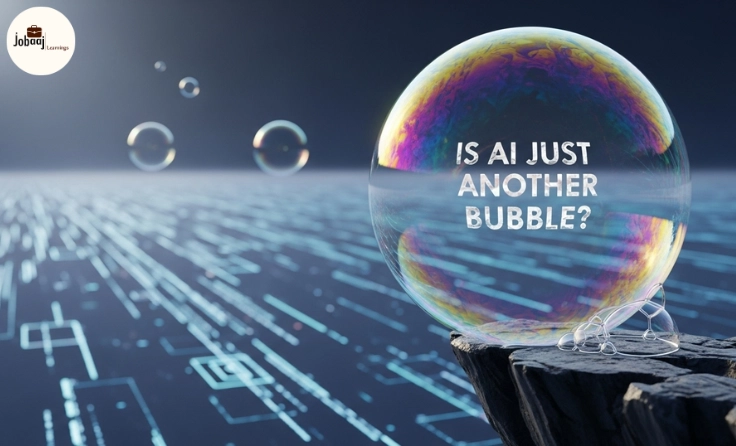
Picture this: it’s the early 2000s, and everyone’s talking about the dot-com bubble. Eager investors were pouring billions into startups, many of which had no viable business models. The frenzy ended with the collapse of many companies, but some giants — like Amazon and Google — emerged stronger than ever. Fast forward to today, and we're hearing a similar buzz around artificial intelligence (AI). But the question on everyone’s mind is, Is AI just another bubble waiting to burst, or is it truly a revolutionary technology?
Exploring a career in Performance Marketing? Apply Now!
AI is everywhere. From the algorithms powering your social media feed to self-driving cars and voice assistants, artificial intelligence seems to be the future. But with every new technological advancement, there are questions: is the hype justified? Or are we heading toward an AI bubble, much like the tech bubbles of the past? In this blog, we’ll explore the current state of AI, the excitement around it, and whether it’s just another passing trend or a lasting game-changer.
The Surge of AI: The Promise of a New Era
AI has come a long way from its early days. In the past few years, we’ve seen AI advancements in machine learning, natural language processing, robotics, and automation that were once thought to be years away. Today, AI is not just about futuristic dreams; it’s a driving force in multiple industries, from healthcare to finance, entertainment, and beyond.
What makes AI so powerful is its ability to learn from data and make decisions at speeds and accuracies far beyond human capabilities. Companies like Google, OpenAI, and DeepMind have made huge strides, bringing AI into mainstream use. Chatbots are now a norm for customer service, AI-powered medical diagnosis is improving accuracy, and automated trading systems are changing how we think about finance. It’s easy to see why many believe that AI is poised to disrupt almost every sector.
The Hype and Investment: Riding the AI Wave
The investment in AI startups is off the charts. According to recent reports, billions of dollars are pouring into the AI sector each year. Venture capitalists, big tech firms, and even governments are heavily investing in AI technology. The excitement surrounding AI often reminds people of the dot-com boom and the early days of cryptocurrency — both of which experienced massive inflows of capital, only to see inflated valuations and, eventually, crashes.
In the AI space, funding and hype are undeniable. Everywhere you look, AI is the focus of discussion. AI conferences, hackathons, and expos are being held across the globe, with every company claiming they have the next big AI breakthrough. The buzz is infectious, but with such rapid growth and investment, it’s worth asking: Is this the real deal, or are we simply riding another hype wave?
The Risks: Is AI Sustainable?
While the potential of AI is undoubtedly exciting, there are risks. One of the biggest concerns is the overhype. AI is still in its early stages, and despite all the progress, there are challenges to overcome. For instance, AI lacks general intelligence — it is highly specialized in certain tasks but struggles with tasks outside of its programming. Ethical issues also abound: What happens when AI makes biased decisions? How do we protect privacy when AI systems have access to vast amounts of personal data?
There’s also the question of job displacement. AI-driven automation is already replacing some jobs, particularly in industries like manufacturing, retail, and customer service. This raises questions about the future of work and whether AI will lead to widespread job loss or create new opportunities.
The Reality Check: AI’s Long-Term Impact
Is AI truly sustainable, or is it just a temporary trend? The answer is more nuanced than simply “yes” or “no.” AI is not a flash-in-the-pan technology; it’s an evolutionary step forward. However, like any groundbreaking technology, it’s likely that we will see some bumps along the way. The excitement around AI may lead to overvaluation in the short term, but the long-term benefits are too significant to ignore.
As AI continues to improve and adapt, we can expect regulation, ethics, and social implications to become major areas of focus. If AI is to reach its full potential, it must be developed and deployed responsibly. That means businesses and governments need to play an active role in shaping AI's future.
Conclusion: AI’s Future Is Still Unwritten
So, is AI just another bubble, or is it here to stay? The truth is, it’s too early to tell. AI is undeniably transformative, and its potential to improve lives, create efficiencies, and solve global problems is vast. But with rapid growth comes the risk of overhype and inflated expectations.
The key to AI’s success lies in balance. If businesses and governments manage AI responsibly, ensuring ethical standards, transparency, and regulation, AI could be one of the greatest technological advancements of the century. But if the hype overtakes the reality, we may see a crash similar to previous tech bubbles.
For now, AI is not just another bubble; it’s a tool shaping the future. But like any tool, it’s up to us how we use it.
Dreaming of a Performance Marketing Career? Start with Performance Marketing Certificate with Jobaaj Learnings.
Frequently asked questions
What is AI and how does it work?
AI, or artificial intelligence, is a branch of computer science that creates machines capable of performing tasks that would normally require human intelligence, such as problem-solving, learning, and decision-making. AI works by analyzing large amounts of data to identify patterns and make decisions based on that data.
Why is AI so hyped right now?
The hype around AI is due to its transformative potential. From automating tasks to improving healthcare outcomes and driving business efficiencies, AI has the ability to revolutionize industries, creating both excitement and uncertainty about its future impact.
Is AI really a bubble or here to stay?
While some of the excitement around AI may be inflated, its long-term potential is undeniable. The technology is evolving rapidly and is poised to disrupt industries like healthcare, transportation, and finance, making it likely to remain a key driver of change.
What are the biggest challenges in AI development?
Some of the biggest challenges include bias in AI systems, the lack of general intelligence, and ethical concerns. Additionally, there are concerns about job displacement due to automation and the need for regulatory frameworks to ensure AI is developed responsibly.
How is AI affecting jobs?
AI is automating tasks in industries like manufacturing, retail, and customer service, which could lead to job displacement. However, it also has the potential to create new types of jobs and industries as AI technology evolves.
Will AI lead to a technological collapse like previous bubbles?
While AI has some of the hallmarks of previous tech bubbles — including hype and heavy investment — its long-term impact on industries suggests it’s not just a passing trend. The real risk is in overvaluation and not addressing the ethical and social implications of AI.

Join 5,00,000+ Subscribers
Be a part of our ever growing community.