Categories






































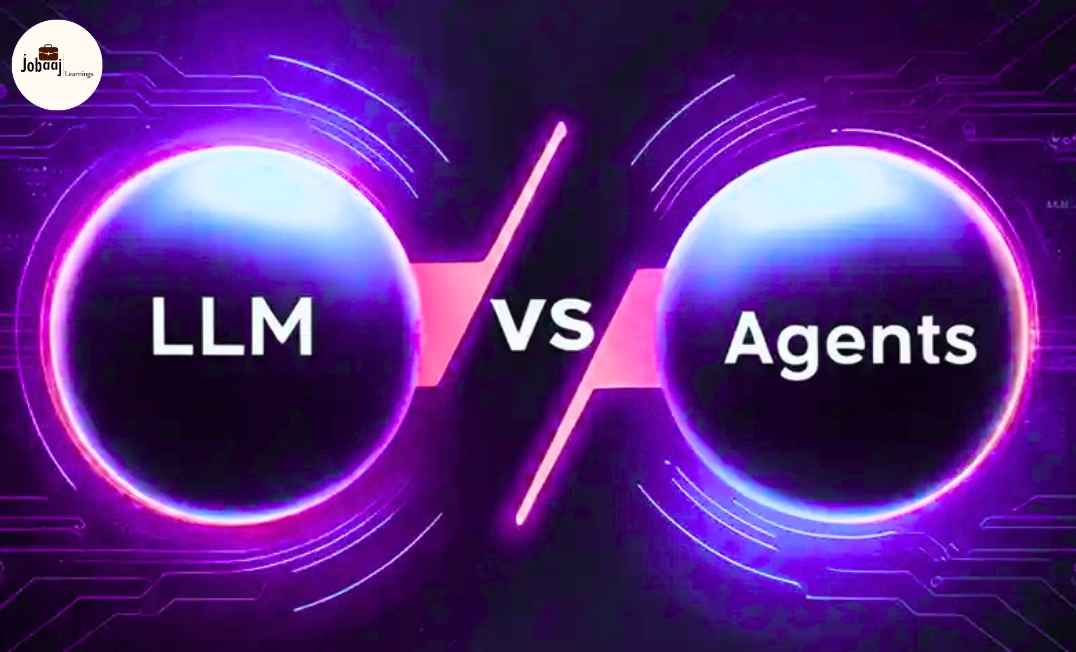
The rise of artificial intelligence is transforming product development. Two major innovations in 2026 are Large Language Models (LLMs) and AI agents. While both rely on AI, they serve different purposes and have unique implications for product teams. Understanding these differences is critical to building smarter, user-focused products.
Exploring a career in Product Management? Apply Now!
This guide explores definitions, distinctions, use cases, adoption frameworks, ethical considerations, and trends to help product managers leverage AI effectively.
What Are Large Language Models (LLMs)?
LLMs, like GPT-4, Claude, and LLaMA, are AI systems trained on massive datasets of text. They generate human-like content, summarize information, answer questions, and even draft code.
For product teams, LLMs are useful for:
- Generating content for apps, marketing, and documentation
- Assisting in research by summarizing reports or data
- Prototyping conversation flows for chatbots
- Suggesting code snippets or optimizations
LLMs are reactive: they respond to prompts but do not act autonomously unless integrated into broader systems.
What Are AI Agents?
AI agents extend LLMs by adding autonomy, decision-making, and multi-step execution. Agents can:
- Interact with multiple tools or APIs
- Make decisions based on defined goals or constraints
- Execute complex tasks without constant human input
Example: An AI agent can automatically gather competitor data, analyze it, and update dashboards, whereas an LLM alone would require prompts for each step.
In short, all AI agents use LLMs, but not all LLMs function as agents. Agents enable proactive, goal-driven AI behavior.
Key Differences Product Teams Should Know
|
Feature |
LLMs |
AI Agents |
|
Functionality |
Generate text, summarize, answer questions |
Execute tasks autonomously across tools and APIs |
|
Autonomy |
Low – relies on user prompts |
High – can plan and execute multi-step tasks |
|
Use Cases |
Chatbots, content generation, prototyping |
Automation workflows, research assistants, task management |
|
Integration Complexity |
Simple API integration |
Requires environment setup, connectors, and monitoring |
|
Decision-Making |
Limited, based on prompts |
Advanced, can prioritize and act on goals |
Understanding these distinctions allows teams to select the right AI tool for each workflow.
Practical Insights for Product Teams
- Use LLMs for prototyping: Quickly generate content, conversation flows, and research summaries.
- Use AI agents for automation: Delegate repetitive or multi-step tasks like data collection, reporting, or workflow orchestration.
- Combine both strategically: LLMs provide reasoning; AI agents execute actions autonomously.
- Prioritize user experience: Ensure LLMs produce accurate outputs and agents do not make unintended decisions.
- Monitor continuously: Track performance and iterate to align outputs with business goals.
Emerging Trends in 2026
- Tool-augmented agents: AI agents integrate with platforms like Slack, Notion, or Salesforce.
- Multimodal AI: Agents can now process text, images, and video.
- Self-improving agents: Agents learn from outcomes, optimizing actions over time.
Teams that leverage these trends will gain speed, efficiency, and innovation advantages.
Step-by-Step Framework for Adoption
Product teams can adopt LLMs and AI agents in a structured way:
- Identify the problem: Determine which tasks require AI reasoning vs. autonomous execution.
- Select the right tool: Use LLMs for content, prompts, and research; agents for automation and workflow execution.
- Prototype quickly: Use LLMs to create initial flows, scripts, or mock outputs.
- Integrate carefully: Deploy AI agents with proper connectors and access to tools.
- Monitor performance: Track accuracy, task completion, and user feedback.
- Iterate and scale: Refine LLM prompts and agent workflows as business needs evolve.
This framework ensures adoption is structured, safe, and value-driven.
Security, Compliance, and Ethical Considerations
Autonomous AI introduces risks that teams must address:
- Data security: Ensure agents access sensitive data securely and comply with regulations.
- Bias and fairness: LLM outputs can reflect training data biases; monitor and correct outputs.
- Accountability: Clear responsibility must be defined for agent-driven actions.
- Transparency: Users should know when they are interacting with AI.
- Ethical use: Prevent misuse of autonomous agents, especially in decision-making or recommendation systems.
Teams should implement monitoring, auditing, and human oversight to mitigate risks.
Real-World Examples
- Slack: Used LLMs to prototype internal messaging features, later deploying agents to automate workflow suggestions.
- Airbnb: Early MVP relied on simple LLM-based content generation, then gradually used agents to manage bookings and notifications.
These examples show that a hybrid approach LLMs for reasoning, agents for execution accelerates delivery while ensuring reliability.
Conclusion
For product teams, distinguishing LLMs vs. AI agents is strategic. LLMs provide flexible, reactive capabilities ideal for prototyping and content generation, while AI agents deliver autonomy and task execution, enabling smarter workflows.
By understanding capabilities, risks, adoption frameworks, and emerging trends, teams can:
- Build faster and smarter products
- Automate repetitive tasks efficiently
- Enhance user experience with intelligent solutions
- Scale safely while maintaining control and compliance
In 2026, mastering both LLMs and AI agents will define high-performing product teams. Using this knowledge strategically ensures products are not only intelligent but actionable, scalable, and aligned with user needs.
Dreaming of a Product Management Career? Start with Product Management Certificate with Jobaaj Learnings.
Frequently asked questions
What is the difference between LLMs and AI agents?
LLMs generate text and respond to prompts, while AI agents act autonomously, executing multi-step tasks and interacting with multiple tools. Agents rely on LLMs but extend their capabilities with decision-making and action.
How can product teams use LLMs effectively?
LLMs are ideal for content generation, prototyping, research summarization, and idea exploration. They speed up early product design and reduce manual work for testing and iteration.
When should teams use AI agents instead of LLMs?
Deploy AI agents for tasks requiring autonomy, multi-step execution, and workflow automation. Agents are best for repetitive, goal-driven operations across tools.
What ethical and security considerations are important for AI agents?
Monitor data access, ensure compliance, prevent biased outputs, define accountability, and maintain transparency. Human oversight is critical when AI agents make autonomous decisions.
How should teams adopt LLMs and AI agents strategically?
Use a step-by-step framework: identify tasks, select appropriate AI, prototype with LLMs, integrate agents carefully, monitor results, and iterate. This ensures safe, efficient, and value-driven adoption.

Join 5,00,000+ Subscribers
Be a part of our ever growing community.