Categories








































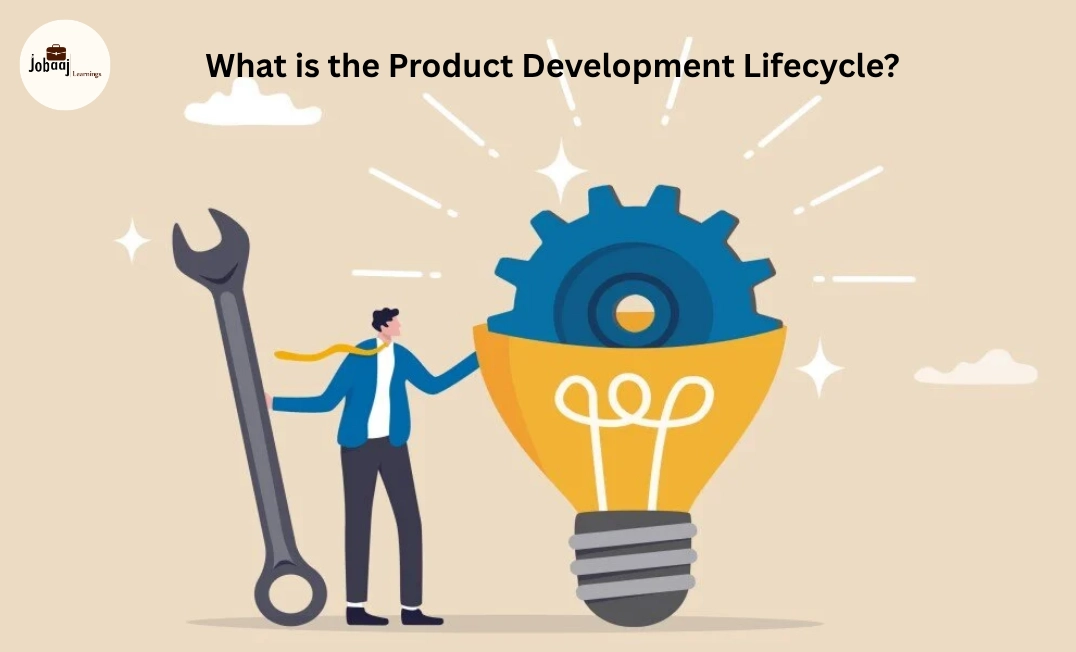
Every product you interact with today the smartphone in your pocket, the app you used to order coffee, or even your favorite ergonomic chair began as a fleeting thought. Someone, somewhere, identified a point of friction and decided to build a bridge over it.
But here is the reality: A great idea is not a product. Between that initial "Aha!" moment and a successful market launch lies a complex, disciplined journey known as the Product Development Lifecycle (PDLC). In an era where 90% of startups fail, the PDLC is the difference between a product that changes lives and one that disappears into the digital graveyard.
In this guide, we’ll pull back the curtain on how world-class products are built, refined, and launched.
Exploring a career in Product Management? Apply Now!
What Exactly is the Product Development Lifecycle?
At its core, the Product Development Lifecycle is a strategic framework that guides a product from its infancy (an idea) through its growth, maturity, and eventual evolution.
Think of it as a GPS for innovation. Instead of driving blindly toward a destination, companies use the PDLC to:
-
Validate Assumptions: Ensure people actually want what is being built.
-
Mitigate Risk: Identify technical or financial "sinkholes" before they happen.
-
Optimize Resources: Ensure the engineering and design teams are working on features that provide the most value.
Why a Structured Lifecycle is Non-Negotiable
In the "move fast and break things" era, it’s tempting to skip steps. But without a structured process:
-
Scope Creep sets in (adding too many features that delay the launch).
-
Technical Debt accumulates (writing messy code to hit deadlines).
-
Market Mismatch occurs (building a masterpiece that nobody actually needs).
A robust PDLC ensures that every hour of work is an investment in Product-Market Fit.
The 8 Critical Stages of Product Development
1. Idea Generation & Conceptualization
Innovation doesn't happen in a vacuum. It usually starts with Empathy. Whether it’s through analyzing customer support tickets or spotting a gap in the current market, this stage is about "Problem Discovery."
-
Pro Tip: Don’t fall in love with your solution; fall in love with the problem.
-
Goal: Create a "Problem Statement" that defines exactly who you are helping and why.
2. Rigorous Market Research & Validation
Once you have an idea, you must try to kill it. If it survives, it’s a winner.
-
Competitor Benchmarking: What are the incumbents missing?
-
The "Mom Test": Talking to potential users in a way that doesn't lead them to lie to you just to be nice.
-
Validation: Use surveys and data to confirm the market is large enough to sustain a business.
3. Product Planning & The Strategic Roadmap
This is where the "Product Manager" (PM) shines. You define the Product Requirements Document (PRD) and decide on the MVP (Minimum Viable Product).
-
The MVP Strategy: What is the smallest version of this product we can build that still solves the core problem?
-
Roadmapping: Setting milestones so the team knows what "Success" looks like in 3, 6, and 12 months.
4. Design, UX, and Prototyping
Before a developer writes a single line of code, the product must be visualized.
-
User Experience (UX): Mapping out the "User Journey." Is it easy to get from point A to point B?
-
High-Fidelity Prototypes: Tools like Figma or Adobe XD allow you to create clickable versions of the app to test with real humans. This saves thousands of dollars in potential coding re-work.
5. Development (The Engineering Phase)
This is the "Black Box" where designs become reality. Most modern teams use Agile Methodology, breaking the build into 2-week "Sprints."
-
Frontend: What the user sees and touches.
-
Backend: The logic, databases, and APIs that power the experience.
-
Technical Scalability: Ensuring the app doesn't crash if 10,000 people join at once.
6. Testing & Quality Assurance (QA)
A product is only as good as its worst bug. QA is the "safety net."
-
Alpha Testing: Internal testing by the employees.
-
Beta Testing: Releasing the product to a small group of "Power Users" to find edge-case bugs.
-
Performance Testing: Checking if the app remains fast under heavy load.
7. The Go-To-Market (GTM) Launch
The launch isn't just a "Publish" button; it’s an event.
-
Marketing & PR: Creating buzz on social media and tech news sites.
-
Onboarding: Ensuring new users understand how to use the product within the first 30 seconds.
-
Sales Enablement: Giving the sales team the tools they need to pitch the value.
8. Feedback, Analytics, and Iteration
The launch is actually just the beginning.
-
Data-Driven Decisions: Using tools like Google Analytics or Mixpanel to see where users get stuck.
-
The Pivot: Sometimes the feedback tells you that the "secondary" feature is actually the one people love most. Successful products iterate based on reality, not ego.
Real-World Case Study
-
Idea: People are tired of calling restaurants and reading credit card numbers over the phone.
-
Research: Data shows a 40% increase in mobile-first food searches.
-
Planning: Decide to focus on local pizza and sushi spots first (the MVP).
-
Design: Create a simple 3-step checkout flow.
-
Build: Develop a driver-side app and a customer-side app.
-
Test: Ensure GPS tracking works in real-time without draining the phone battery.
-
Launch: Release in one specific city (e.g., San Francisco) to test the logistics.
-
Iterate: Users want to track their delivery in real-time add live map tracking in Version 2.0.
Final Thoughts
The most important thing to remember is that the Product Development Lifecycle is cyclical. You launch, you learn, and you go back to the planning stage. In a world of shifting user expectations, the only way to stay relevant is to never stop developing.
Whether you are a developer, a designer, or a curious entrepreneur, mastering this flow is the key to building products that don't just exist but thrive.
Dreaming of a Product Management Career? Start with Product Management Certificate with Jobaaj Learnings.
Frequently asked questions
What is the product development lifecycle?
The product development lifecycle is the process of creating a product from idea generation to launch and continuous improvement.
What are the main stages of product development?
The main stages include idea generation, market research, planning, design, development, testing, launch, and feedback.
Why is market research important in product development?
Market research helps validate the idea, understand customer needs, and analyze competitors before building the product.
What happens after a product is launched?
After launch, companies collect user feedback, analyze performance, and continuously improve the product through updates.
Is product development a one-time process?
No, it is a continuous cycle where products are regularly updated and improved based on user feedback and market changes.

Join 5,00,000+ Subscribers
Be a part of our ever growing community.