Categories






































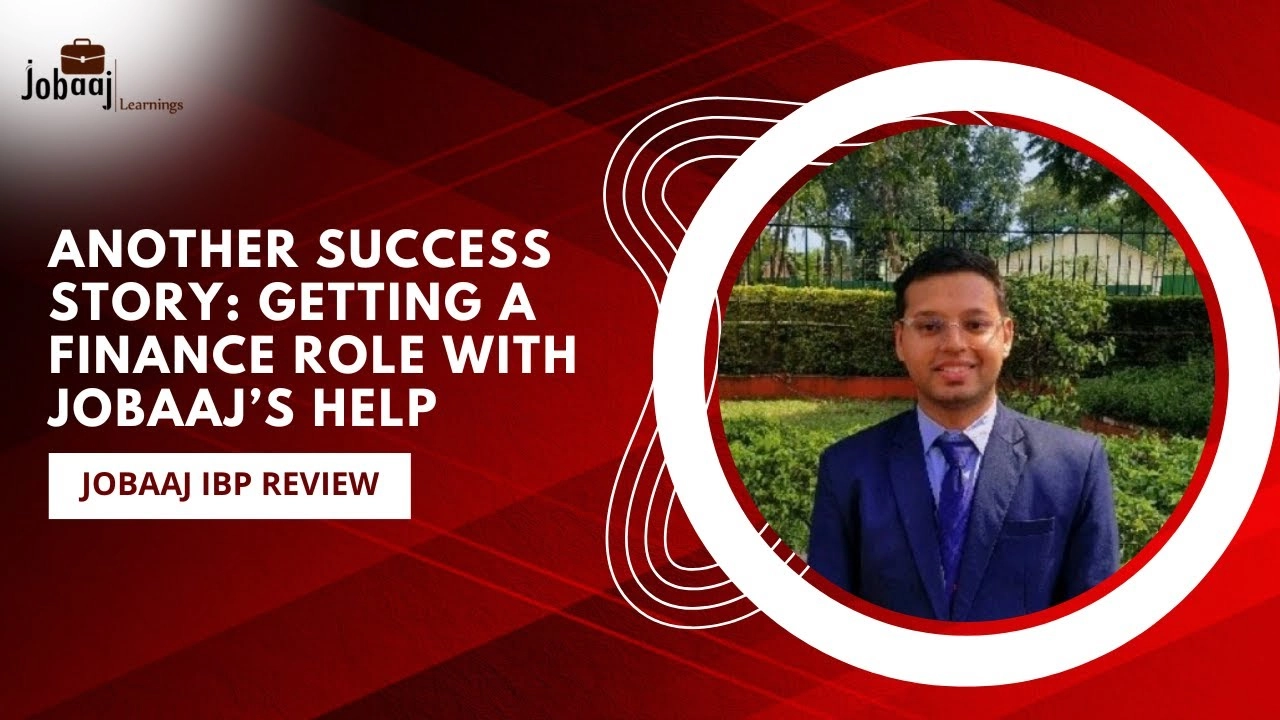
Oman Razi's Jobaaj Learnings Review: From MBA Graduate to Financial Analyst at Gallagher Mohan

"During my college placements, most of the roles were in sales, not core finance. I wasn't shortlisted for any core finance positions." — Oman Razi
Oman Razi is from Jharkhand. He holds a B.Com Honours from the University of Delhi and an MBA in finance from Symbiosis, Pune, with internships at the Steel Authority of India and ProCapitas. Despite that, his MBA placements offered him sales roles and no core finance shortlists at all. After Jobaaj Learnings' Investment Banking Program, he was hired as a Financial Analyst at Gallagher Mohan.
If you are searching “is Jobaaj Learnings genuine”, “is Jobaaj real or fake” or “how do I get a core finance role after an MBA”, Oman's account has the most detailed interview breakdown in this series: five stages, including a two-day take-home financial model and a 10-minute live Excel test on a shared Google Sheet. He is also honest that he had to redo his projects multiple times. Read it alongside the other conversations in our Interview Series and the wider feedback on the reviews page.
Key Takeaways: Oman's Jobaaj Learnings Review
- Profile: B.Com Honours (Delhi University), MBA in finance (Symbiosis, Pune), plus internships at the Steel Authority of India and ProCapitas.
- The blocker: MBA placements offered mostly sales roles — he was not shortlisted for a single core finance position.
- What his SAIL internship did and didn't cover: five years of financial statement analysis, liquidity and ratios — but no financial modelling and no market research.
- Four projects on the programme. He was hired after completing three.
- He redid them repeatedly. “I had to redo projects multiple times” — and says each redo is why he could answer valuation questions confidently.
- A five-stage interview: finance MCQ → HR → a two-day Excel modelling case study → technical round on DCF, IRR and NPV → a model discussion plus a live 10-minute Excel test.
- Speed: roughly 15 days from application to offer — about 10 without the holidays in between.
- Outcome: Financial Analyst at Gallagher Mohan, modelling real estate investments for clients. Salary not disclosed.
Who Is Oman Razi? A Strong CV That Produced Sales Offers
Oman's profile before the programme was not weak:
- B.Com Honours — University of Delhi
- MBA in finance — Symbiosis, Pune
- Financial analyst intern — Steel Authority of India Limited
- Investment banking intern — ProCapitas
And yet:
"During my college placements, most of the roles were in sales, not core finance. I wasn't shortlisted for any core finance positions, which led me to connect with Jobaaj."
Not rejected after interview — not shortlisted at all. That pattern repeats across this series: Nikit Shetty describes MBA finance placements pointing at mutual fund distribution and insurance sales; Uma Maheshwari turned down an “Analyst” role that was actually sales.
What His SAIL Internship Covered — and What It Missed
Oman is precise about the limits of his internship, which is what makes his case legible:
"My role as a financial analyst intern primarily involved analyzing the past five years of financial statements. I focused on liquidity and working capital analysis, calculating key ratios such as current ratios, quick ratios, and inventory turnover."
Asked directly whether it included financial modelling or market research, his answer was no: “it was more about financial statement analysis. My main task was submitting a report to the management with my recommendations for improving liquidity.”
So the gap was specific. He could read financial statements; he could not build models. That is exactly the gap core finance roles screen for.
The Projects — and Redoing Them Repeatedly
The programme set four projects. Oman describes them as:
- Financial models using DCF
- Comparable company analysis
- Equity research reports for the companies he modelled
The honest part is what building them actually involved:
"I had to redo projects multiple times, but each redo helped me understand the models better. When I was asked questions in interviews about cash flows or valuation, I could recall my past mistakes and answer confidently."
This is now the fourth candidate in this series describing repeated modelling corrections — alongside Vasu Bansal (who wanted to quit), Uma Maheshwari (who criticised the feedback cycles) and Durga Prasana (who got fed up). Oman frames it as the mechanism rather than the cost: the mistakes are what he could recall under interview questioning. Expect the same, and budget for it.
He was hired after completing three of the four projects — the call came while he was still working through the programme.
The Interview: Five Stages in About Ten Working Days
| Stage | What it involved |
|---|---|
| 1. MCQ test | Basic finance |
| 2. HR interview | Standard HR round |
| 3. Case study | Build a financial model in Excel — he completed it in two days |
| 4. Technical interview | DCF, IRR and NPV |
| 5. Final round | Discussion of the model he built, plus a live Excel test |
Total elapsed time: about 15 days including holidays — roughly 10 working days for five stages and a full modelling exercise.
The Live Excel Test
The final component is the one to prepare for:
"They shared a Google Sheet with me and asked me to solve problems in real-time using formulas like SUMIF and COUNTIF. It was a live test, and I had 10 minutes to complete it."
Ten minutes, watched, on a shared sheet. Knowing the functions is not the test — being fast with them is. Several candidates in this series report a dedicated Excel round; assume one.
The Role: Real Estate Investment Modelling
Oman's job at Gallagher Mohan:
"I will be working with real estate clients, analyzing their investments in properties. My role involves creating financial models to assess whether their property investments are profitable and worth pursuing."
Worth noting as a cross-reference: Adnan Khan, elsewhere in this series, describes a similar real estate financial analysis role — underwriting and modelling property deals — at a firm he names as G&M Financial. Real estate financial analysis appears more than once as a destination from this programme.
No salary figure is disclosed.
His Advice: Understand Why, Not Just How
Oman's advice to MBA graduates struggling to reach core finance is the most technically specific in this series:
"Ensure your basics are clear. For example, if you're asked about ratios, understand why you're using that formula. Understand the logic behind it. For instance, when calculating the inventory turnover ratio, we use COGS (Cost of Goods Sold) and average inventory to get an accurate figure because it reflects the cost of inventory, not just its value."
That example is the whole point. Plenty of candidates can state the inventory turnover formula. Being able to explain why COGS rather than revenue — because inventory is carried at cost, so the numerator has to match — is what separates memorisation from understanding, and it is what a technical round is probing.
Pros and Cons, Based on Oman's Account
What worked:
- The investment banking overview course, which he says gave him a strong foundation
- A detailed Excel course — directly relevant to a live, timed Excel test
- Financial modelling training producing DCF and comparable company models
- Equity research report writing, which his internships had not covered
- An opportunity surfaced while he was still mid-programme
- Guidance through a five-stage process that closed in about ten working days
What his account shows honestly:
- He redid projects multiple times before they were right.
- He was hired before completing the programme — three of four projects done.
- An MBA plus two internships produced zero core finance shortlists on their own.
- No salary is disclosed and no rating was asked for or given.
- He raises no criticism of the programme, so there is none to report and we have not invented one.
Finance Interview Questions and Model Answers
Why does inventory turnover use COGS rather than revenue?
Model answer: Because inventory sits on the balance sheet at cost, not at selling price. Dividing revenue by average inventory mixes two different bases and inflates the ratio. COGS over average inventory compares like with like — how many times the cost of stock was cycled through in the period. This is exactly the kind of “why” question a technical round uses to separate understanding from recall.
Walk us through a DCF.
Model answer: Project free cash flows over a forecast horizon from explicit revenue, margin and capex assumptions. Calculate a terminal value using perpetuity growth or an exit multiple. Discount both back at WACC and sum for enterprise value. Then say which assumption the valuation is most sensitive to — that is usually the real question behind the question.
What's the difference between IRR and NPV?
Model answer: NPV gives the value created in currency terms at a given discount rate; IRR gives the discount rate at which NPV would be zero, so it reads as an implied return. NPV is the more reliable decision rule because IRR misbehaves when cash flows change sign more than once, and it does not account for project scale.
How do you assess a company's liquidity?
Model answer: Current ratio and quick ratio for the headline position, then working capital movement over time, which tells you the direction rather than the snapshot. The more useful check is operating cash flow — a company can pass a current ratio test on receivables it is not actually collecting.
How would you evaluate whether a property investment is worth pursuing?
Model answer: Build the model from acquisition cost, financing structure, projected rental or resale income, and holding costs. Calculate NPV, IRR and payback, then sensitivity-test the variables that actually move — interest rates, occupancy and exit yield. A property deal usually fails on the financing assumptions rather than on the asset.
How do you write an equity research report?
Model answer: Start from the investment thesis — what you believe and why the market has it wrong — then support it with the business model, industry context, financial analysis and valuation. Risks are not a disclaimer section; they are the part that shows you have tested your own conclusion.
Oman's Advice for MBA Graduates
- Get the basics genuinely clear — and understand the logic behind each formula, not just the formula.
- Expect a live Excel test. Ten minutes on a shared sheet with someone watching is a different skill from knowing the functions.
- Treat project redos as the learning. His mistakes are what he could recall under interview questioning.
- Don't wait to finish the programme. He was interviewing after three of four projects.
- Statement analysis isn't modelling. His SAIL internship taught the first and not the second — know which one your CV actually evidences.
Full Podcast Transcript
The complete conversation, unedited.
Podcaster: Good afternoon everyone. We are back with another successful podcast in our Investment Banking Program. We have with us Mr. Oman Razi. Mr. Razi, how are you?
Oman: I'm good, sir. How are you?
Podcaster: I'm fine as well. So, Oman, please tell the audience about yourself.
Oman: Sure. I am from Jharkhand. I did my BCOM honors from the University of Delhi and this year I completed my MBA in finance from Symbiosis Pune. During my MBA, I interned at Steel Authority of India Limited as a financial analyst intern and recently completed an investment banking internship at ProCapitas. This is a bit about my background.
Podcaster: What was that role like? What did you do as a financial analyst there?
Oman: So, my role as a financial analyst intern primarily involved analyzing the past five years of financial statements. I focused on liquidity and working capital analysis, calculating key ratios such as current ratios, quick ratios, and inventory turnover. I provided recommendations for improvement based on my analysis of these ratios.
Podcaster: But there was no financial modeling or stock price prediction, right? No market research?
Oman: Correct, it was more about financial statement analysis. My main task was submitting a report to the management with my recommendations for improving liquidity.
Podcaster: You did your MBA, got an internship at Steel Authority, but then you chose to come to us at Jobaaj. Why was that?
Oman: During my college placements, most of the roles were in sales, not core finance. I wasn't shortlisted for any core finance positions, which led me to connect with Jobaaj. I enrolled in their investment banking and financial modeling courses, which really helped me land a core finance role.
Podcaster: You joined us and completed all the learning, gave your exams, and worked on the projects. What were the projects like?
Oman: There were four projects in total. I worked on building financial models using DCF (Discounted Cash Flow) and comparable company analysis. I also prepared equity research reports for the companies I built models for. Along the way, I learned a lot about how to write equity research reports, and these projects helped me understand the models in depth.
Podcaster: But you didn't even complete all four projects before landing your job. You only finished three. How did that happen?
Oman: Yes, I completed three projects before I got the job offer. I had completed my third project when I got a call from Vishakha ma'am about an opening for a financial analyst at Gallagher Mohan. I applied and went through the interview process even before completing all the projects.
Podcaster: And during the interview, I'm sure you had to showcase your financial modeling skills, and the concepts you learned during your projects came in handy, right?
Oman: Definitely, sir. I had to redo projects multiple times, but each redo helped me understand the models better. When I was asked questions in interviews about cash flows or valuation, I could recall my past mistakes and answer confidently.
Podcaster: So, tell us about the placement process. How did it go for you?
Oman: After completing my third project, I received a call from Vishakha ma'am regarding the financial analyst role. The process included an MCQ test on basic finance, followed by an HR interview. I then had to solve a financial model in Excel as part of a case study, which I completed in two days. The next round was a technical interview covering finance topics like DCF, IRR, and NPV. The final round involved discussing the financial model I created, followed by an Excel test where I had to use formulas like SUMIF and COUNTIF to solve questions.
Podcaster: That sounds intense. How long did this entire process take from application to offer?
Oman: It took about 15 days, including some holidays. Without the holidays, it would have taken around 10 days.
Podcaster: So, now that you've secured your role as a financial analyst, what does your job entail?
Oman: I will be working with real estate clients, analyzing their investments in properties. My role involves creating financial models to assess whether their property investments are profitable and worth pursuing.
Podcaster: What advice would you give to other students who are struggling to land core finance roles after their MBA?
Oman: My advice would be to ensure your basics are clear. For example, if you're asked about ratios, understand why you're using that formula. Understand the logic behind it. For instance, when calculating the inventory turnover ratio, we use COGS (Cost of Goods Sold) and average inventory to get an accurate figure because it reflects the cost of inventory, not just its value.
Podcaster: You also mentioned that during the interview, you had to solve Excel problems live. Can you tell us more about that?
Oman: Yes, they shared a Google Sheet with me and asked me to solve problems in real-time using formulas like SUMIF and COUNTIF. It was a live test, and I had 10 minutes to complete it.
Podcaster: Now that the journey's over, tell us about your overall experience with Jobaaj and the placement process.
Oman: It was a fantastic experience. The investment banking overview course gave me a strong foundation in finance. The Excel course was detailed, and the financial modeling course helped me build real-world models. The guidance from you and Vishakha ma'am throughout the process was invaluable. Thanks to the training at Jobaaj, I landed my dream job as a financial analyst.
Frequently Asked Questions
Is Jobaaj Learnings genuine, or is it fake?
This page documents one recorded case: Oman Razi, an MBA in finance from Symbiosis with two internships and no core finance shortlists, hired as a Financial Analyst at Gallagher Mohan after a five-stage interview. Employer, role and interview structure are named on camera, and he admits to redoing his projects multiple times. No salary is disclosed. See the wider review set on the reviews page.
Why don't MBA placements lead to core finance roles?
Oman's experience: the roles on offer were mostly sales, and he was not shortlisted for a single core finance position — despite an MBA in finance and two relevant internships. Several other candidates in this series describe the same pattern.
What was the interview process?
Five stages: a finance MCQ test, an HR interview, a two-day Excel financial modelling case study, a technical round on DCF, IRR and NPV, and a final round discussing his model plus a live 10-minute Excel test on a shared Google Sheet.
How long did it take from application to offer?
About 15 days including holidays — roughly 10 working days for all five stages.
Do you need to finish the whole programme before applying?
Not in his case. Oman was hired after completing three of the four projects, and went through the entire interview process before finishing the programme.
What should you prepare for a financial analyst interview?
DCF, IRR and NPV, financial ratios with the reasoning behind each formula, building a model in Excel to a deadline, and genuine speed with SUMIF, COUNTIF and similar functions under live conditions.
Join 5,00,000+ Subscribers
Be a part of our ever growing community.
Related reads
Ankit's Jobaaj Learnings Review: From Inventory to Remote Financial Controller at Blue Polaris
Vedant Jobaaj Learnings Review: From CFA Level 1 to Associate Analyst at CareEdge Advisory