Categories














/content/learnings/assets/header/ManagementConsulting.svg)
/content/learnings/assets/header/InvestmentBanking.svg)



























/content/learnings/assets/header/programs/1.png)
/content/learnings/assets/header/programs/4.png)

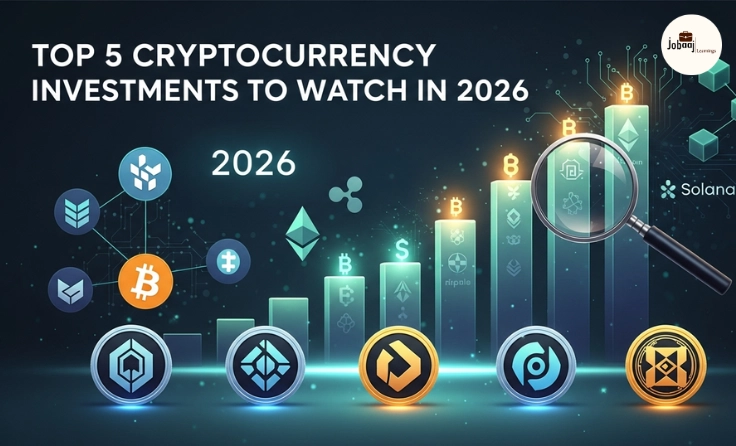
Cryptocurrency has come a long way since its inception, and it’s no longer just a buzzword in the world of finance. Over the past few years, digital currencies have made their mark, with many early investors seeing substantial returns. As we step into 2026, the cryptocurrency market continues to evolve, with new innovations, more widespread adoption, and exciting opportunities for investors.
Exploring a career in Investment Banking? Apply now!
But with over 20,000 cryptocurrencies in existence, how do you choose the ones worth keeping an eye on in 2026? Whether you're an experienced investor or someone just starting, picking the right cryptocurrencies can feel overwhelming. Don’t worry; we’ve got you covered. In this blog, we’ll discuss the top 5 cryptocurrency investments to watch in 2026, helping you make informed decisions as you navigate the world of digital assets.
1. Bitcoin (BTC)
It’s no surprise that Bitcoin remains one of the top investments in 2026. As the first cryptocurrency ever created, Bitcoin has established itself as the digital gold of the crypto market. Even though its price has experienced volatility in the past, Bitcoin continues to be widely recognized as a safe-haven asset in the world of cryptocurrencies.
Why Bitcoin?
-
Bitcoin remains the largest cryptocurrency by market capitalization and is often considered the benchmark for other digital currencies.
-
More institutional investors, including major corporations and financial institutions, are buying and holding Bitcoin, cementing its position as a store of value.
-
Bitcoin is often viewed as a hedge against inflation, similar to gold. As governments print more fiat currency, Bitcoin’s fixed supply (21 million coins) offers a sense of scarcity, making it attractive to long-term investors.
How to Get Started:
You can purchase Bitcoin on most cryptocurrency exchanges like Coinbase, Binance, and Kraken. If you’re just starting, it’s advisable to buy Bitcoin in small amounts through Dollar-Cost Averaging (DCA) to mitigate risk.
2. Ethereum (ETH)
While Bitcoin is often viewed as a store of value, Ethereum stands out as the backbone for decentralized applications (dApps) and smart contracts. Ethereum introduced the world to smart contracts, allowing developers to create decentralized applications that run on the blockchain.
Why Ethereum?
-
Ethereum enables smart contracts, which are self-executing contracts with the terms of the agreement directly written into lines of code. These contracts are decentralized, trustless, and secure.
-
Ethereum’s transition to Ethereum 2.0, which focuses on improving scalability, security, and energy efficiency through Proof-of-Stake (PoS), is expected to enhance its long-term potential.
-
Ethereum is the leading platform for decentralized finance (DeFi) projects and non-fungible tokens (NFTs), two of the hottest sectors in crypto right now.
How to Get Started:
Ethereum can be purchased on most cryptocurrency exchanges. You can also participate in staking Ethereum once the Ethereum 2.0 upgrade is fully implemented to earn rewards.
3. Solana (SOL)
Solana has emerged as a top contender in the cryptocurrency space, known for its speed, scalability, and low transaction fees. With the growth of decentralized applications (dApps) and decentralized finance (DeFi), Solana has positioned itself as a serious alternative to Ethereum.
Why Solana?
-
Solana can process 65,000 transactions per second (TPS), which is significantly faster than Ethereum and Bitcoin. This makes it a highly attractive platform for developers building high-speed dApps.
-
Solana’s low fees make it ideal for small transactions and microtransactions, which are often a bottleneck for other blockchains.
-
Solana is seeing a surge in developer activity, with new dApps and projects launching regularly on the platform, including in the NFT and DeFi spaces.
How to Get Started:
Solana can be purchased on major exchanges like Binance and Coinbase. For long-term holding, consider storing your SOL tokens in a secure wallet like Phantom or Sollet.
4. Cardano (ADA)
Cardano has been gaining attention as a highly scalable, energy-efficient blockchain. Unlike many other blockchains that use Proof of Work (PoW), Cardano operates on the more sustainable Proof of Stake (PoS) consensus mechanism, which is appealing to investors looking for green, eco-friendly options in the crypto space.
Why Cardano?
-
Cardano focuses on creating a blockchain that’s both scalable and energy-efficient, addressing concerns around the high energy consumption of traditional PoW blockchains like Bitcoin.
-
Cardano uses peer-reviewed research to develop its technology, making it a highly respected project in the blockchain space.
-
With the Alonzo upgrade, Cardano now supports smart contracts, opening the door for developers to build decentralized applications on its platform.
How to Get Started:
You can purchase ADA on major exchanges like Coinbase, Binance, and Kraken. Cardano offers a unique staking model that allows holders to earn passive rewards by participating in the network’s proof-of-stake consensus.
5. Polkadot (DOT)
Polkadot is a blockchain interoperability project that aims to connect multiple blockchains into a unified network. Created by Gavin Wood, one of Ethereum’s co-founders, Polkadot is focused on enabling different blockchains to communicate and share data with one another.
Why Polkadot?
-
Polkadot’s unique design allows it to connect different blockchains, enabling a more integrated and seamless crypto ecosystem. This can greatly enhance the functionality and utility of blockchain-based applications.
-
Polkadot’s parachain technology allows for parallel processing, which enhances scalability by allowing multiple blockchains to run simultaneously.
-
Polkadot has a growing community of developers and supporters, and it’s one of the most innovative projects in the crypto space.
How to Get Started:
Polkadot (DOT) can be purchased on most major cryptocurrency exchanges like Binance and Kraken. If you plan on holding Polkadot long-term, make sure to store it in a secure wallet like Polkadot.js or Ledger.
Conclusion
As we head into 2026, the cryptocurrency landscape is filled with opportunities. Whether you’re looking to invest in the leading cryptocurrencies like Bitcoin and Ethereum, or you’re intrigued by emerging players like Solana, Cardano, or Polkadot, there are plenty of options to diversify your portfolio and potentially reap the rewards of the evolving crypto market.
Before diving into any investment, always remember to do your research, understand the risks involved, and invest responsibly. The crypto market is still volatile and subject to regulatory changes, so make sure you’re prepared for the ups and downs.
By choosing the right cryptocurrencies and adopting a long-term mindset, you can position yourself to succeed in the 2026 crypto market.
Dreaming of a Finance career? Start with Investment Banking Certification with Jobaaj Learnings.
Frequently asked questions
What are the top cryptocurrencies to invest in for 2026?
The top cryptocurrencies to watch in 2026 include **Bitcoin**, **Ethereum**, **Solana**, **Cardano**, and **Polkadot**. Each offers unique advantages in the growing blockchain space.
Why should I invest in Ethereum in 2026?
Ethereum continues to be the leading platform for **smart contracts** and **decentralized applications (dApps)**. With the upcoming **Ethereum 2.0** upgrade, it is set to become more scalable, energy-efficient, and faster.
How does Solana differ from Ethereum?
Solana is known for its high-speed blockchain and low transaction fees, making it an attractive alternative to Ethereum, especially for applications requiring fast, low-cost transactions.
Is Polkadot a good investment in 2026?
Polkadot is a unique project that focuses on blockchain **interoperability**. Its ability to connect different blockchains and allow them to communicate makes it an exciting option for future growth.
What is the potential of Cardano in 2026?
Cardano is an energy-efficient blockchain using **Proof-of-Stake**. With its scientific approach and the recent launch of **smart contracts**, it is becoming a leading contender for **DeFi** and **NFT** projects.
Should I invest in cryptocurrency long-term?
Cryptocurrency can be a great long-term investment, but it’s important to understand the risks. The market is volatile, and regulatory changes can impact the prices. It’s wise to do thorough research before investing.

Join 5,00,000+ Subscribers
Be a part of our ever growing community.