

 Categories









































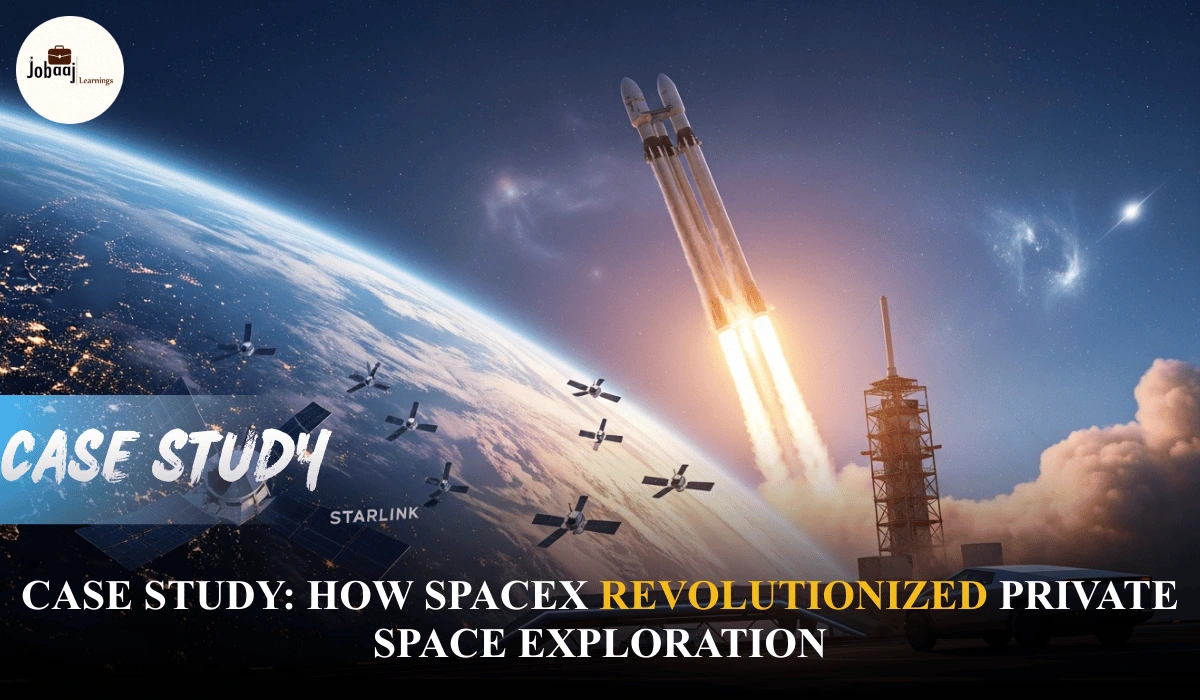
Space exploration has long been dominated by government agencies such as NASA, Roscosmos, ESA, and others. For decades, space missions were synonymous with large public budgets, bureaucratic planning, and extended timelines. However, the rise of private companies in the aerospace industry has shifted this long-held paradigm. Among these private players, SpaceX stands out as a pioneer that has dramatically transformed how humanity approaches space travel.
Founded in 2002 by Elon Musk with the ambitious mission of making life multiplanetary, SpaceX has achieved what many considered impossible. From developing reusable rockets to launching crewed missions to the International Space Station (ISS), SpaceX’s milestones have redefined the boundaries of innovation and entrepreneurship in space exploration.
This case study explores how SpaceX has revolutionized private space exploration, addressing its challenges, unique strategies, key findings, results, and impact on the future of space travel.
Problem Statement
Before SpaceX entered the space sector, the major challenges in space exploration were:
1. High Cost:
Traditional space missions were extremely expensive. Rockets and spacecraft were often single-use and tossed away after launch, requiring huge budgets and government funding.
2. Slow Development:
Conventional aerospace timelines were long. Developing new rockets or spacecraft could take a decade or more.
3. Limited Innovation:
Because space missions were predominantly government-led, innovation was constrained by regulations, bureaucracy, and risk aversion.
4. Accessibility Constraints:
Private companies and smaller nations had minimal opportunities to participate in space missions due to high entry barriers.
SpaceX entered this landscape with ambitious goals, but it also had to confront these entrenched problems head-on. Their mission was not only to enter the aerospace sector but to disrupt it completely by creating a more cost-effective, innovative, and rapid space program.
SpaceX’s Strategic Approach
SpaceX’s strategy can be broken down into several core innovations and business decisions that set it apart in the aerospace industry.
1. Reusable Rockets
One of the most groundbreaking innovations from SpaceX has been the development of reusable launch vehicles. Unlike traditional rockets that were discarded after use, SpaceX designed the Falcon 9 rocket to return safely to Earth after launch and land back on a landing pad or drone ship.
This revolutionized cost-saving in space missions, because rockets could be refurbished and re-launched, reducing the cost of sending payloads into space.
2. Vertical Integration and In-House Manufacturing
SpaceX manufactures the majority of its parts and components internally, rather than outsourcing. This tight control over the supply chain helps reduce costs, improve quality, and accelerate development timelines.
3. Iterative Testing and Rapid Development Cycles
Instead of following traditional aerospace development timelines, SpaceX embraces rapid iteration. Prototypes are built, tested, failed, improved, and tested again in quick succession. This engineering mindset mirrors software development more than traditional aerospace development.
4. Commercial and Government Partnerships
SpaceX didn’t limit itself to government contracts. While it secured major collaborations with NASA, including cargo and crew missions to the International Space Station, SpaceX also sought commercial satellite launch contracts, making space accessible for private companies and research institutions.
5. Ambitious Vision and Public Engagement
From day one, SpaceX communicated a bold vision: to make life multiplanetary and ultimately send humans to Mars. This ambitious narrative captured imaginations around the world and attracted top-tier talent, investors, and media attention.
Key Findings
After years of innovation, testing, and iteration, several key findings have emerged from SpaceX’s journey:
1.Cost Efficiency Through Reusability
SpaceX proved that reusable rockets are not just a theoretical concept but a practical solution. By flying Falcon 9 boosters repeatedly, SpaceX cut launch costs by a significant margin compared to traditional space agencies.
2.Increased Launch Frequency
Where most agencies averaged a handful of missions per year, SpaceX significantly increased launch cadence. With hundreds of launches delivered over recent years, SpaceX has made rapid deployment a reality.
3.Bridging Public and Private Space Missions
SpaceX has successfully blended government contracts with commercial launches. NASA’s Crew Dragon missions marked the first time a private company ferried astronauts to the ISS, showcasing a new era of public-private cooperation.
4.Building a Global Constellation
With projects like Starlink, SpaceX is deploying thousands of satellites to create a global broadband network. This not only serves commercial interests but also helps finance SpaceX’s broader space exploration goals.
Results and Impact
The results of SpaceX’s innovations are profound and far-reaching:
1.Lowered Barrier to Entry
Reduced launch costs have enabled universities, research institutions, and private companies to participate in space missions that were previously cost-prohibitive.
2.Commercialization of Space
SpaceX helped usher in a new age where space is no longer the monopoly of governments. Private companies can now launch satellites, conduct research missions, or potentially pave the way for space tourism.
3.New Space Policy Frameworks
Governments worldwide are updating regulations to accommodate private space firms. SpaceX’s successes encouraged regulatory reforms that make space collaboration more feasible.
4.Demonstrated Human Spaceflight Capabilities
SpaceX’s Crew Dragon capsule safely transported NASA astronauts to and from the International Space Station—a first for any private entity. This represents a historic milestone in human spaceflight.
Challenges Faced
Despite its successes, SpaceX also navigated major challenges:
-
Technical Risks: Rocket testing and development face inherent dangers, including launch failures and prototype crashes.
-
Financial Pressures: Developing new technologies and maintaining high launch frequencies required continuous funding and strategic financial planning.
-
Regulatory Hurdles: Navigating complex aerospace regulations required significant collaboration with global space agencies.
-
Public Scrutiny: As a high-profile company, SpaceX’s successes and setbacks are broadcast worldwide, increasing both attention and pressure.
Conclusion
SpaceX’s journey from a startup aerospace company to a global leader in space innovation stands as one of the most remarkable stories of modern engineering and entrepreneurship. By challenging conventional methods, embracing failure as a step toward success, and daring to dream big, SpaceX has reshaped the future of space exploration.
Today, SpaceX continues to push boundaries:
-
Starship development aimed at interplanetary travel
-
Larger-scale deployment of the Starlink constellation
-
Expansion of crewed missions beyond Earth orbit
SpaceX’s innovations are not just technological achievements—they are transformative forces redefining what is possible for humankind.
Could you solve it?
Think you can last in the competitive world of Product Management?? No?
Don't worry. Click on the link to join hundreds of other people who aspire to be Product Managers. With professional instructors working in the industry, you will be able to learn how the competitive world of Product Management works and increase your chances of getting recruited as one!
Join our latest cohort NOW!!
[Disclaimer: This case study is entirely hypothetical and unrelated to real-world situations. It's designed for educational purposes to illustrate theoretical concepts and potential scenarios within a given context. Any similarities to actual events or individuals are purely coincidental.]





