

 Categories














/content/learnings/assets/header/ManagementConsulting.svg)
/content/learnings/assets/header/InvestmentBanking.svg)


























/content/learnings/assets/header/programs/1.png)
/content/learnings/assets/header/programs/4.png)

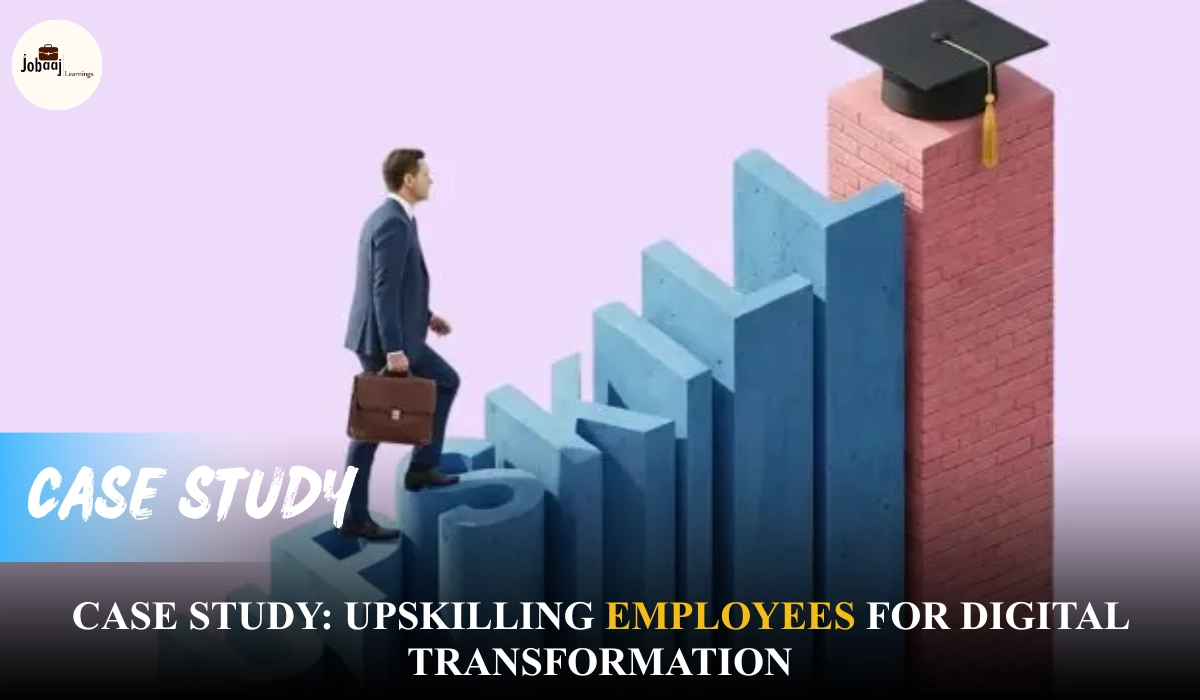
Digital transformation is often associated with technology.
Companies invest in artificial intelligence, cloud computing, automation, analytics platforms, and advanced software systems expecting these technologies to improve efficiency and create competitive advantages.
However, technology alone does not transform organisations.
The biggest factor behind successful transformation is people.
When companies introduce new technologies, employees must understand how to use them, adapt to new workflows, and develop new ways of working.
This creates one of the biggest challenges for modern businesses:
How do you prepare an existing workforce for a rapidly changing digital environment?
Many organisations face a common problem. Their employees have years of industry experience but may lack the digital skills required for future roles.
This creates a gap between:
Current employee capabilities and future business requirements.
This case study explores how a company can approach employee upskilling as a strategic initiative, covering the problem, objectives, approach, implementation strategy, findings, results, and key business lessons.
Background
A large organisation operating across multiple departments decided to accelerate its digital transformation journey.
The company planned to introduce:
- Data analytics platforms
- Cloud-based systems
- Automation tools
- AI-powered solutions
- Digital collaboration platforms
The objective was to improve decision-making, increase productivity, and create more efficient business processes.
However, leadership identified a major challenge.
While the technology infrastructure was improving, many employees were not fully prepared to work with these new systems.
Employees were comfortable with existing processes but lacked confidence in:
- Data-driven decision-making
- Digital tools
- Automation technologies
- New software platforms
The company realised that successful transformation required more than implementing technology.
It required transforming employee capabilities.
The Problem Statement
The organisation faced multiple workforce challenges.
1. Digital Skill Gap
Many employees had strong domain knowledge but limited exposure to modern technologies.
For example:
A finance employee may understand financial processes but lack knowledge of analytics tools.
A sales employee may understand customers but not know how to use CRM analytics.
A manager may have leadership experience but limited understanding of AI-based decision-making.
2. Resistance to Change
Digital transformation often creates uncertainty among employees.
Common concerns included:
- Fear of technology replacing jobs
- Difficulty adapting to new systems
- Lack of confidence while learning new skills
3. Lack of Structured Learning Approach
Previously, training was conducted through occasional workshops.
However, digital transformation required continuous learning rather than one-time training sessions.
4. Difficulty Measuring Skill Development
The company lacked a clear system to understand:
- Which skills employees needed
- Current capability levels
- Training effectiveness
Project Objective
The primary objective was:
To build a digitally skilled workforce capable of adopting new technologies and supporting long-term business transformation.
The company defined several goals:
Objective 1:
Identify existing skill gaps across departments.
Objective 2:
Create personalised learning paths for employees.
Objective 3:
Improve adoption of digital tools.
Objective 4:
Develop internal digital champions who could support teams.
Objective 5:
Measure improvement through performance indicators.
Approach
The company followed a structured five-step approach.
Step 1: Assessing Current Skills
The first step was understanding where employees currently stood.
The company conducted:
- Skill assessments
- Employee surveys
- Manager feedback sessions
- Role-based capability analysis
Employees were evaluated across areas such as:
- Digital literacy
- Data skills
- Technology awareness
- Tool usage
- Problem-solving ability
Step 2: Identifying Future Skill Requirements
The organisation analysed future business needs.
Based on transformation goals, important skills were identified.
These included:
Digital Skills
- Cloud platforms
- Collaboration tools
- Automation software
Data Skills
- Data analysis
- Dashboard creation
- Data interpretation
AI Skills
- AI tool usage
- Automation opportunities
- AI-assisted decision-making
Business Skills
- Agile working
- Digital project management
- Change management
Step 3: Creating Role-Based Learning Paths
Instead of providing the same training to everyone, the company created personalised learning journeys.
Different employees received different learning paths.
Example: Finance Team
Training included:
- Advanced Excel
- Power BI
- Financial analytics
- Automation tools
Example: Marketing Team
Training included:
- Digital marketing platforms
- Customer analytics
- AI content tools
Example: Managers
Training included:
- Digital leadership
- Data-driven decision-making
- Change management
Step 4: Implementing the Learning Program
The company introduced a blended learning approach.
The programme included:
Online Learning
Employees accessed courses through digital learning platforms.
Instructor-Led Sessions
Experts conducted practical workshops.
Project-Based Learning
Employees applied their knowledge through real business projects.
Peer Learning
Experienced employees helped colleagues adopt new tools.
Step 5: Creating Digital Champions
One important strategy was identifying employees who could become internal technology supporters.
These employees:
- Learned advanced skills
- Helped colleagues
- Shared best practices
- Supported adoption
This reduced dependency on external trainers.
Implementation Framework
The company followed a three-phase implementation model.
Phase 1: Foundation Building
Duration:
0–3 months
Focus:
- Digital awareness
- Basic technology skills
- Understanding transformation goals
Phase 2: Skill Development
Duration:
3–9 months
Focus:
- Role-specific technical skills
- Practical applications
- Digital projects
Phase 3: Continuous Improvement
Duration:
9+ months
Focus:
- Advanced learning
- New technologies
- Continuous adaptation
Findings
After implementing the programme, several important findings emerged.
Finding 1: Technology Adoption Depends on Employee Confidence
The organisation discovered that employees were not necessarily resistant to technology.
Many were simply uncertain because they lacked knowledge and confidence.
Once employees received proper training, adoption improved significantly.
Finding 2: Generic Training Programs Were Less Effective
The company found that one-size-fits-all training did not create meaningful results.
Employees learned better when training was connected to their actual job responsibilities.
Finding 3: Continuous Learning Became More Important Than One-Time Training
Technology changes quickly.
A single training programme cannot prepare employees permanently.
The organisation shifted from:
Training → Completion
to:
Learning → Applying → Improving
Finding 4: Managers Played a Critical Role
Employees were more willing to learn when managers actively supported digital adoption.
Leadership involvement became a major success factor.
Results and Business Impact
After implementing the upskilling strategy, the organisation achieved several improvements.
Improved Technology Adoption
Employees became more comfortable using digital platforms and automation tools.
Higher Productivity
Automation and better digital skills helped teams complete tasks more efficiently.
Better Decision-Making
Employees started using data instead of relying only on assumptions.
Increased Employee Confidence
Workers felt more prepared for future roles and technological changes.
Stronger Internal Talent Pool
The company reduced dependency on external hiring by developing existing employees.
Key Lessons From the Case Study
1. Digital Transformation Is a People Transformation
Technology can be purchased.
But successful implementation depends on employees who can use it effectively.
2. Skills Must Match Business Goals
Training should not happen randomly.
Companies should first understand future requirements and then build relevant skills.
3. Upskilling Improves Employee Retention
Employees are more likely to stay with organisations that invest in their growth.
4. Learning Should Become Part of Company Culture
Future organisations need continuous learning environments.
What Businesses Can Learn From This Case
Companies planning digital transformation should focus on:
- Understanding workforce capability gaps
- Creating personalised learning programmes
- Supporting employees through change
- Measuring training outcomes
- Encouraging continuous development
The biggest mistake organisations make is investing millions in technology while ignoring employee readiness.
Conclusion
Digital transformation is not only about implementing new systems.
It is about preparing people to work differently.
The companies that succeed in the future will not simply be those with the best technology.
They will be those that build employees who can understand, adapt, and use that technology effectively.
Upskilling is no longer just an HR activity.
It has become a core business strategy.
Organisations that invest in their people today will be better prepared for the challenges of tomorrow.
Was that difficult?
Think being a Management Consultant is too hard?? Fear not.
Click on the link here to join our program where Shubham Agarwal, a professional management consultant, will teach you all about the exciting field of Management Consultancy and make sure simple case studies like these never scare you!
Join our latest cohort NOW!!
[Disclaimer: This case study is entirely hypothetical and unrelated to real-world situations. It's designed for educational purposes to illustrate theoretical concepts and potential scenarios within a given context. Any similarities to actual events or individuals are purely coincidental.]







