

 Categories














/content/learnings/assets/header/ManagementConsulting.svg)
/content/learnings/assets/header/InvestmentBanking.svg)

























/content/learnings/assets/header/programs/1.png)
/content/learnings/assets/header/programs/4.png)

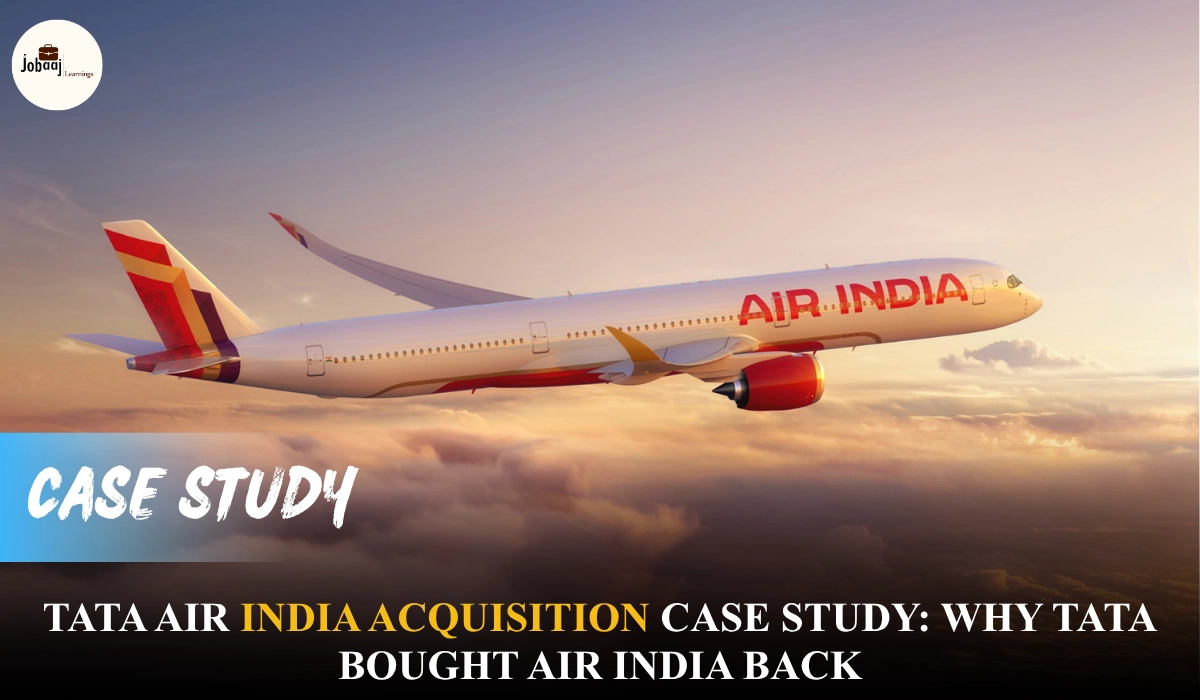
The relationship between Tata and Air India goes back almost a century.
In 1932, J.R.D. Tata launched Tata Airlines, becoming the pioneer of commercial aviation in India. The airline started with a small fleet and operated mail services between Karachi and Bombay.
Over the years, Tata Airlines expanded and became Air India in 1946. The airline developed a strong international reputation for luxury, hospitality and operational excellence.
The famous Maharaja mascot became globally recognised as a symbol of Indian aviation.
However, in 1953, the Indian government nationalised Air India, taking control of the airline as part of its broader economic policy.
For several decades, Air India operated as the country’s national carrier. While it initially performed well, problems began increasing as the aviation industry became more competitive.
The Decline of Air India: Understanding the Problem
Before Tata’s acquisition, Air India had become a classic example of a company with strong brand value but weak business performance.
1. Financial Crisis
Air India accumulated thousands of crores in losses over multiple years.
The airline struggled because of:
- High operational expenses
- Increasing fuel costs
- Expensive maintenance
- Inefficient route planning
- Heavy debt burden
The government had to repeatedly provide financial support to keep the airline operating.
This created a situation where taxpayers were supporting a business that was unable to compete effectively.
2. Changing Aviation Competition
The Indian aviation industry changed dramatically after liberalisation.
Private airlines entered the market with a completely different business model.
Companies like IndiGo focused on:
- Lower costs
- Efficient operations
- Quick aircraft turnaround
- Affordable pricing
Air India, with its legacy structure, struggled to match this efficiency.
The airline lost significant domestic market share and faced increasing pressure from private competitors.
3. Customer Experience Problems
Air India was once considered a premium airline, but over time customer perception declined.
Passengers complained about:
- Old aircraft interiors
- Inconsistent service quality
- Delays
- Poor digital experience
The gap between Air India’s historic reputation and actual customer experience became a major challenge.
Why Did Tata Buy Air India?
The acquisition was not simply about purchasing an airline.
Tata Group identified several strategic reasons behind the deal.
Objective 1: Create a Global Indian Airline
One of Tata’s biggest ambitions was building an airline from India that could compete internationally.
Before acquiring Air India, Tata had aviation businesses like Vistara and AirAsia India, but they lacked:
- Long-haul international routes
- Large fleet size
- Global airport presence
Air India provided Tata with immediate access to:
- International routes
- Valuable airport slots
- Global recognition
- Existing customer base
Instead of building an airline from zero, Tata acquired a platform that already had global reach.
Objective 2: Capture India’s Aviation Growth Opportunity
India’s aviation industry was expected to grow rapidly due to:
- Rising disposable income
- Expanding middle class
- Increased business travel
- Growing tourism
- International mobility
Tata understood that aviation would become a major growth sector.
Owning Air India gave Tata the opportunity to participate in one of the fastest-growing aviation markets in the world.
Objective 3: Revive a National Brand
For Tata, Air India was not just a company.
It was part of Tata’s own history.
Bringing Air India back represented:
- Restoring J.R.D. Tata’s legacy
- Reviving an iconic Indian brand
- Rebuilding global trust in Indian aviation
The emotional connection was an important factor behind Tata’s decision.
Acquisition Strategy: How Tata Planned the Turnaround
Tata did not approach Air India as a simple ownership change.
The company created a complete transformation strategy.
Approach 1: Fleet Modernisation
One of the biggest problems with Air India was its aging aircraft fleet.
Older aircraft resulted in:
- Higher maintenance costs
- Lower fuel efficiency
- Poor passenger experience
Tata addressed this by announcing one of the largest aircraft orders in aviation history.
The order included:
- Airbus A350 aircraft
- Airbus A320 family aircraft
- Boeing 787 Dreamliners
- Boeing 777 aircraft
The objective was to create a modern fleet capable of competing with global airlines.
Approach 2: Customer Experience Transformation
Tata recognised that rebuilding customer trust was critical.
The company focused on improving:
- Cabin interiors
- Food quality
- Airport experience
- Digital services
- Employee training
The goal was to bring back the premium image associated with Air India’s earlier years.
Approach 3: Creating an Aviation Group
Rather than operating multiple airlines separately, Tata aimed to consolidate its aviation businesses.
The strategy involved bringing together:
- Air India
- Vistara
- Air India Express
- AirAsia India
This would create a stronger airline group with:
- Full-service capability
- Low-cost operations
- Domestic strength
- International reach
Approach 4: Cultural Transformation
One of the biggest challenges was changing Air India’s organisational culture.
A company that operated under government ownership for decades needed to transition into a private-sector environment.
Tata focused on:
- Performance-driven culture
- Faster decision-making
- Employee accountability
- Customer-first thinking
Major Challenges Tata Faced
Challenge 1: Turning Around a Legacy Organisation
Large organisations often struggle with transformation because of established processes and resistance to change.
Air India had decades of legacy systems that needed restructuring.
Challenge 2: Competing With IndiGo
IndiGo had become India’s largest airline by focusing on efficiency and low costs.
Tata had to create a different strategy by positioning Air India as a premium global airline.
Challenge 3: High Investment Requirement
Airlines require massive capital investment.
Tata needed billions of rupees for:
- Aircraft
- Technology
- Training
- Infrastructure upgrades
Returns would take years.
Key Findings From the Case Study
Finding 1: Strategic Acquisitions Can Unlock Hidden Value
Air India looked like a failing business financially, but Tata identified valuable assets:
- International routes
- Brand recognition
- Airport slots
- Customer base
The acquisition shows that companies can create value by transforming underperforming businesses.
Finding 2: Legacy Brands Need Modern Execution
A strong brand alone is not enough.
Air India had global recognition, but poor execution damaged its reputation.
Tata’s challenge was proving that a historic brand could be modernised.
Finding 3: Long-Term Vision Creates Competitive Advantage
Many investors focus on short-term profitability.
Tata viewed Air India as a decades-long opportunity.
The company accepted short-term challenges to build long-term strategic advantage.
Results and Impact
1. Creation of India’s Largest Airline Group
After integration with Vistara and Air India Express, Tata created one of India’s largest aviation groups.
2. Historic Aircraft Expansion
The aircraft order positioned Air India for major international growth.
3. Improved Global Positioning
Air India regained focus as an international carrier representing India globally.
4. Increased Competition in Aviation
The acquisition changed India’s aviation landscape by creating a stronger competitor against IndiGo.
Final Analysis: Was Tata’s Decision Right?
The success of the acquisition cannot be measured only by immediate profits.
Airline transformations require years.
The real question is whether Tata can successfully combine:
- Strong brand heritage
- Modern operations
- Global network
- Customer experience
If successful, Air India could become one of the biggest corporate turnaround stories in India.
Business Lessons From Tata-Air India Acquisition
1. Buy Problems With Potential, Not Just Profits
Successful companies often acquire businesses that others consider difficult.
2. Strategy Matters More Than Ownership
Changing ownership does not automatically create success. Transformation requires execution.
3. Brand Revival Requires Customer Trust
A famous brand must continuously deliver value.
4. Long-Term Thinking Creates Sustainable Growth
Major transformations require patience and commitment.
Conclusion
The Tata-Air India acquisition case study represents more than a corporate takeover. It is a story of strategic vision, brand revival and long-term transformation. Tata Group did not acquire Air India because it was a profitable business. Instead, it identified the hidden potential behind a struggling airline with a powerful legacy, valuable international routes and a globally recognised brand.
The biggest challenge for Tata is not acquiring Air India but transforming it into a world-class airline capable of competing with global aviation giants. The company must successfully overcome operational inefficiencies, improve customer experience, modernise its fleet and build a strong organisational culture.
The acquisition highlights an important business lesson: companies can create significant value by investing in businesses that have strong foundations but require strategic restructuring. Tata’s decision reflects a long-term approach where short-term challenges are accepted in pursuit of future growth.
If Tata successfully executes its turnaround strategy, Air India could become one of the most successful corporate revival stories in India, proving that with the right leadership, investment and execution, even struggling legacy businesses can be transformed into global success stories.
Was that difficult?
Think being a Management Consultant is too hard?? Fear not.
Click on the link here to join our program where Shubham Agarwal, a professional management consultant, will teach you all about the exciting field of Management Consultancy and make sure simple case studies like these never scare you!
Join our latest cohort NOW!!
[Disclaimer: This case study is entirely hypothetical and unrelated to real-world situations. It's designed for educational purposes to illustrate theoretical concepts and potential scenarios within a given context. Any similarities to actual events or individuals are purely coincidental.]







