Categories








































Ankit's Jobaaj Learnings Review: From Inventory to Remote Financial Controller at Blue Polaris

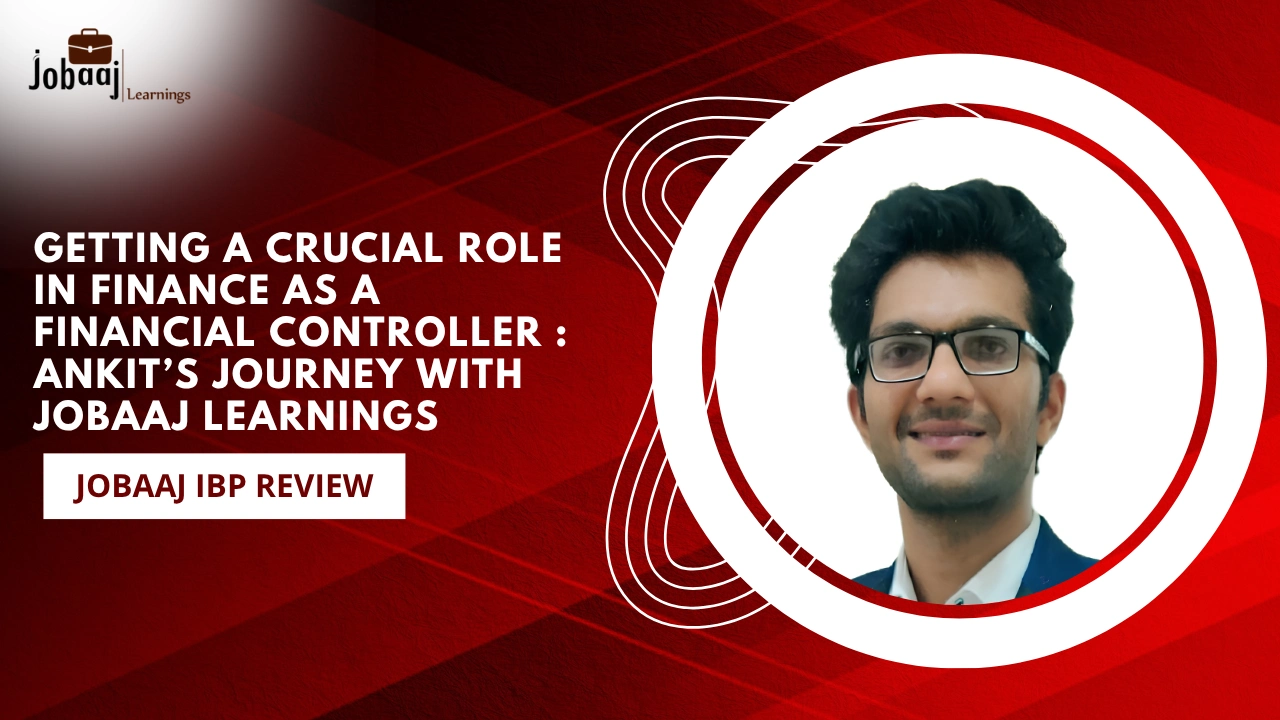
"My constraint was that I wanted to join only a remote job. That was a very big constraint for the job search team also. But they coordinated very well and gave 100% effort." — Ankit, who rated Jobaaj Learnings 3.75 out of 5 in this conversation and said the course side and the placement side need to be better linked"
Ankit is an experienced professional, not a fresher. He left his previous job in May 2025 when the company asked him to relocate to Dubai at short notice; his role there was inventory controlling in coordination with the finance team — procurement, reorder levels, forecasting, reviewing invoices and bookkeeping. He wanted a fully remote job and wanted to grow within finance, so he searched online for courses, found Jobaaj Learnings, and enrolled in the Investment Banking Program, which he says came with a placement guarantee. He finished the course in three to four months, gave five to six interviews, and was placed in August as a Financial Controller at Blue Polaris — a fully remote role, 1 pm to 10 pm, Monday to Friday, leading a two-person accounts team.
If you have searched "is Jobaaj real or fake", "is Jobaaj Learnings genuine", "Jobaaj Learnings scam" or "is Jobaaj Learnings worth it", treat this page as one data point, not a verdict. It is a recorded, on-camera conversation with one placed student. What it puts on record is checkable: a named company (Blue Polaris), a named role (Financial Controller), a remote-only constraint that the placement team had to work around, a two-round interview process with the actual questions asked, a rating of 3.75/5 rather than a perfect score, and a specific complaint about how the learning side and placement side connect. Read this alongside the full set of student feedback on the Jobaaj Learnings reviews page and the other conversations in our Interview Series before you decide.
Key Takeaways: Ankit's Jobaaj Learnings Review
- Profile: experienced; previously inventory controller with a Dubai-headquartered company (procurement, reorder levels, forecasting, invoice review, bookkeeping oversight, earlier costing work). Not from a pure finance seat.
- Why he left: employer wanted him to relocate to Dubai at short notice; last working month May 2025.
- Constraint: remote-only. He says this made the search hard for the placement team too.
- Course: completed in three to four months, then built projects. Says the programme was sold with a 100% placement guarantee.
- Placement support named: team optimised his LinkedIn and Naukri profiles, applied to companies through his profile daily, and had direct contact with company HR teams. The Blue Polaris opening came through that channel.
- Interviews given: five to six after joining, including AI-conducted interviews. He described many challenges before the offer.
- Outcome: Financial Controller at Blue Polaris, placed in August. Fully remote, 1 pm to 10 pm, five days a week. Owns book closing, accounting-standards compliance, MIS reports, cash flow statements; two-person AR/AP team reports to him; to be involved in budgets and forecasts.
- Process: message from the company's South Africa team → screening call the next day → round 1 with a financial analyst (Ind AS, IFRS, UK GAAP, multi-country compliance, deadline prioritisation) → round 2 with the CEO the following day (confidence, multi-country bank reconciliations).
- Preparation method: read the JD; understand the industry (manufacturing vs service changes everything); understand the business model; get brief knowledge of everything rather than depth in one area; use AI (he named Claude and ChatGPT) to generate likely questions and process checklists from the JD.
- His rating: 3.75 out of 5 (7.5/10), combining course, coordination and placement. Course content: "great", Excel-heavy in a useful way. Placement team: "doing very great."
- Reported problems: the learning part and the placement part need to be interlinked; he had "little bit some issues" on the Jobaaj Learnings side (not specified) and said other students he knows say the same about the course–placement link. Host said it would be passed to the manager.
Who Is Ankit? His Background Before Jobaaj Learnings
Ankit did not describe his degree in this conversation; he described his work. His previous role:
- Role: inventory controlling, working in coordination with the finance team, for a company that later wanted to move him to Dubai.
- What it involved: managing procurement and reorder levels; maintaining inventory to the sales team's requirements; forecasting; overall financial control of the company; reviewing invoices and bookkeeping done by the finance team.
- Earlier: costing work.
- How he characterised it: "not completely finance" — he reviewed the finance team's output but his major responsibility was inventory. He said himself he was "not that much perfect for the finance background."
That gap adjacent to finance but not in it,is what the first interview round at Blue Polaris probed.
Why He Left His Job, and What He Was Looking For
Ankit's employer wanted to relocate him to Dubai. He could not do that at short notice, so May 2025 was his last working month. Two conditions shaped what came next: he wanted to work only remotely, and he wanted to grow within finance rather than stay in inventory. He searched online for courses that fit both, found Jobaaj Learnings, and enrolled in the Investment Banking Program. He said the programme was offered with a 100% placement guarantee.
The remote-only requirement is the constraint that runs through the rest of his account. He said it was a big constraint for the placement team as well, and that he was, in his own words, not confident he would get a job.
The Outcome: Financial Controller at Blue Polaris, Remote
The opening reached him as a senior accountant vacancy; the role he describes doing is financial control. What he stated:
- Company: Blue Polaris, with operations in several countries and HR teams in India and South Africa.
- Role: Financial Controller — a "complete finance role."
- Responsibilities: closing the books of accounts and bookkeeping oversight; ensuring everything meets accounting standards; preparing MIS reports and cash flow statements; the company plans to involve him in upcoming budgets and forecasts.
- Team: two people handling AR/AP report to him; he reviews their work.
- Work model: fully remote, 1 pm to 10 pm, Monday to Friday.
- Timing: placed in August.
What Jobaaj Learnings Actually Did, According to Ankit
Stripping out the general remarks, these are the concrete things Ankit attributes to the programme and the placement team:
- Profile optimisation. The team reworked his LinkedIn profile and his Naukri profile.
- Applied on his behalf. They applied to companies through his profile on a daily basis.
- Direct HR relationships. The team has direct contact with company HR teams; the Blue Polaris opening came via their communication with the company's Indian HR team, after which the South Africa team messaged him.
- Worked around the remote-only constraint. He is explicit that this made their job harder and that they still put in full effort.
- Kept him going through rejections. Five to six interviews, including AI interviews, with what he called many challenges. He says the team kept telling him he would get the job within the prescribed time and to stop assuming a remote job was impossible.
- Course content. He called it great, with Excel as a major and useful component for accounting and finance roles.
What he did not credit Jobaaj with: his interview preparation method, which was his own and AI-assisted (see below). He also drew a sharp line between the placement team, which he praised without qualification, and the learning side, where he had unspecified issues.
Inside the Blue Polaris Interview Process
| Stage | Who / when | What was asked |
|---|---|---|
| 0. Outreach | Message from the company's South Africa team | "We have an opening for a senior accountant role — are you interested?" |
| 1. Screening call | One day later | Screening; he was moved to a first interview |
| 2. First round | A financial analyst at the company | Introduction; what he handled in his current company; whether his procurement/inventory work links to finance; Ind AS and accounting standards; handling compliances across countries with different timelines; how he would prioritise if a management deliverable and an auditor's request for sales numbers were both due the same day |
| 3. Second round | CEO, the next day | Described as a confidence-and-capability check; whether he has a finance background; how he would handle overall compliances; how he would manage reconciliations across bank accounts in different countries |
Three things stand out. The process moved fast — message, screening call the next day, first round, CEO round the day after. The first round was built around a doubt about his profile (is inventory control really finance?), and he had prepared for exactly that. And the CEO round was about judgement and confidence, not textbook accounting.
Ankit's Preparation Method: JD, Industry, Business Model, AI
Ankit was the most methodical about preparation of anyone in this series so far. His sequence:
- Read the job description first. Everything else follows from what the company says it needs.
- Identify the industry. Accounting, costing and the fundamentals differ completely between manufacturing and services; the questions will too.
- Understand the business model. Where the company operates, how, and what exactly it does — which tells you what your role will actually be.
- Understand the position. What level and scope the company is hiring for.
- Go broad, not deep. His reasoning: you cannot cover all of Ind AS or IFRS before an interview, and even if you did, they might not ask. Get a brief working knowledge of everything relevant, because that is what you can realistically use.
- Use AI to generate the question set. Feed the company and its business model into an AI tool (he named Claude and ChatGPT) and ask what a finance candidate is likely to be asked. If the JD says "close the books of accounts" and you have never owned month-end close, ask the tool for the closing procedure for that type of company and learn the checklist.
- Be honest about reviewer vs doer. If asked a practical question — how do you calculate depreciation — and you reviewed the work rather than did it, say so. Claiming depth you do not have invites deeper questions you cannot answer.
His closing line on the subject: after all of that, the rest depends on luck.
Financial Controller Interview Questions to Prepare For
These are the questions Ankit reported being asked, with a reference answer for each.
Your background is inventory and procurement. How is that related to finance?
Model answer: Draw the line explicitly. Inventory control sits on the balance sheet (inventory valuation, provisioning for obsolescence), the P&L (COGS, carrying cost) and cash flow (working capital tied up in stock). Reorder-level and forecasting work is demand-driven working-capital management. Reviewing invoices and bookkeeping is a control function. Then close the gap honestly: state what you reviewed versus what you executed, and what you have since studied (standards, close process) to move into a full finance seat.
We operate in several countries. How would you handle compliances with different timelines?
Model answer: A compliance calendar per entity — statutory filings, tax, payroll, audit — with owners, internal deadlines set ahead of statutory ones, and a monthly review. Ankit's answer drew on his previous employer, which had entities in the USA, Japan and Germany that his team already managed; if you have that, say it.
Management needs a report today and the auditor needs sales numbers today. How do you prioritise?
Model answer: Ask what each is actually for and when it is truly needed. Auditor requests usually have statutory consequences and a fixed timeline; management reports are often negotiable by hours. Confirm the hard deadline, deliver the non-negotiable one first, communicate a revised time to the other party immediately rather than going silent, and delegate what your team can complete in parallel.
What do you know about Ind AS, IFRS and UK GAAP?
Model answer: Cover the frameworks at a working level: Ind AS is India's converged version of IFRS; IFRS is the global standard used across most of the company's non-US entities; UK GAAP (FRS 102) is the UK's domestic framework. Know the areas most likely to matter for a controller — revenue recognition, leases, fixed assets and depreciation, provisions, foreign-currency translation — rather than trying to memorise every standard. Ankit's stated approach was breadth over depth.
We have bank accounts in multiple countries. How will you manage reconciliations?
Model answer: Standardise a monthly reconciliation for every account with a fixed owner and due date; reconcile in local currency first, then translate at the closing rate; track unreconciled items with ageing and clear them before close; maintain a single tracker across entities so nothing is missed. Mention the tooling you have used, and be honest if you have only reviewed rather than performed reconciliations.
Walk me through your month-end close process.
Model answer: This is the question Ankit used as his example of preparing from the JD with an AI-generated checklist: sub-ledger cut-offs (AR, AP, payroll, inventory), accruals and prepayments, fixed-asset run and depreciation, intercompany reconciliation, bank reconciliations, revaluation of foreign-currency balances, review of trial balance and variances, then MIS and cash flow reporting. Know the sequence and the controls at each step.
Pros and Cons, Based on Ankit's Account
What he said worked:
- The placement team's process: profile optimisation on LinkedIn and Naukri, daily applications through his profile, and direct HR relationships that produced the opening.
- The team's persistence against a remote-only constraint he expected to be a deal-breaker.
- Sustained confidence-building through five to six interviews and rejections.
- Course material, which he called great, and the Excel-heavy content, which he found directly relevant to accounting and finance roles.
- The result: a fully remote, five-day, complete finance role with a team reporting to him.
- He said he is already recommending the placement team specifically to friends who are job-hunting.
What he said could be better:
- The learning part and the placement part need to be interlinked. This was his main suggestion. He said other students he knows have said the same.
- Unspecified issues on the Jobaaj Learnings side. His words: "if I interlink this with Jobaaj Learnings, I have little bit some issues with them." He did not elaborate, and separated this clearly from the course content, which he said has no issues.
- He was not aware how good the placement team was. He framed this as a positive surprise, but it also implies the placement process was not well explained to him during the course phase — the same interlinking gap from a different angle.
What the conversation leaves open:
- He did not state his degree or total years of experience.
- He did not give the exact number of months between finishing the course and the offer.
- He did not name his placement coordinator(s).
Ankit's Tips If You're Considering Jobaaj Learnings
- Prepare from the JD outward. JD → industry → business model → position. Manufacturing and service companies ask completely different questions.
- Breadth beats depth before an interview. You cannot finish IFRS in days, and they may not ask. Get working knowledge of everything on the JD instead.
- Use AI to build your question bank and process checklists. Give it the company and business model; ask what a finance candidate will be asked; ask for the procedure behind any JD item you have not personally owned.
- Reflect the checklist, but don't overclaim. Interviewers read a good checklist as evidence you have done the work. If you only reviewed it, say so before they go deep.
- Expect AI-conducted interviews. Some of his five to six were run by AI systems.
- A hard constraint like remote-only is survivable, but slows things down. Tell the placement team early and expect more rejections.
- Ask how the course and the placement phase connect. This was his main criticism; knowing the handover upfront would have helped him.
Full Podcast Transcript
Podcaster: First of all, thank you so much for joining this podcast, and congratulations on getting placed. How are you feeling?
Ankit: I'm feeling great.
Podcaster: Before getting started, can you tell our audience about yourself and your journey till now?
Ankit: I left my previous job in 2025 — May was my last month — because the company wanted to relocate me to Dubai, and I couldn't relocate at very short notice. So I started searching on the internet for courses I could join for remote working, because I wanted to work remotely and grow in the finance field. For that purpose I joined the Jobaaj platform — Jobaaj Learnings, for investment banking — and they also gave me a 100% placement guarantee. I completed the course in three to four months. After completing the course I did some projects, and meanwhile the Jobaaj HR team started working on the hiring process. They optimised my LinkedIn profile and my Naukri profile, and started applying through my profile. I got many interviews and faced many challenges clearing them — some AI interviews were also there. But over that period the Jobaaj team was always available, gave me 100% support, and gave me confidence that I would get the job within the prescribed time. Finally I got the placement in August.
Podcaster: Approximately how many interviews have you given?
Ankit: After Jobaaj, I attended almost five to six interviews.
Podcaster: You were working remotely for a Dubai company. What role were you in?
Ankit: Mainly an inventory controlling role, in coordination with the finance team. I had to manage procurement, inventory controlling, reorder levels, and maintain inventory as required by the sales team. For that we did forecasting, controlling, managing inventory, and overall financial control of the company — bookkeeping and an overall overview of the finance team.
Podcaster: So you were in the finance field before as well?
Ankit: Not completely the finance team. I had to look after all the invoices and everything done by them — I reviewed everything. But my major role was inventory controlling.
Podcaster: And what are your roles and responsibilities in the company you're placed in now?
Ankit: It's Blue Polaris. My major role is to manage financial control — a complete finance role. I need to do the closing of the books of accounts and bookkeeping. There's a team working under me, two people, who manage AR/AP and everything related to the company, but I need to look after that and keep eyes on their work, ensure everything is according to accounting standards. I also need to prepare MIS reports and cash flow statements, and they're planning to involve me in the upcoming budgets and forecast preparation.
Podcaster: So it's a complete finance role. What questions were you asked in the interview? Walk us through the process.
Ankit: Jobaaj was already applying on a daily basis to different companies, and they have direct interaction with companies' HR teams. They had some communication with the Indian HR team of this company, and I got a message from the company's South Africa team: "We have an opening for a senior accountant role — are you interested?" After one day I had a screening call with them. After the screening call they gave me a first round of interview. Most of the questions were finance-related. It was an introduction-type round with a financial analyst. They asked what I handled in my current company — they wanted to link my procurement role with finance, checking whether what I'd done was related to the finance field or not. For that I had already prepared — Ind AS, accounting standards, IFRS, UK GAAP — brief things I'd checked with AI systems. They asked about Ind AS. They have compliance work, so most questions were about compliances: "We have operations in different countries — do you know how to handle compliances in different countries?" I told them we were already handling companies in different countries — USA, Japan, Germany — so we manage that. They were satisfied. Another question: "We have different timelines for different compliances — how will you manage it?" And: "If you have compliance work in your pipeline, your deadline is today, you need to submit important work to management, and the auditor is also asking for the company's sales numbers — how will you prioritise?" I gave my replies and they were satisfied.
Podcaster: So there were about three rounds?
Ankit: That was the first round. After that they coordinated with their CEO, and the second round was with the CEO the next day. That was the managerial round — a confidence-checking round. They were checking whether the person has the confidence and capability to do the work, and whether he has a finance background. The CEO's main questions were how I'd handle overall compliances, and — because they have different bank accounts in different countries — how I'd handle reconciliations and everything.
Podcaster: Is it a complete remote job or on-site?
Ankit: Complete remote. My timings will be 1 pm to 10 pm, Monday to Friday, five days.
Podcaster: Ankit, can you tell our students what strategy you followed for clearing interviews? Was there a strategy, or did you just read interview questions?
Ankit: The major strategy is: first check the job description and check what exactly the company requires. Focus on what type of industry it is. If we have an interview for a manufacturing company, all questions will be totally different; if it's the service industry, totally different again. Accounting, costing, all fundamentals are different in manufacturing versus services. So first, the industry. Second, the company's business model — where and how they operate, what exactly they do. On the basis of the business model you have an idea of what your role in the company will be. Next, understand the position they're hiring for. And the very important thing is the job description — prepare for the job description. My background was inventory controlling, and before that costing, so I wasn't that perfect for a finance background. My major preparation was to have brief knowledge of everything, because we don't have time to go deep. If I'm talking about Indian accounting standards, IFRS — it's not possible to cover everything before an interview, and even if you complete all of IFRS in days, it may be that the interviewer doesn't ask anything about Ind AS and you don't get selected, and you'll be disappointed. So have brief knowledge of everything, and always use AI for that — Claude, ChatGPT. Tell the AI: this is the company, this is the business model. It will detect the company's business model and give you suggested questions — what kind of questions can be asked of a finance person. Everything else depends on luck.
Podcaster: That's right — the rest is up to the candidate and their luck. I hope it helps everyone watching.
Ankit: The very important thing is the job description. For example, if the job description says you need to close the books of accounts and you've never worked on closing books, enter into ChatGPT: what is the procedure for closing books of accounts in this particular type of company? It will give you a checklist. If you reflect that checklist in front of the interviewers, they'll say okay, he has that knowledge, so he's worked on it. Then it depends on luck — they may ask practical things, like how you'd calculate depreciation. Then we can say: I was the reviewer, I wasn't the person doing everything, but I was involved in the process. That kind of justification we can give. Because if we weren't involved in a task, we can't go deep in front of the interviewer — otherwise they'll ask very deep questions and we won't be able to answer.
Podcaster: Now let's talk about the job search team. How was the coordination with the placement team, the counsellor and the program coordinator? Was everything smooth, or did you face any problems?
Ankit: I haven't faced any issue. I did face one thing — I wasn't confident I'd get the job. I faced many issues because my constraint was that I wanted to join only a remote job. That was a very big constraint for the job search team also. But they coordinated very well and gave 100% effort, and I really appreciate that, because they always tried to keep my confidence at its peak — "you will definitely get the job, Ankit, don't keep in your mind that you won't be able to get a remote job — you'll get the job as you require." And that happened; the results are in front of you.
Podcaster: That's great to hear. Now the course material — the lectures and live sessions. Did you find them helpful?
Ankit: The course material is really great. I learned a lot with respect to investment banking and everything. Microsoft Excel was a major part of the course, because in most industries, as an accountant or in a finance role, Excel is very important — so the course is great with respect to that also. The only thing I'd suggest improving is that we need to interlink both things — the learning part and the placement part. Some students I know are saying we need a good link between the course part and the placement part. The placement team is actually doing very great — I wasn't aware of that, so it's a very great effort they've made. But if I interlink this with Jobaaj Learnings, I have a little bit some issues with them. If I'm talking about the course itself, the course is great — the course doesn't have an issue.
Podcaster: Understood. I'll suggest these things to the manager so they can work on it. Now if I ask you to rate Jobaaj Learnings on a scale of 1 to 10, based on all your experience — placement team, counsellor, program coordinator, course material?
Ankit: Separate rating for the learning, or overall Jobaaj?
Podcaster: Combined — you can combine everything.
Ankit: I'll give 3.75 out of 5.
Podcaster: Got it. Thank you so much — that's all from my side. Congratulations on getting placed, and all the best for your future.
Ankit: I'm also suggesting it to many of my friends who are looking for jobs. I'll definitely suggest the Jobaaj placement team specifically. Thank you very much for your efforts.
Podcaster: Thank you so much, and have a great journey ahead.
Frequently asked questions
Is Jobaaj Learnings genuine, or is it a scam?
This page documents one case on camera: Ankit, an experienced inventory controller who would only accept remote work, placed as Financial Controller at Blue Polaris after five to six interviews. He rated the platform 3.75/5, praised the placement team, called the course content great, and criticised the link between the two. A candid, non-perfect rating with a named company and a described process is evidence of a real placement — not proof of a rate. Weigh it against the full review set on the reviews page.
Does Jobaaj Learnings really offer a placement guarantee?
Ankit said he was given a 100% placement guarantee when he enrolled, and that the team told him he would get a job within a prescribed time. He was placed. The terms of that guarantee are not covered in this conversation — check them directly with Jobaaj before enrolling.
Can you get a fully remote finance job through Jobaaj Learnings?
Ankit did — 1 pm to 10 pm, Monday to Friday, fully remote. He is clear that remote-only was a major constraint that made the search harder and that he did not expect it to work.
What does Jobaaj Learnings' placement support actually involve?
In Ankit's case: optimising his LinkedIn and Naukri profiles, applying to companies through his profile daily, maintaining direct contact with company HR teams (which produced this opening), and repeated confidence-building through rejections.
What is the interview process at Blue Polaris?
Outreach from the South Africa team, a screening call one day later, a first round with a financial analyst (background-to-finance linkage, Ind AS/IFRS/UK GAAP, multi-country compliance, deadline prioritisation), and a CEO round the next day (confidence, compliance ownership, multi-country bank reconciliations).
Why did Ankit rate Jobaaj Learnings 3.75 out of 5?
The placement team and course content both got strong praise. The deduction was for the lack of interlinking between the learning phase and the placement phase, plus unspecified issues he had on the Jobaaj Learnings side. He said other students he knows raised the same interlinking point.
Is the Investment Banking Program worth it for an experienced professional switching into finance?
Ankit's account: the course, and especially its Excel content, was directly useful; the placement team produced the role; the handover between the two needs work. One student's view is a starting point for your research, not a substitute for it. Compare more accounts in the Interview Series.
Join 5,00,000+ Subscribers
Be a part of our ever growing community.
Related reads
Vedant Jobaaj Learnings Review: From CFA Level 1 to Associate Analyst at CareEdge Advisory
Harsh Sharma Jobaaj Learnings Review: From CFA Level. 2 to Asset Management Analyst at Klyvora