Categories








































Adnan Khan's Jobaaj Learnings Review: From LLB to Financial Analyst at G&M Financial

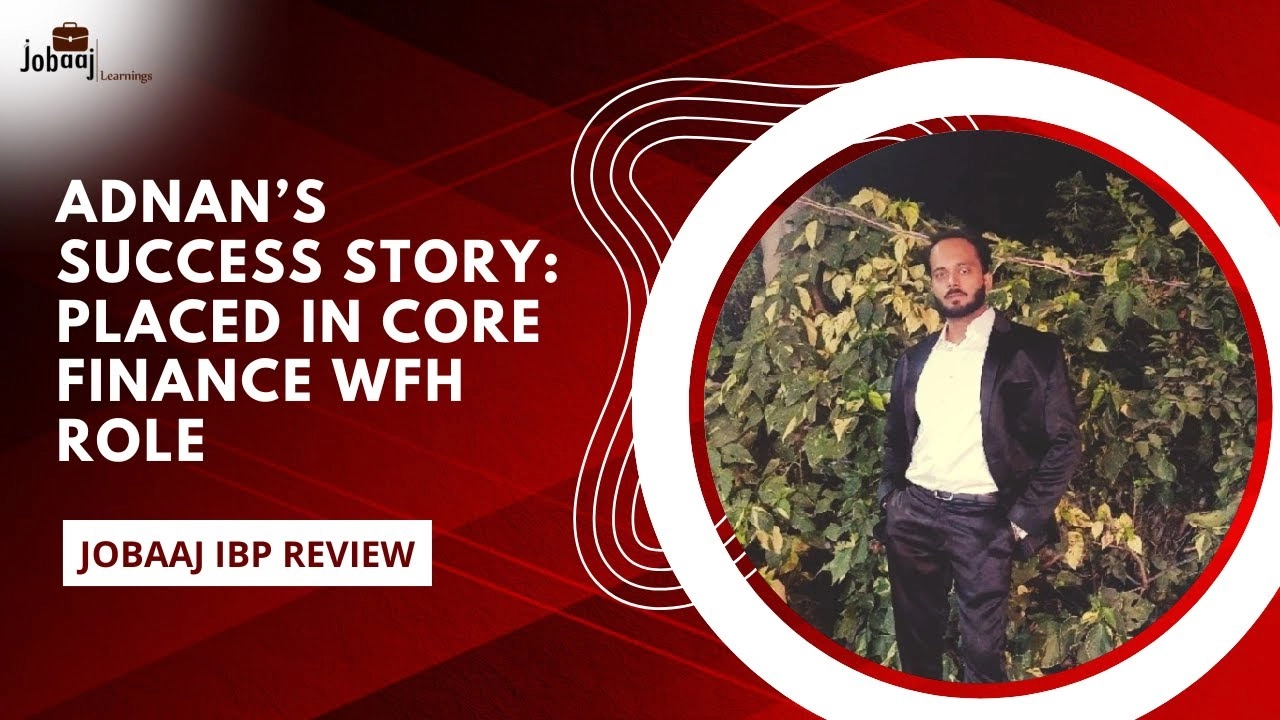
"At first, I thought the course might be a scam, but when I saw the mentorship and practical approach, I decided to enroll... I was really shocked when I got placed." — Adnan Khan
Adnan Khan is from Maharashtra and holds a BBA, an MBA and an LLB. He has eight years of work experience — HDFC Bank as a sales executive handling auto loans, then a construction company managing financial work and materials. He lost that job to COVID, completed his LLB during the gap, and worked as a legal executive. After Jobaaj Learnings' Investment Banking Program, he was hired as a Financial Analyst at G&M Financial.
If you are searching “is Jobaaj real or fake” or “is Jobaaj Learnings a scam”, Adnan asked himself that exact question before enrolling — and says so on camera. He is also unusually precise about the cost: 8–10 months to finish the course while working, then 3–4 months to get placed, with a 1.5-month interview process on top. Read it alongside the other conversations in our Interview Series and the wider feedback on the reviews page.
Key Takeaways: Adnan's Jobaaj Learnings Review
- Profile: BBA, MBA and LLB, with eight years of experience across banking sales, construction finance, and legal work.
- The setback: he lost his job to COVID, and used the period to complete his LLB and work as a legal executive.
- Why three degrees weren't enough: an MBA from a Tier 2 college with “lack of practical exposure and the skill set required in the job market.”
- He suspected it was a scam. What changed his mind was seeing the mentorship and the practical approach.
- He had no LinkedIn account. The team created and optimised one for him.
- The interview was four stages: quiz → case study → HR round → a technical session where he built a financial model live on a video call.
- Also tested: communication, analytical ability, Excel, and current affairs in real estate and macroeconomics — including the impact of rising interest rates.
- The real timeline: 8–10 months for the course while working, 3–4 months to placement, and a 1.5-month interview process.
- Outcome: Financial Analyst at G&M Financial, a KPO doing real estate underwriting and modelling — permanent work-from-home. Second day on the job when recorded.
Who Is Adnan Khan? Three Degrees and Eight Years of the Wrong Experience
Adnan's background is dense:
- BBA, MBA and LLB
- HDFC Bank — sales executive, providing auto loans and processing loan files
- A construction company — handling financial aspects and supervising materials
- Legal executive under a senior lawyer, after completing his LLB
- Eight years of experience in total
None of it was investment banking. And the pandemic removed the job he had:
"Unfortunately, I lost my job due to COVID, but during that period, I completed my LLB and worked as a legal executive under a senior lawyer."
Why an MBA Didn't Open the Door
Adnan's diagnosis is direct and does not spare his own credentials:
"I completed my MBA from a Tier 2 college, and the main reason I struggled to get placed in higher firms was the lack of practical exposure and the skill set required in the job market. The MBA program didn't provide me with the hands-on knowledge needed for roles like investment banking."
His broader conclusion is one worth arguing with rather than accepting uncritically — but he states it plainly:
"Even someone who's just a graduate, but has the right skills, can land a higher CTC compared to someone with multiple degrees but without the necessary skills."
“At First, I Thought the Course Might Be a Scam”
This is the reason this particular review is worth reading, and it deserves to be quoted in full:
"Honestly, I didn't have the practical knowledge of how the market works. At first, I thought the course might be a scam, but when I saw the mentorship and practical approach, I decided to enroll. The course gave me certifications, a LinkedIn profile, and the right exposure, which I hadn't received from my earlier degrees. I was really shocked when I got placed."
Two things to take from it. First, the scepticism was reasonable — and if you are reading this page because you have the same doubt, so is yours. Second, what resolved it for him was seeing the mentorship and the practical approach, not marketing material. The free workshops that other candidates in this series describe are how you can do the same test before paying.
His own reaction to the outcome — “I was really shocked when I got placed” — is not the language of a scripted testimonial.
He Didn't Have a LinkedIn Account
A small detail that says a lot about where he was starting from:
"I didn't have a LinkedIn account before, but they created and optimized one for me, found suitable jobs, and helped me prepare for interviews."
For a candidate with eight years of experience trying to enter finance, an absent professional profile is a hard blocker — recruiters cannot find you and applications have nothing to corroborate them. Building one from zero is a small intervention with disproportionate effect.
The Interview: Four Stages, Including a Live Modelling Test
| Stage | What it involved |
|---|---|
| 1. Quiz | An initial screening test |
| 2. Case study | Assigned after the quiz |
| 3. HR round | Standard HR interview |
| 4. Technical session | A financial modelling task completed live on a video call |
The fourth stage is the one to prepare for. Building a model while someone watches, in real time, is a different test from submitting one — there is nowhere to hide a shaky method.
What They Actually Tested
- Communication — assessed first
- Analytical skills
- Excel proficiency
- Current affairs in real estate and macroeconomics — he was asked about the impact of rising interest rates on the economy
- Time value of money, IRR and NPV
The macroeconomics question is worth noting. A technical role in real estate underwriting expects you to understand the environment the assets sit in, not just the arithmetic.
The Real Timeline — and It Isn't Short
Adnan gives the most complete timeline in this series, and it is considerably longer than the fast cases:
- 8–10 months to complete the course — because he was working at the same time.
- 3–4 months after finishing to get placed.
- About 1.5 months for the G&M Financial interview process itself.
That is roughly a year to eighteen months end to end. Compare it with Atishay Jain in this same series — three and a half months — and the difference is explained by circumstances, not the programme: Atishay was unemployed, quick through the material, and already held CA plus three CFA levels. Adnan was working full-time throughout. If you are studying alongside a job, his numbers are the more relevant ones.
The Outcome: Financial Analyst at G&M Financial
Adnan describes his employer as “a knowledge processing outsourcing company that deals with underwriting real estate and financial modeling in real estate.”
| Detail | What Adnan stated |
|---|---|
| Employer | G&M Financial |
| Role | Financial Analyst |
| Domain | Real estate underwriting and financial modelling |
| Work setup | Permanent work-from-home |
| Status | Second day on the job; in the training phase |
| Salary | Not disclosed |
The remote arrangement matters more than usual here. Adnan is based in a part of Maharashtra where, as he confirms, investment banking opportunities are not plentiful. A permanent work-from-home finance role removes relocation from the equation entirely.
Pros and Cons, Based on Adnan's Account
What worked:
- Practical, hands-on training his MBA had not provided
- Mentorship visible enough to overcome his initial suspicion of the programme
- A LinkedIn profile created and optimised from nothing
- Job matching and interview preparation from the HR team
- Assignments that built confidence in applying what he had learned
- A remote finance role in a location with few such opportunities
What his account shows honestly:
- He thought it might be a scam before enrolling.
- It took 8–10 months to finish while working, and a further 3–4 months to place.
- The interview process alone ran 1.5 months.
- He was on day two and still in training when this was recorded — so nothing here evidences performance in the role.
- No salary is disclosed and no rating was asked for.
- Three degrees and eight years of experience did not get him there on their own.
Financial Analyst Interview Questions and Model Answers
How do you ensure a financial model is accurate and reliable?
Model answer: Start from clean, verified data and document every assumption where it can be seen rather than buried in a formula. Run sensitivity analysis so you know which inputs actually move the answer. Then check the output against real-world data and have someone else review it — a model nobody has challenged is not yet reliable.
How do you approach financial statement analysis?
Model answer: Read the three statements together for overall health, then prioritise the ratios that answer the question being asked — profitability such as ROE, liquidity such as the current ratio, and leverage such as debt-to-equity. Cash flow from operations is the one I watch closest, because a company can report profit while running out of cash.
Describe making a quick financial decision.
Model answer: At a construction company we had to decide quickly whether to proceed with a large capital expenditure. I pulled the cash flow position and the projected return, analysed it fast but properly, and recommended delaying by a few months to protect cash flow. It was accepted, and the company avoided unnecessary strain.
How would you assess the feasibility of a real estate project?
Model answer: Gather projected costs, expected revenues, the financing structure and market trends, then build a model on explicit assumptions about construction cost, rental income and demand. Calculate NPV, IRR and payback period to judge profitability against risk, and run sensitivity analysis on the variables that actually move — interest rates and construction costs above all.
Describe identifying and managing a financial risk.
Model answer: At the construction company I saw that fluctuating material costs could push us past budget and delay the timeline. I raised it with the project manager early and proposed a proper risk analysis with contingency planning and price-lock agreements with suppliers. Because it was addressed before it materialised, the project finished on time and on cost.
What qualities make a good financial analyst?
Model answer: Attention to detail, genuine analytical judgement, and the ability to explain complex financial data clearly to someone who will act on it. Problem-solving matters because the data is rarely complete, and adaptability matters because the market conditions your model assumes will change.
Adnan's Advice
"I would say focus on continuous learning. Don't just rely on qualifications. Work on building practical skills that align with the job market needs."
- Test your scepticism instead of acting on it. He thought it might be a scam and looked at the mentorship and teaching before deciding.
- Fix your professional profile. He had no LinkedIn account at all after eight years of work.
- Expect a live technical test. His final round was building a model on a video call in real time.
- Follow the macro news in your domain. He was asked about interest rates and the economy in a real estate role.
- Budget the real time. A year or more, if you are studying while working.
Full Podcast Transcript
The complete conversation, unedited.
Podcaster: Good afternoon and welcome to this podcast. First of all, congratulations on getting placed. Could you give us a quick introduction?
Adnan: My name is Adnan Khan. I've completed my BBA, MBA, and LLB, along with a degree in Investment Banking from Jobaaj. I've also done several financial modeling courses from Jobaaj. I have 8 years of experience, which includes working at HDFC Bank as a sales executive. My role involved providing auto loans and processing loan files. After that, I worked at a construction company, handling financial aspects and supervising materials. Unfortunately, I lost my job due to COVID, but during that period, I completed my LLB and worked as a legal executive under a senior lawyer. I then came across the Jobaaj program on Instagram, enrolled in it, and today, I've secured a role at G&M Financial as a financial analyst.
Podcaster: That's an incredible journey, Adnan. So, the company you've joined is G&M Financial, correct?
Adnan: Yes, it's a knowledge processing outsourcing company that deals with underwriting real estate and financial modeling in real estate.
Podcaster: And you're working as a financial analyst, right?
Adnan: Yes, sir. Today is actually my second day on the job.
Podcaster: How's the work going so far? Is it a work-from-home job?
Adnan: Yes, it's a permanent work-from-home opportunity, and I'm currently in the training phase.
Podcaster: Now, I understand you're from a place where investment banking opportunities may not be plentiful. Where are you from?
Adnan: I'm from Maharashtra.
Podcaster: I imagine there aren't many opportunities like this in your area.
Adnan: Yes, sir, that's true.
Podcaster: Now, let's get into the problem statement. You already had an MBA, but during COVID, you lost your job. Despite having a solid educational background, it was challenging for you to secure a job, right?
Adnan: Yes, sir. I completed my MBA from a Tier 2 college, and the main reason I struggled to get placed in higher firms was the lack of practical exposure and the skill set required in the job market. The MBA program didn't provide me with the hands-on knowledge needed for roles like investment banking.
Podcaster: So, you've identified that the job market is shifting from qualification-based placements to skill-based placements, correct?
Adnan: Exactly! Even someone who's just a graduate, but has the right skills, can land a higher CTC compared to someone with multiple degrees but without the necessary skills.
Podcaster: Let's talk about your placement process. How difficult was it?
Adnan: It wasn't difficult for me at all, thanks to the HR team at Jobaaj. They were very cooperative and helped me throughout the process. I didn't have a LinkedIn account before, but they created and optimized one for me, found suitable jobs, and helped me prepare for interviews.
Podcaster: Can you walk us through the placement process? Was there a case study or HR round?
Adnan: Yes, first I had a quiz. After that, I was assigned a case study, followed by an HR round. Then there was a technical session where I had to complete a financial modeling task live on a video call.
Podcaster: So, the interview was designed to test practical skills. What skills did they focus on?
Adnan: They tested my communication skills first, followed by analytical skills, Excel proficiency, and current affairs related to real estate and macroeconomics. For example, they asked me about the impact of rising interest rates on the economy.
Podcaster: And I assume financial statement analysis, valuation, and formulas like IRR and NPV were part of the process too?
Adnan: Yes, definitely. It involved time value of money concepts, which we covered in the course.
Podcaster: What made you decide to take a course on investment banking despite already having an LLB and an MBA?
Adnan: Honestly, I didn't have the practical knowledge of how the market works. At first, I thought the course might be a scam, but when I saw the mentorship and practical approach, I decided to enroll. The course gave me certifications, a LinkedIn profile, and the right exposure, which I hadn't received from my earlier degrees. I was really shocked when I got placed.
Podcaster: How long did it take for you to complete the course and get placed?
Adnan: It took me 8 to 10 months to complete the course because I was working at the same time. The assignment phase really helped me build confidence in applying what I had learned. After completing everything, it took me about 3 to 4 months to get placed. The interview process with G&M Financial took around 1.5 months.
Podcaster: Despite having an MBA, you were able to break into a finance role through practical learning.
Adnan: Yes, exactly. The course really prepared me by providing real-world tasks and practical assignments. It wasn't easy, but it was worth it.
Podcaster: What advice would you give to someone aspiring for a similar role?
Adnan: I would say focus on continuous learning. Don't just rely on qualifications. Work on building practical skills that align with the job market needs.
Frequently Asked Questions
Is Jobaaj Learnings a scam?
Adnan asked himself that before enrolling — his words: “At first, I thought the course might be a scam.” What changed his mind was seeing the mentorship and practical approach. He went on to be hired as a Financial Analyst at G&M Financial, an employer he names on camera. That is one documented case, not proof of a rate. Compare it against the wider review set on the reviews page.
How long does it actually take?
For Adnan, studying while working: 8–10 months for the course, 3–4 months to get placed after that, and a 1.5-month interview process — over a year end to end. Faster cases in this series involved candidates who were not working.
Why wasn't an MBA enough?
He attributes it to a Tier 2 college and, more importantly, a lack of practical exposure and market-relevant skills. His view is that the market has shifted from qualification-based hiring to skills-based hiring.
What was the interview process?
Four stages: a quiz, an assigned case study, an HR round, and a technical session where he built a financial model live on a video call. They also tested communication, analytics, Excel, and current affairs on real estate and macroeconomics.
Can you get a finance job from a smaller city?
Adnan did, from a part of Maharashtra where he confirms such opportunities are scarce — because the role is permanent work-from-home. Remote roles change what geography means for a finance career.
What does a real estate underwriting analyst do?
G&M Financial is a knowledge processing outsourcing firm handling real estate underwriting and financial modelling — assessing property deals financially and building the models that support those judgements.
Join 5,00,000+ Subscribers
Be a part of our ever growing community.
Related reads
Ankit's Jobaaj Learnings Review: From Inventory to Remote Financial Controller at Blue Polaris
Vedant Jobaaj Learnings Review: From CFA Level 1 to Associate Analyst at CareEdge Advisory