Categories




































Top 25 Cognizant Interview Questions and Answers for Freshers in 2026

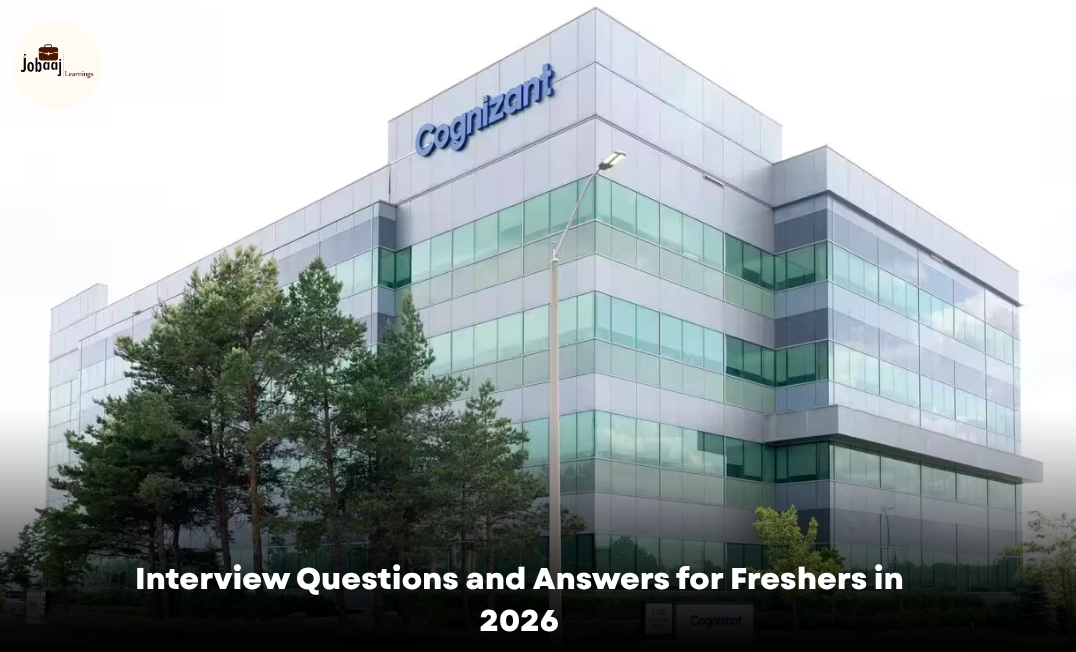
Getting selected by a reputed IT company like Cognizant is a dream for many fresh graduates starting their careers in the technology industry. Cognizant conducts multiple rounds of interviews to evaluate candidates on their technical knowledge, problem-solving ability, communication skills, and overall suitability for the role.
For freshers, the Cognizant interview process generally includes HR discussions, technical interviews, and questions based on programming concepts, databases, projects, and computer science fundamentals.
Many candidates prepare only technical topics but ignore important HR questions like “Tell me about yourself”, “Why do you want to join Cognizant?”, and “Why should we hire you?” These questions play an important role because they help recruiters understand your confidence, career goals, and attitude.
The key to cracking a Cognizant interview is not memorising answers but understanding the concepts and learning how to present your knowledge effectively.
In this blog, we have covered the top 25 Cognizant interview questions and answers for freshers, including HR questions, technical questions, programming concepts, SQL, DBMS, and project-based questions.
Cognizant Interview Preparation Tips for Freshers
Before appearing for a Cognizant interview, focus on these important areas:
Understand your resume:
Interviewers often ask questions from your resume. Be prepared to explain your projects, internships, skills, and certifications clearly.
Revise programming fundamentals:
Freshers should have a good understanding of programming concepts, OOPs, data structures, and basic problem-solving.
Prepare SQL and DBMS concepts:
Database questions are commonly asked in technical interviews, especially for IT roles.
Practice explaining projects:
Your project explanation should include the objective, technology used, your role, challenges faced, and outcome.
Top 25 Cognizant Interview Questions and Answers
1. Tell Me About Yourself
This is usually the first question asked in a Cognizant interview. Through this question, recruiters want to understand your background, communication skills, confidence, and how effectively you can introduce yourself.
A good introduction creates the first impression, so your answer should be clear and related to your professional journey.
How to answer:
Follow this structure:
- Start with your education background
- Mention relevant technical skills
- Explain projects or internships
- End with your career goals and interest in Cognizant
Avoid explaining personal details that are not related to the job.
Sample Answer:
“Thank you for giving me this opportunity. My name is Rahul Sharma, and I have recently completed my Bachelor’s degree in Computer Science.
During my academic journey, I developed an interest in software development and problem-solving. I have worked on academic projects where I applied programming concepts and improved my technical skills.
Apart from academics, I have also focused on learning new technologies through online courses and practical projects.
I am looking for an opportunity at Cognizant where I can apply my skills, learn from experienced professionals, and contribute to real-world technology solutions.”
2. Why Do You Want to Join Cognizant?
This question helps interviewers understand whether you have researched the company and whether you are genuinely interested in joining Cognizant.
Recruiters prefer candidates who understand the company’s work and have a clear reason for applying.
How to answer:
Your answer should include:
- What you know about Cognizant
- Learning opportunities
- Technology exposure
- Career growth
Avoid saying only “because Cognizant is a big company.”
Sample Answer:
“I want to join Cognizant because it is one of the leading IT services companies that provides opportunities to work on diverse technology projects across different industries.
As a fresher, I am looking for an organisation where I can improve my technical skills, learn from experienced professionals, and gain exposure to real-world projects.
I believe Cognizant’s learning environment and focus on innovation will help me build a strong foundation for my career.”
3. What Do You Know About Cognizant?
This question checks whether you have done basic research about the company before attending the interview.
A candidate who understands the organisation shows genuine interest and better preparation.
How to answer:
Mention:
- Company background
- Industry presence
- Services offered
- Global presence
Keep your answer brief and relevant.
Sample Answer:
“Cognizant is a multinational technology company that provides IT services, consulting, and digital transformation solutions to businesses worldwide.
The company works in areas such as cloud computing, artificial intelligence, data analytics, software development, and business consulting.
Cognizant has a strong global presence and helps organisations improve their digital capabilities through technology solutions.”
4. Why Should We Hire You?
Cognizant asks this question to understand your confidence and how your skills match the requirements of the role.
For freshers, companies mainly look for learning ability, adaptability, and a positive attitude.
How to answer:
Focus on:
- Your willingness to learn
- Technical foundation
- Problem-solving ability
- Teamwork skills
Avoid comparing yourself with other candidates.
Sample Answer:
“As a fresher, I may not have extensive professional experience, but I bring strong learning ability, adaptability, and dedication towards my work.
Through my academic projects and technical learning, I have developed problem-solving skills and the ability to work in a team environment.
I believe my willingness to learn new technologies and my commitment towards continuous improvement will help me contribute effectively at Cognizant.”
5. What Are Your Strengths and Weaknesses?
This question helps interviewers understand your self-awareness and whether you can identify your positive qualities and areas of improvement.
How to answer:
Choose strengths that are useful for the role and explain how they have helped you.
For weaknesses, mention a genuine area of improvement and explain what steps you are taking to improve it.
Good strengths include:
- Quick learner
- Problem-solving ability
- Adaptability
- Teamwork
- Time management
Sample Answer:
“One of my strengths is my ability to learn quickly. Whenever I come across a new technology or concept, I try to understand it through practice and real examples.
Another strength is my problem-solving approach. During my academic projects, I focused on analysing problems and finding practical solutions.
One area I am working on improving is spending extra time ensuring my work is accurate. To improve this, I have started setting priorities and managing my time more effectively.”
6. Where Do You See Yourself After 5 Years?
This question helps Cognizant recruiters understand your career goals, ambition, and whether you are interested in long-term growth with the organisation.
Companies prefer candidates who have a learning mindset and want to develop their skills over time.
How to answer:
Your answer should focus on:
- Professional growth
- Learning new technologies
- Taking more responsibilities
- Contributing to the organisation
Avoid giving unrealistic answers like becoming a manager immediately.
Sample Answer:
“In the next five years, I see myself as a skilled professional with strong knowledge in my field. I want to continuously improve my technical and problem-solving skills while taking on more challenging responsibilities.
I would like to grow with Cognizant, contribute to important projects, and become someone who can add value to the team through my skills and experience.”
7. Are You Comfortable Relocating?
Cognizant has offices across different locations, and employees may be required to work from different locations depending on project requirements.
This question checks your flexibility and willingness to adapt.
How to answer:
Be honest but show openness towards opportunities.
If you have no restrictions, clearly mention your flexibility.
Sample Answer:
“Yes, I am comfortable relocating if required by the organisation. I believe working in different locations helps in learning new things, experiencing different work environments, and growing professionally.”
8. Are You Comfortable Working With Different Technologies?
Cognizant works with multiple technologies and domains, so freshers may be assigned projects based on business requirements.
This question checks your adaptability and willingness to learn.
How to answer:
Show that you have a strong foundation and are open to learning new technologies.
Sample Answer:
“Yes, I am comfortable working with different technologies. I believe technology keeps evolving, and continuous learning is important in the IT industry.
I have a basic understanding of programming concepts and I am always willing to learn new tools and technologies based on project requirements.”
9. Explain Your Resume
Interviewers often use your resume as a starting point for technical discussions. They want to check whether you genuinely understand the skills and experiences mentioned in your profile.
How to answer:
Explain your resume in this order:
- Education background
- Technical skills
- Projects
- Internships or certifications
- Achievements
Do not simply read your resume. Explain the important points.
Sample Answer:
“I have completed my Bachelor’s degree in Computer Science. During my academic journey, I developed an interest in programming and software development.
I have worked with technologies like Java, SQL, and Python through projects and practical learning.
My major project helped me understand how technical concepts are applied in real-world scenarios. Along with technical skills, I have also focused on improving my communication and teamwork abilities.”
10. Explain Your Final Year Project
Project-based questions are very common in Cognizant technical interviews. Recruiters want to understand your practical knowledge and whether you have actually worked on the project.
How to answer:
Explain:
- Project title
- Objective
- Technologies used
- Your role
- Challenges faced
- Outcome
Sample Answer:
“My final year project was a web-based inventory management system. The objective of the project was to simplify inventory tracking and reduce manual record management.
We used technologies like Java, SQL, and web development tools to build the application.
My role was mainly focused on database management and backend development. Through this project, I improved my programming skills and learned how to work effectively as part of a team.”
11. What Was Your Role in Your Project?
This question helps interviewers understand your individual contribution. Many candidates mention team projects but fail to explain what they personally worked on.
How to answer:
Clearly mention:
- Your responsibilities
- Technologies you used
- Problems you solved
Be honest about your contribution.
Sample Answer:
“In my project, my responsibility was mainly focused on backend development and database management.
I worked on creating database structures, writing queries, and integrating different modules.
I also participated in testing and debugging activities, which helped me improve my problem-solving skills and understand the complete project workflow.”
12. What Challenges Did You Face During Your Project?
Cognizant interviewers ask this question to evaluate your problem-solving approach and ability to handle difficulties.
How to answer:
Explain:
- The challenge
- Your approach
- The solution
- The learning outcome
Sample Answer:
“During my project, we faced challenges while integrating different components because some modules were not working properly together.
I analysed the issue, discussed it with my team members, and we tested different solutions step by step.
Eventually, we successfully resolved the problem. This experience taught me the importance of teamwork, patience, and systematic problem-solving.”
Technical Interview Questions
13. Explain Object-Oriented Programming Concepts
OOP concepts are among the most commonly asked technical questions for Cognizant freshers, especially for candidates from computer science backgrounds.
Interviewers ask this question to check your understanding of programming fundamentals.
How to answer:
Explain the four main pillars of OOP:
- Encapsulation
- Inheritance
- Polymorphism
- Abstraction
Sample Answer:
“Object-Oriented Programming is a programming approach based on objects and classes.
The four main concepts of OOP are:
Encapsulation: It combines data and methods into a single unit and provides data security.
Inheritance: It allows one class to acquire properties and behaviours of another class.
Polymorphism: It allows methods to perform different functions based on the situation.
Abstraction: It hides unnecessary implementation details and shows only essential information to users.”
14. Difference Between Class and Object
This question checks your basic understanding of object-oriented programming.
How to answer:
Explain the difference with a simple example.
Sample Answer:
“A class is a blueprint or template used to create objects. It defines the properties and behaviours that an object will have.
An object is an actual instance of a class that represents a real-world entity.
For example, a class can be considered a blueprint of a car, while a specific car created using that blueprint is an object.”
15. Difference Between Method Overloading and Method Overriding
This is a common Java and OOP interview question.
How to answer:
Explain the difference based on:
- Definition
- When it happens
- Purpose
Sample Answer:
“Method overloading means having multiple methods with the same name but different parameters within the same class. It is an example of compile-time polymorphism.
Method overriding happens when a child class provides a different implementation of a method already defined in the parent class. It represents runtime polymorphism.”
16. What Are the Four Pillars of OOP?
This is a frequently asked technical question for software development roles. Cognizant interviewers ask this to check whether you have a strong understanding of object-oriented programming fundamentals.
How to answer:
Explain all four concepts briefly with their practical meaning:
- Encapsulation
- Inheritance
- Polymorphism
- Abstraction
Sample Answer:
“The four pillars of Object-Oriented Programming are:
Encapsulation: It combines data and methods into a single unit and restricts direct access to data for better security.
Inheritance: It allows one class to reuse the properties and methods of another class, which improves code reusability.
Polymorphism: It allows the same method or function to behave differently in different situations.
Abstraction: It hides complex implementation details and only shows the required information to the user.
These concepts help developers create structured, reusable, and maintainable programs.”
17. Explain DBMS and Its Importance
Database Management System is an important topic for Cognizant technical interviews, especially for candidates applying for software and data-related roles.
How to answer:
Explain:
- What DBMS is
- Why it is used
- Real-world applications
Sample Answer:
“A Database Management System, or DBMS, is software used to store, manage, organise, and retrieve data efficiently.
It allows users and applications to interact with databases while maintaining data security, consistency, and accuracy.
For example, banking systems use DBMS to store customer information, transaction details, and account records securely.”
18. Difference Between Primary Key and Foreign Key
This question tests your understanding of database relationships and data integrity.
How to answer:
Explain the purpose and difference clearly.
Sample Answer:
“A primary key is a column or combination of columns that uniquely identifies each record in a table. It cannot contain duplicate or null values.
A foreign key is a column that creates a relationship between two tables by referring to the primary key of another table.
For example, a customer ID can be a primary key in a customer table and the same customer ID can act as a foreign key in an order table.”
19. Explain SQL Joins With Examples
SQL joins are commonly asked in Cognizant technical interviews because databases are an important part of software development.
How to answer:
Explain that joins are used to combine data from multiple tables.
Mention common types:
- Inner Join
- Left Join
- Right Join
- Full Join
Sample Answer:
“SQL joins are used to combine data from two or more tables based on a related column.
An Inner Join returns only the matching records from both tables.
A Left Join returns all records from the left table and matching records from the right table.
For example, if we have a customer table and an order table, joins can help us combine customer details with their order information.”
20. Difference Between DELETE, DROP, and TRUNCATE
This is a common SQL question asked to check your understanding of database operations.
How to answer:
Explain the difference based on:
- Type of operation
- Data removal
- Table structure
Sample Answer:
“DELETE, DROP, and TRUNCATE are used for removing data in SQL, but they work differently.
DELETE: Removes selected records from a table and can use conditions with WHERE.
TRUNCATE: Removes all records from a table but keeps the table structure.
DROP: Completely removes the table along with its structure and data.
For example, if we only want to remove specific customer records, we use DELETE. If we want to remove the entire table, we use DROP.”
21. What Is Normalisation in Database?
Interviewers ask this question to check your understanding of database design and avoiding data duplication.
How to answer:
Explain:
- Meaning of normalisation
- Purpose
- Benefits
Sample Answer:
“Database normalisation is a process of organising data in a database to reduce redundancy and improve data consistency.
It divides large tables into smaller related tables and establishes relationships between them.
The main benefits of normalisation are reducing duplicate data, improving data accuracy, and making database management easier.”
22. Difference Between Process and Thread
This question tests your operating system fundamentals, which are commonly asked in technical interviews.
How to answer:
Explain the difference based on:
- Definition
- Memory usage
- Execution
Sample Answer:
“A process is an independent program that has its own memory space and resources.
A thread is a smaller unit of execution within a process that shares the same memory resources.
Processes are heavier and require more resources, while threads are lightweight and allow faster execution within applications.”
23. What Is Exception Handling?
Exception handling is an important programming concept, especially in languages like Java and Python.
Interviewers ask this to understand whether you know how to handle errors in programs.
How to answer:
Explain:
- Meaning of exception handling
- Why it is used
- Common keywords
Sample Answer:
“Exception handling is a mechanism used to handle runtime errors and prevent the program from crashing unexpectedly.
It allows developers to manage errors and maintain the normal flow of execution.
In Java, exception handling is implemented using keywords like try, catch, finally, and throw.”
24. Write a Program to Check Whether a String Is Palindrome
Coding questions are often included in Cognizant technical interviews to evaluate your logical thinking and programming approach.
How to answer:
Explain your logic first before writing the code.
Logic:
- Reverse the given string
- Compare it with the original string
- If both are equal, it is a palindrome
Sample Answer (Java):
public class Palindrome {
    public static void main(String[] args) {
        String str = "madam";
        String rev = "";

        for(int i = str.length()-1; i >= 0; i--) {
            rev = rev + str.charAt(i);
        }

        if(str.equals(rev)) {
            System.out.println("Palindrome");
        } else {
            System.out.println("Not Palindrome");
        }
    }
}
25. Do You Have Any Questions for Us?
This is usually the final question in a Cognizant interview. Many candidates ignore this opportunity, but asking thoughtful questions shows your interest in the role.
How to answer:
Ask questions related to:
- Role responsibilities
- Learning opportunities
- Team structure
- Growth opportunities
Avoid asking only about salary or benefits during the first interaction.
Sample Answer:
“Yes, I would like to know more about the learning opportunities available for freshers at Cognizant and how the organisation supports employees in developing new technical skills.
I would also like to understand the type of projects that freshers usually get an opportunity to work on.”
Common Mistakes to Avoid in Cognizant Interview
Even after good preparation, some mistakes can affect your interview performance. Avoid these common errors:
1. Not Knowing Your Resume
Be prepared to explain every skill, project, and certification mentioned on your resume.
2. Memorising Answers
Prepared answers are helpful, but speaking like a script can make your responses sound unnatural.
3. Ignoring Basic Concepts
Many candidates focus only on advanced topics but fail to answer basic programming, SQL, and DBMS questions.
4. Giving False Information
Never mention skills or projects that you cannot explain during the interview.
5. Not Researching Cognizant
Understanding Cognizant’s services, work culture, and technology areas shows genuine interest.
Final Tips to Crack Cognizant Interview
A Cognizant interview is not only about technical knowledge. The company also looks for candidates who are adaptable, willing to learn, and capable of working in a professional environment.
Before your interview:
- Revise programming fundamentals
- Practice SQL and DBMS concepts
- Prepare your project explanation
- Research Cognizant and the role
- Practice speaking confidently
Remember, as a fresher, you are not expected to know everything. What matters most is your ability to learn, your problem-solving approach, and your willingness to grow.
Frequently asked questions
What are the most commonly asked Cognizant interview questions for freshers?
Cognizant commonly asks questions related to self-introduction, company knowledge, projects, programming concepts, OOPs, SQL, DBMS, and basic computer science fundamentals.
Is Cognizant interview difficult for freshers?
Cognizant interviews are generally manageable for freshers who have a clear understanding of programming basics, technical concepts, projects, and good communication skills.
What programming languages should I prepare for Cognizant interview?
Freshers should prepare at least one programming language properly, such as Java, Python, C++, or C, along with basic problem-solving concepts.
Does Cognizant ask SQL questions in interviews?
Yes, Cognizant often asks basic SQL and DBMS questions related to queries, joins, keys, normalisation, and database concepts.
How should freshers prepare for Cognizant technical interviews?
Freshers should focus on programming fundamentals, OOP concepts, DBMS, SQL, projects, and practising common interview questions with clear explanations.
Join 5,00,000+ Subscribers
Be a part of our ever growing community.