Categories












/content/learnings/assets/header/ManagementConsulting.svg)
/content/learnings/assets/header/InvestmentBanking.svg)
























/content/learnings/assets/header/programs/1.png)
/content/learnings/assets/header/programs/4.png)

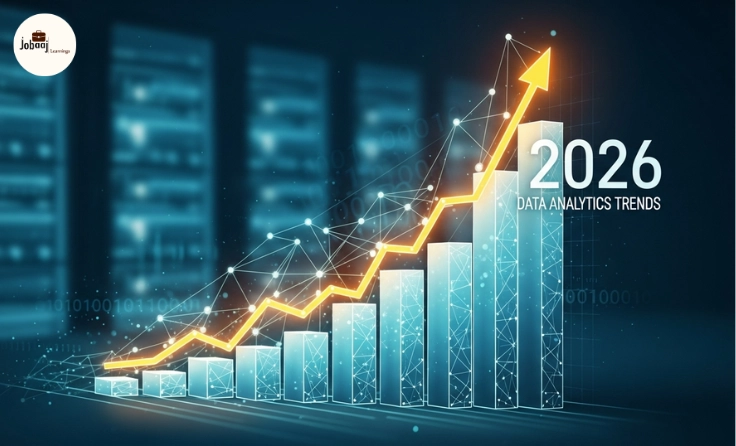
The world of data analytics is evolving faster than ever, with new technologies, tools, and trends emerging all the time. In 2026, the field is set to undergo even more transformations as businesses and organizations harness the power of data to stay competitive.
Exploring a career in Data and Business Analytics? Apply Now!
Whether you’re a seasoned data professional or just getting started, keeping up with the latest trends is essential. Data analytics is no longer just about analyzing historical data; it’s about predicting the future, making smarter decisions, and driving innovation. In this blog, we’ll explore the most significant data analytics trends in 2026, and why you should pay attention to them to stay ahead of the curve.
1. AI and Machine Learning Integration
AI and machine learning (ML) are already transforming the world of data analytics, but by 2026, their integration will be more seamless than ever. These technologies will help businesses:
-
Automate the analysis of massive datasets.
-
Predict trends and outcomes with higher accuracy.
-
Generate insights in real-time, enabling faster decision-making.
In 2026, AI-powered analytics tools will become the norm, empowering companies to automate insights, reduce human error, and unlock new opportunities.
2. Edge Analytics for Real-Time Decision Making
With the explosion of the Internet of Things (IoT), data is being generated everywhere. Edge analytics will allow data to be processed at the source (the "edge" of the network) instead of sending it all to a centralized server. This means:
-
Faster decision-making with real-time data processing.
-
Improved security by keeping sensitive data local.
-
Cost-efficiency as less data needs to be transmitted to the cloud.
By 2026, edge analytics will be crucial in industries like manufacturing, healthcare, and transportation, where real-time data is essential for efficiency.
3. Cloud-Native Analytics Platforms
As more companies transition to cloud computing, cloud-native analytics platforms will take center stage in 2026. These platforms will allow businesses to:
-
Scale their data storage and processing capabilities efficiently.
-
Leverage powerful AI and ML algorithms directly in the cloud.
-
Access real-time analytics without the need for on-premise hardware.
Cloud-native platforms like Google BigQuery, AWS Redshift, and Microsoft Azure will make data analytics more accessible and scalable for businesses of all sizes.
4. Augmented Analytics
Augmented analytics is the next evolution of traditional data analytics, where AI and ML work together to assist in the data analysis process. In 2026, this trend will empower businesses to:
-
Automate data preparation, reducing time spent on manual tasks.
-
Generate insights without needing deep technical expertise.
-
Improve predictive modeling, making it easier to forecast future outcomes.
The rise of self-service analytics tools will democratize data analysis, enabling non-technical users to make data-driven decisions.
5. Explainable AI (XAI)
As AI models become more complex, explainable AI (XAI) will become crucial in ensuring that AI-driven decisions are understandable and trustworthy. Businesses will need to adopt XAI to:
-
Ensure transparency in AI-generated insights and decisions.
-
Build trust with customers and stakeholders by explaining how AI systems make decisions.
-
Stay compliant with data regulations that require businesses to explain automated decisions.
By 2026, expect XAI to be widely adopted across industries like finance, healthcare, and insurance, where regulatory requirements demand clear explanations.
6. Data Privacy and Security in Analytics
As data breaches and privacy concerns become more prevalent, data privacy and security will continue to be top priorities for businesses in 2026. Key trends include:
-
Stronger data encryption and secure data storage methods.
-
Compliance with global data privacy regulations like GDPR and CCPA.
-
Ethical AI models that protect sensitive data.
Companies will need to balance data-driven decision-making with ethical data use and compliance, ensuring they protect both consumer and corporate interests.
7. Natural Language Processing (NLP) for Data Interaction
Natural Language Processing (NLP) will allow users to interact with analytics platforms using everyday language. This trend will be huge in 2026 as:
-
Users will be able to ask questions like, "What were our sales last quarter?" or "Which market should we enter next?" and get instant insights.
-
AI-powered chatbots and voice assistants will be integrated into analytics tools, improving the user experience.
-
Businesses will be able to provide real-time customer service using NLP technology, helping customers interact with systems more intuitively.
As NLP becomes more advanced, it will simplify data analysis and make it more accessible for everyone in the organization.
8. Data Democratization
Data democratization is the process of making data accessible to everyone, not just data scientists. In 2026, this trend will become more prevalent as businesses:
-
Provide self-service analytics tools to employees across departments.
-
Encourage data literacy by training employees to understand and use data in their day-to-day tasks.
-
Break down silos between technical and non-technical teams, allowing everyone to access and act on data.
By 2026, data democratization will empower all teams—marketing, sales, operations—to make data-driven decisions without relying solely on specialized data teams.
9. Data Governance and Ethics
As data becomes more central to business operations, data governance and ethics will take center stage. By 2026:
-
Companies will implement stronger governance frameworks to ensure data is used responsibly and ethically.
-
AI models will be built to be unbiased and transparent, ensuring fairness in data-driven decisions.
-
Organizations will focus on making sure that data privacy laws are adhered to, while also ensuring their use of data is ethical.
Expect a major shift in how organizations manage their data and prioritize ethical decision-making as data plays a larger role in everyday operations.
10. Quantum Computing in Data Analytics
Although it’s still in its early stages, quantum computing is set to revolutionize data analytics in the coming years. By 2026, businesses will begin to see the potential of quantum computing in:
-
Solving complex problems faster than classical computers ever could.
-
Enhancing predictive models with unparalleled computational power.
-
Unlocking new insights in fields like healthcare, logistics, and material science.
As quantum computing evolves, it will enable businesses to process vast amounts of data and develop insights that were previously unimaginable.
Conclusion
The world of data analytics in 2026 is full of exciting and transformative trends that will revolutionize the way businesses interact with data. From AI-driven insights and edge analytics to data democratization and quantum computing, these trends will shape the future of industries and create new opportunities for innovation.
For those working in or entering the field of data analytics, staying ahead of these trends is key to staying competitive. Embrace these changes and continuously improve your skills to be ready for the data-driven future that lies ahead.
Aspiring for a career in Data and Business Analytics? Begin your journey with a Data and Business Analytics Certificate from Jobaaj Learnings.
Frequently asked questions
What are the key data analytics trends for 2026?
Key trends for 2026 include AI and machine learning integration, edge computing, quantum computing, augmented analytics, and explainable AI, all of which will reshape how businesses use data.
How will AI impact data analytics in 2026?
AI will continue to enhance data analytics by automating insights generation, improving predictive analytics, and enabling real-time decision-making, making it easier for businesses to process and act on data.
What is edge analytics and why is it important?
Edge analytics involves processing data closer to where it is generated, allowing for faster, real-time insights. This is important for industries like manufacturing and healthcare that require immediate decision-making.
How can businesses benefit from augmented analytics in 2026?
Augmented analytics will allow businesses to automate data analysis, generate insights faster, and improve decision-making by using AI and machine learning to simplify complex tasks.
Why is explainable AI important in data analytics?
Explainable AI ensures transparency in AI-driven decision-making, helping businesses maintain accountability and trust while using AI models to analyze data and make decisions.
What are cloud-native analytics platforms?
Cloud-native analytics platforms are built to run on cloud infrastructure, offering scalability, real-time processing, and seamless integration with AI and machine learning tools, making them ideal for modern data analytics needs.

Join 5,00,000+ Subscribers
Be a part of our ever growing community.