Categories





































Durga Prasana's Jobaaj Learnings Review: From Chartered Accountant to Investment Banking at Oxan Partners

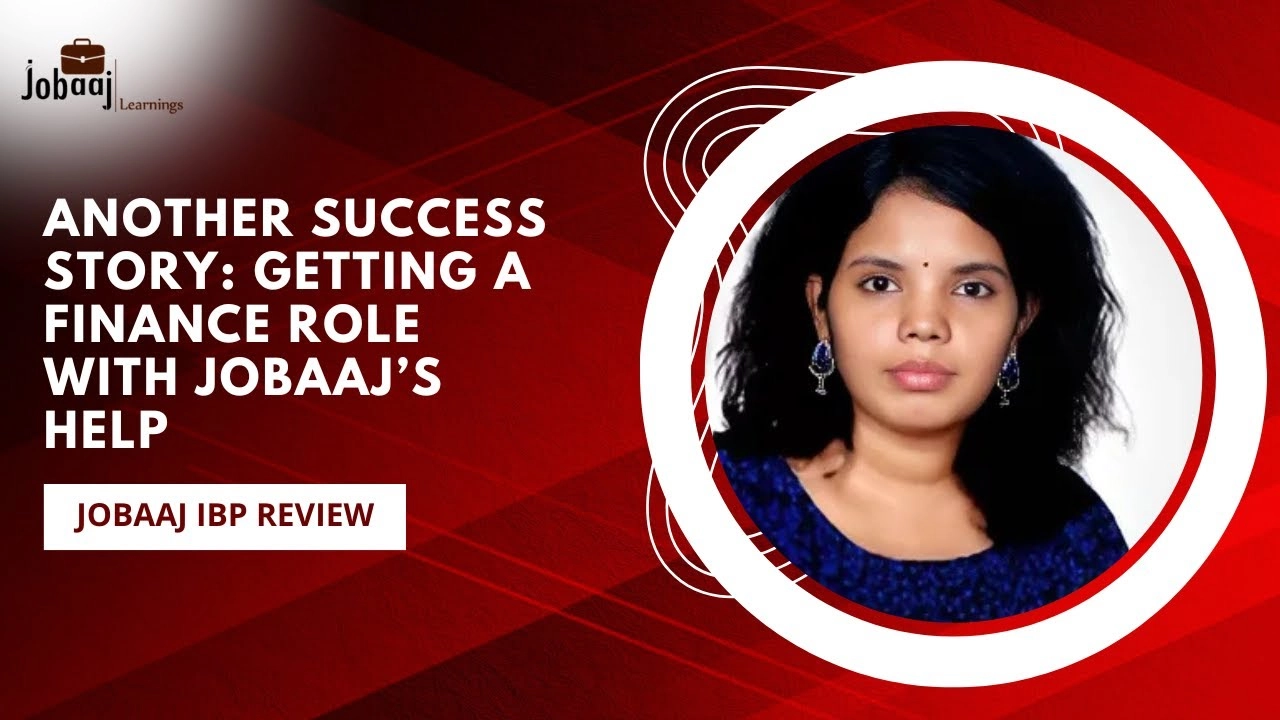
"There were times I got fed up, especially with the same mistakes, but after some conversations, I understood where I was going wrong. Now, I can explain these concepts to others confidently." — Durga Prasana
Durga Prasana is a qualified Chartered Accountant, having cleared in the May 2024 attempt. She worked until July 2024 and then set out to break into investment banking — and found it hard enough that she enrolled in Jobaaj Learnings' Investment Banking Program with its placement support. Roughly two months into the placement process, she was hired at Oxan Partners.
If you are searching “is Jobaaj Learnings genuine”, “is Jobaaj real or fake” or “is CA enough for investment banking”, Durga's is the clearest answer to that last question from someone who holds the qualification. She says CA gave her credibility and shortlists but not the technical skills the industry wanted. She is also candid that she got fed up during the assignments and faced rejections along the way. Read it alongside the other conversations in our Interview Series and the wider feedback on the reviews page.
Key Takeaways: Durga's Jobaaj Learnings Review
- Profile: qualified Chartered Accountant, cleared in the May 2024 attempt. Worked until July 2024.
- Why she needed more: CA gave her solid theory; investment banking wanted specific technical skills and practical experience she did not have.
- What CA did do: gave her credibility and got her shortlisted by many good companies — her words.
- The assignments were the hard part. She made repeated mistakes, got detailed feedback, and admits to getting fed up before it clicked.
- What she learned practically: how concepts like working capital actually appear in real company financial statements, not just in theory.
- Placement support: two named coordinators who handled LinkedIn optimisation, how to approach HR, and applying for roles.
- Timeline: about two months from starting the placement process to the offer, across one or two interviews — alongside rejections she mentions separately.
- Outcome: hired at Oxan Partners as a fresher in the industry. Role title and salary not stated.
- On gender: she reports no discrimination, and says both men and women helped her with referrals and questions.
Who Is Durga Prasana? A CA Who Couldn't Get Into IB
Durga qualified as a Chartered Accountant in the May 2024 attempt and was working until July 2024. Then she started looking for investment banking roles — and hit a wall:
"It was tough to break into, so I decided to pursue coaching and an internship to help me gain a foothold."
That is a striking position to be in. India's most demanding professional finance qualification, and still unable to convert applications in the finance domain she wanted.
Why CA Alone Wasn't Enough
Her explanation is measured and does not disparage her own qualification:
"CA is a very professional and rewarding qualification. It pays well in many domains. But when it comes to investment banking, you need more specific technical skills and deep knowledge. While CA gave me solid theoretical understanding, I needed practical experience and mentorship to understand what the industry actually requires."
And later in the conversation she gives the other half, which matters just as much:
"CA definitely gave me an edge. It helped me get shortlisted by many good companies. Even though I faced rejections, I know the CA qualification gave me credibility and helped me stand out."
Read those two together. CA got her through the door to be considered; it did not get her through the technical assessment. The gap was application, not credibility.
The Assignments: Where She Nearly Gave Up
This is the most honest part of Durga's account, and we are giving it space rather than a passing mention.
Her starting point: “It was a completely new experience for me. Before the assignments, I only knew the theory.”
What the assignments taught her, concretely: “I learned how working capital is applied in real company financial statements, not just the theory.”
What it cost:
"Initially, I made some mistakes in my assignments, like the capital growth percentage, but I received detailed feedback... There were times I got fed up, especially with the same mistakes, but after some conversations, I understood where I was going wrong."
Her verdict afterwards is worth noting too: “Now, I can explain these concepts to others confidently.”
What the Placement Team Actually Did
Durga names two coordinators, Vishakha and Vanshika, and lists specific actions rather than general support:
- LinkedIn optimisation
- How to approach HR — something she says she did not know how to do
- Applying for roles
- Answering questions, in her words, “no matter how small the doubt”
The process started after she completed her assignments — the placement team reached out to her, rather than the other way round.
The Timeline and the Outcome
| Stage | Detail |
|---|---|
| CA qualified | May 2024 attempt |
| Working until | July 2024 |
| Placement process to offer | About two months |
| Interviews before the offer | One or two — though she refers separately to facing rejections |
| Employer | Oxan Partners |
| Role title / salary | Not stated |
She describes the outcome as “a great opportunity to work as a fresher in this industry” — entering investment banking at entry level despite holding a CA.
On Being a Woman in Finance
Asked directly whether she faced gender-based discrimination in what is often described as a male-dominated industry, Durga's answer was unqualified:
"No, sir, I never faced any discrimination. Many people, both men and women, were willing to help me with referrals or doubts. I didn't experience any setbacks because of my gender."
That is one person's experience of one job search, and it does not settle a structural question — but it is her answer, given directly, and it belongs on the record as she gave it.
Pros and Cons, Based on Durga's Account
What worked:
- Assignments that converted CA theory into applied work on real financial statements
- Detailed feedback, repeated until the concepts held
- Two named placement coordinators handling LinkedIn, HR outreach and applications
- Learning how to approach companies and ask for referrals — something she had no idea how to do
- An offer roughly two months into the placement process
What she says was hard:
- She got fed up during the assignments, particularly repeating the same mistakes.
- She faced rejections during the search, despite the CA shortlisting advantage.
- She entered as a fresher — a qualified CA taking an entry-level industry position.
- No role title or salary is disclosed, so the outcome cannot be sized.
Investment Banking Interview Questions and Model Answers
What technical skills make you an asset to this team?
Model answer: Financial analysis built on Excel — modelling, forecasting and ratio analysis — plus market data platforms for research. On the interpretive side, reading KPIs like EBITDA, P/E and debt-to-equity to form a view on financial health rather than just reporting the numbers.
How does working capital affect a company's financial health?
Model answer: Working capital is current assets minus current liabilities — a measure of short-term liquidity and operational efficiency. Positive working capital means the company can cover its near-term obligations and still reinvest. Negative working capital signals a liquidity problem that constrains both debt service and growth — though in some business models, such as retail with fast inventory turnover, it is normal rather than alarming.
Why does mentorship matter in investment banking?
Model answer: Because the gap between knowing the theory and doing the work is large, and it is mostly invisible from the outside. Someone who has already navigated it can tell you what the industry actually expects, which shortcuts months of guessing. In my own case, mentorship is what bridged academic knowledge and practical application.
Describe working under pressure.
Model answer: Preparing a financial model against a tight deadline with several data discrepancies still unresolved. I broke it into smaller steps, dealt with the discrepancies that materially changed the output first, and kept the team informed as I went. Staying organised is what makes a deadline achievable; panicking about it does not.
How do you stay updated on the finance industry?
Model answer: Financial news and market reports daily, practitioners on professional networks, and webinars or networking events for what is not yet written down. Alongside that, structured courses in financial modelling and investment banking to keep the technical side current rather than only the commentary.
Is a CA qualification enough for investment banking?
Model answer: It is a genuine advantage for credibility and getting shortlisted — but on its own it is not sufficient. IB wants applied technical skill: modelling, valuation, and comfort in a spreadsheet under time pressure. The honest answer in an interview is to say what the qualification gives you and what you built separately to close the rest.
Durga's Advice for Breaking Into Finance
- Accept that it's hard for a fresher. Her opening line, and she does not soften it.
- Mentorship and professional guidance are the levers. Not more theory.
- Learn how to approach companies. She did not know how to reach out or ask for referrals — and that is a learnable skill, not a personality trait.
- Apply theory on a spreadsheet. That is where she found out what she did not actually understand.
- Persist through the corrections. The point where she was fed up was immediately before the point where it made sense.
Full Podcast Transcript
The complete conversation, unedited.
Podcaster: Good afternoon everyone. We're back with another successful placement. We have with us Miss Durga Prasana. How are you Durga?
Durga: I'm good, sir. How are you?
Podcaster: I'm fine as well. We are so happy to see that you got placed. So please tell our audience about yourself.
Durga: Hey everyone! I'm Durga Prasana, a qualified Chartered Accountant. After completing my qualification, I decided to pursue a career in investment banking. I know it's not an easy domain to break into, so I enrolled in an Investment Banking course with Jobaaj, along with their job assistance and placement program. After my internship, I was fortunate to receive a great opportunity to work as a fresher in this industry, thanks to the continuous support from the Jobaaj team.
Podcaster: Now let's break down your journey. You mentioned that you're a qualified CA. When did you complete your Chartered Accountancy?
Durga: I qualified in the May 2024 attempt.
Podcaster: May 2024! And did you work after that?
Durga: No, sir. I was working until July 2024. After that, I started looking for placements in the IB industry. It was tough to break into, so I decided to pursue coaching and an internship to help me gain a foothold. That's when I chose this course at Jobaaj.
Podcaster: Right! So, Durga, CA is a prestigious degree and many people consider it at some point. But why do you think CA alone wasn't enough to break into IB or core finance?
Durga: CA is a very professional and rewarding qualification. It pays well in many domains. But when it comes to investment banking, you need more specific technical skills and deep knowledge. While CA gave me solid theoretical understanding, I needed practical experience and mentorship to understand what the industry actually requires. That's where Jobaaj's professional guidance made a difference.
Podcaster: Right, you've studied a lot of theory in finance, but as you said, CA studies lack practical application.
Durga: Yes, exactly.
Podcaster: Now, let's talk about the journey with us. After enrolling, you studied and cleared the exam. Then came the assignments. How was that experience?
Durga: It was a completely new experience for me. Before the assignments, I only knew the theory, but the course helped me apply my knowledge practically. For example, I learned how working capital is applied in real company financial statements, not just the theory. Initially, I made some mistakes in my assignments, like the capital growth percentage, but I received detailed feedback from you, and I learned a lot. It was a great learning experience for me.
Podcaster: I can imagine you were frustrated at some points with all the corrections. It must have felt like a lot of work, right?
Durga: Yes, sir! There were times I got fed up, especially with the same mistakes, but after some conversations, I understood where I was going wrong. Now, I can explain these concepts to others confidently.
Podcaster: Exactly, the real learning happens when you apply theory on the spreadsheet. One mistake in a cell can ruin everything, and fixing it takes time. But that's the reality of the job!
Durga: Absolutely, sir.
Podcaster: After all the hard work with assignments, what was the placement process like?
Durga: After completing my assignments, the placement team reached out to me. Vishakha ma'am and Vanshika ma'am were instrumental in the entire placement process. They helped me with LinkedIn optimization, approaching HRs, and applying for roles. They guided me at every step, no matter how small the doubt. I felt very supported throughout the process.
Podcaster: How long did it take for you to land your job?
Durga: It took around two months from starting the placement process to getting the job. I attended one or two interviews before getting the offer from Oxan Partners.
Podcaster: So, was CA helpful in landing the job, or do you think the rejections were more about your profile or performance?
Durga: CA definitely gave me an edge. It helped me get shortlisted by many good companies. Even though I faced rejections, I know the CA qualification gave me credibility and helped me stand out.
Podcaster: People often say that finance is a male-dominated industry. Did you face any gender-based discrimination or challenges?
Durga: No, sir, I never faced any discrimination. Many people, both men and women, were willing to help me with referrals or doubts. I didn't experience any setbacks because of my gender.
Podcaster: That's great to hear. And finally, what advice would you give to others who want to break into the finance industry, especially women?
Durga: I would say, it's not easy for a fresher to get into the finance industry, but mentorship and professional guidance are key. I didn't know how to approach companies or apply for referrals initially, but with the help of Jobaaj, I learned everything. Finance is competitive, but with persistence and the right guidance, anyone can make it.
Frequently Asked Questions
Is Jobaaj Learnings genuine, or is it fake?
This page documents one recorded case: Durga Prasana, a Chartered Accountant who qualified in May 2024, took the Investment Banking Program and was hired at Oxan Partners roughly two months into the placement process. She names her employer and her coordinators, and admits on camera to getting fed up with the assignments and facing rejections. No salary is disclosed. See the wider review set on the reviews page.
Is a CA qualification enough to get into investment banking?
Durga's answer is no, on its own — but it helps. CA gave her credibility and got her shortlisted at good companies; what it did not give her was the specific technical skill and practical experience the industry tests for.
What's the hardest part of the course?
The assignments. She made repeated mistakes, needed several rounds of feedback, and admits to getting fed up. Two other candidates in this series describe the same assignments as the hardest part of the programme.
How long did it take her to get placed?
About two months from the start of the placement process to the offer, across one or two interviews — alongside rejections she mentions separately.
What did the placement team do?
LinkedIn optimisation, teaching her how to approach HR, and helping her apply for roles — plus answering questions however small. She says she did not know how to approach companies or ask for referrals before that.
Is finance harder for women to break into?
Durga says she faced no discrimination during her search, and that both men and women helped her with referrals and questions. That is her experience of one job search rather than an answer to the wider question.
Join 5,00,000+ Subscribers
Be a part of our ever growing community.
Related reads
Ankit's Jobaaj Learnings Review: From Inventory to Remote Financial Controller at Blue Polaris
Vedant Jobaaj Learnings Review: From CFA Level 1 to Associate Analyst at CareEdge Advisory