Categories








































Priya's Jobaaj Learnings Review: From Equity Knowledge Partners to Investment Banking Analyst at Evalueserve

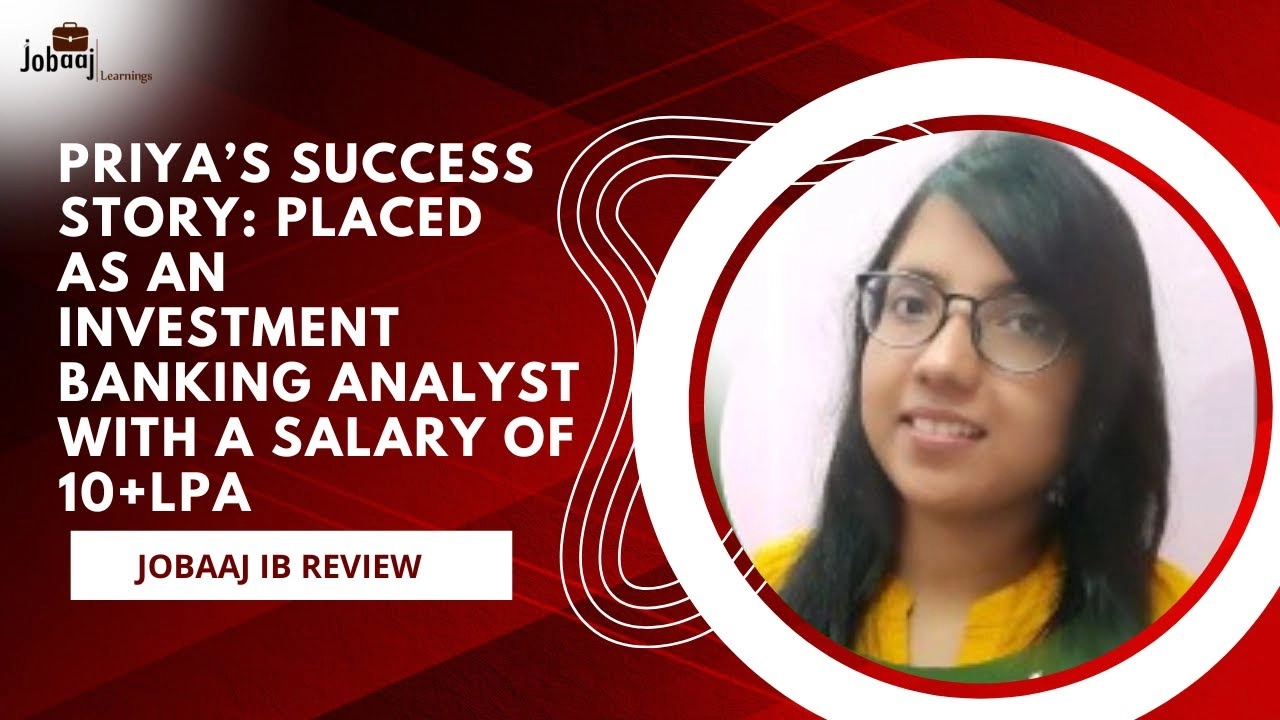
"If you give vague answers, interviewers will likely cross-question you. Being honest is important. If you don't know something, it's better to admit it and express your willingness to learn. That's exactly what I did during my interviews." — Priya
Priya is from Delhi, holds an Economics degree from Shyam Lal College, Delhi University and an MBA in finance, and has worked at Wipro, S&P Global, and Equity Knowledge Partners — where she has been an Investment Banking Analyst since April 2023. She received a call from Jobaaj about a role at Evalueserve, and moved there in the same role.
Worth being precise about what this page is, because the framing matters. Priya was already an Investment Banking Analyst with a year and a half in the role and prior experience at two large firms. This is an experienced professional switching employers, assisted by the recruitment side — not a fresher trained and placed by a course. She describes no coursework, mentors or modules anywhere in the conversation. What she does offer is genuinely valuable: a working analyst's account of what the job requires, what the tools are, and what a switch interview is like.
If you are searching “is Jobaaj real or fake” or “is Jobaaj Learnings genuine”, this evidences the recruitment service and provides a practitioner's skills breakdown. Read it alongside the other conversations in our Interview Series and the wider feedback on the reviews page.
Key Takeaways: Priya's Jobaaj Review
- Not a fresher story. Priya was already an Investment Banking Analyst with a year and a half in the seat.
- Background: Economics (Shyam Lal College, DU), MBA in finance. Prior experience at Wipro and S&P Global.
- Current role: Investment Banking Analyst at Equity Knowledge Partners since April 2023.
- Outcome: a move to Evalueserve in the same role, joining 13 January. Salary not disclosed.
- How it happened: a call from Jobaaj, then interview preparation and follow-up with HR to keep responses moving.
- The skills she names for IB: reading financial statements including footnotes and adjustments, trading and transaction comps, benchmarking research, PowerPoint for company profiles, and working Excel — advanced Excel is not mandatory.
- The tools: Capital IQ, Bloomberg and FactSet — which she says are not hard to learn if you do not know them yet.
- Switching was harder than entering. Her second interview was more technical, with higher expectations because of her experience.
- Her interview rule: never give vague answers — admit what you don't know and say you're willing to learn.
Who Is Priya? An Analyst Already Doing the Job
Priya's background is more substantial than most accounts in this series:
- Economics — Shyam Lal College, Delhi University
- MBA in finance
- Wipro and S&P Global — earlier roles
- Equity Knowledge Partners — Investment Banking Analyst since April 2023, over a year and a half
She was not trying to break into investment banking. She was already in it, and moving to a larger firm in the same role.
How the Move Happened
"I received a call from Jobaaj, and they guided me throughout the interview process. They helped me prepare for the interview and kept following up to ensure I was getting responses from the HR."
Three specific things in that sentence, and the third is the one experienced candidates value most:
- The opportunity came to her by phone.
- Interview preparation support.
- Chasing HR for responses — the part of a process where candidates most often go silent and give up.
What an Investment Banking Analyst Actually Needs
This is the most useful section on the page, because it comes from someone doing the job rather than preparing for it. Priya's list:
| Skill | What she says about it |
|---|---|
| Reading financial statements | Essential — including balance sheets, footnotes, and making adjustments |
| Trading and transaction comps | Core daily work |
| Research | Crucial, especially for benchmarking and comparing companies |
| PowerPoint | Needed for building company profiles |
| Excel | Good working knowledge — advanced Excel is not mandatory |
| Secondary research | A big part of preparing presentations |
Two details worth flagging, because they cut against common assumptions. Footnotes and adjustments get named explicitly — the tedious part of statement analysis that candidates skip and that the job depends on. And she says advanced Excel is not mandatory for this role, which contradicts what several other accounts in this series emphasise. Both can be true: different IB seats weight modelling and research differently, so ask what a specific role actually involves.
A Day in the Job
Priya's description is unglamorous and useful:
"My workday starts at 10 a.m., and the first thing I do is check emails and get to work. In Investment Banking, most tasks are based on daily deliverables, so I have to stay on top of my assignments and meet deadlines."
What lands on her desk varies by what the manager needs: company profiles, trading comps, transactions and benchmarking. Her summary: “Every day is a little different, but it's always about delivering high-quality work on time.”
The Tools
Across her roles Priya has used Capital IQ, Bloomberg and FactSet — the standard market data platforms — plus PowerPoint and Excel.
Her reassurance to candidates who have not used them: “Having knowledge of these tools can be beneficial, but they're not too hard to learn if you don't know them yet.” Access is the barrier, not difficulty; the platforms are expensive and mostly encountered on the job.
Switching Jobs Is Harder Than Getting the First One
Priya makes a point rarely covered in placement stories:
"As for the job switch, it was challenging, but having prior experience helped. The questions in my second interview were more technical, and I had to deal with higher expectations due to my experience."
Experience is an advantage and a liability at the same time. It gets you considered; it also raises the bar you are measured against. A fresher who cannot answer a technical question is inexperienced; an analyst who cannot is unconvincing.
Her Interview Rule: Don't Bluff
The most transferable advice in this conversation:
"If you give vague answers, interviewers will likely cross-question you. Being honest is important. If you don't know something, it's better to admit it and express your willingness to learn. That's exactly what I did during my interviews."
Note that she is describing what she actually did, in the interviews she cleared. A vague answer invites a follow-up question you are even less able to answer; an honest one ends the thread and demonstrates judgement.
Pros and Cons, Based on Priya's Account
What worked:
- An opportunity brought to her rather than found by her
- Interview preparation support for a more technical second-round process
- Active follow-up with HR to keep her application moving
- A move into the same role at a larger firm with a confirmed joining date
What this account does not cover:
- Any training programme. No course, mentors, assignments or modules are mentioned.
- Any career transition. She was already an IB analyst; the role did not change.
- Salary. Not disclosed, so the size of the move is unknown.
- Any criticism. She raises none, so there is nothing to report and we have not invented one.
Investment Banking Analyst Interview Questions and Model Answers
How do you analyse a company's financial health?
Answer: Start with the three statements together, then look at revenue trends, margins, liquidity, debt levels and cash generation. Ratios like current, quick and return on equity give the comparative picture. The part that separates real analysis from summary is reading the footnotes — that is where the adjustments that change the conclusion usually sit.
How do you prioritise multiple client requests under deadline?
Answer: Urgency against importance, with the complex items given more time rather than squeezed. In IB the work is daily deliverables, so slippage compounds fast — which is why keeping stakeholders informed about progress and any delay matters as much as the work itself.
Describe a challenging situation at work.
Answer: A financial model due on a tight deadline where the client data was incomplete. I worked with the team, went to other departments for the missing pieces, and put in extra hours to close it. It was delivered on time and the client was satisfied — but the real lesson was chasing the data early rather than working around the gap.
Explain a financial model you've used.
Answer: DCF, most extensively — forecasting future cash flows and discounting them to present value to reach an intrinsic valuation. It is most reliable for companies with strong, predictable cash generation, and least reliable exactly where people most want a precise answer.
How would you prepare a company profile for an investor?
Answer: Gather the financials and understand the business model first — revenue streams, competitive position, growth strategy. Then industry analysis and a peer comparison, recent financial performance, and an honest treatment of the key risks alongside the opportunities. A profile that lists only upside is not useful to an investor.
What if you don't have all the information you need?
Answer: Go and get it — colleagues, other departments, the client. If it genuinely is not available, make reasonable assumptions, complete the work, and state clearly which parts rest on assumption. Managing expectations about a data gap is better than delivering something that looks complete and is not.
Priya's Advice for Finance Job Seekers
- Work from the job description. Her main point — brush up specifically on the skills it names, so you know what to expect.
- Understand what the company is looking for before preparing, not after.
- Get the basics genuinely solid. For freshers: finance concepts and reading financial statements come before anything advanced.
- Never answer vaguely. It invites cross-questioning you cannot survive.
- Admit what you don't know and say you are willing to learn — her own approach in the interviews she cleared.
- Don't be put off by unfamiliar tools. Capital IQ, Bloomberg and FactSet are learnable on the job.
Full Podcast Transcript
The complete conversation, unedited.
Podcaster: Welcome, Priya, to this podcast! Let's start with a quick background of yourself. Can you tell us where you're from and what you're doing?
Priya: I'm from Delhi. I've been working with Equity Knowledge Partners for over a year and a half now. Before that, I gained experience at S&P Global and Wipro. As for my education, I did my MBA in finance and graduated with a degree in Economics from Delhi University's Shyam Lal College.
Podcaster: So, what profile do you hold at Equity?
Priya: I joined as an Investment Banking Analyst.
Podcaster: Interesting! When did you join?
Priya: I joined in April 2023.
Podcaster: Alright, so you're moving on now. What's next for you?
Priya: I've already received a job offer from Evalueserve, and I will be joining them on January 13.
Podcaster: That's fantastic! What profile will you be taking up at Evalueserve?
Priya: I'll be continuing with the same role — Investment Banking Analyst.
Podcaster: Excellent! Let's talk about how you secured this new opportunity. Could you share the process with us?
Priya: Sure! I received a call from Jobaaj, and they guided me throughout the interview process. They helped me prepare for the interview and kept following up to ensure I was getting responses from the HR. It was a really smooth process, and I'm grateful for their support.
Podcaster: So, Jobaaj played a key role in helping you make this switch. Now, for anyone looking to get into an Investment Banking profile, what skills are required?
Priya: In Investment Banking, you need to be able to read and understand financial statements. You'll work on trading forms and transaction forms, so having a good grasp of balance sheets, footnotes, and making adjustments is essential. Strong research skills are also crucial, especially for benchmarking and comparing companies. You also need to be proficient in PPT for making company profiles, and a good working knowledge of Excel is important, though advanced Excel skills aren't mandatory. Also, secondary research plays a big role in preparing presentations.
Podcaster: Sounds like a well-rounded skillset. What does your typical day at work look like?
Priya: My workday starts at 10 a.m., and the first thing I do is check emails and get to work. In Investment Banking, most tasks are based on daily deliverables, so I have to stay on top of my assignments and meet deadlines. It's crucial to stay proactive, complete tasks quickly, and communicate with the team to ensure timely delivery.
Podcaster: What kind of tasks do you usually handle?
Priya: It depends on the manager's request. Sometimes I prepare company profiles, work on trading comps, or handle transactions and benchmarking. Every day is a little different, but it's always about delivering high-quality work on time.
Podcaster: Now that you're switching to Evalueserve, what challenges did you face along the way, both while working in this domain and during your job switch?
Priya: In interviews, it's crucial how you respond to questions. If you give vague answers, interviewers will likely cross-question you. Being honest is important. If you don't know something, it's better to admit it and express your willingness to learn. That's exactly what I did during my interviews. As for the job switch, it was challenging, but having prior experience helped. The questions in my second interview were more technical, and I had to deal with higher expectations due to my experience.
Podcaster: So, for freshers, what should they focus on for an interview?
Priya: For freshers, having a solid understanding of the basics — like finance concepts and reading financial statements — is key. Once you have that, it's all about brushing up on your skills before the interview and understanding the job description. That way, you know what to expect.
Podcaster: Good advice! And what tools or software do you use at your workplace?
Priya: In my previous roles, I've worked with platforms like Capital IQ, Bloomberg, and FactSet. Having knowledge of these tools can be beneficial, but they're not too hard to learn if you don't know them yet. Additionally, proficiency in PowerPoint and Excel is essential for preparing presentations and building financial models.
Podcaster: That makes sense. Lastly, any advice for those looking for a job in finance, especially in Investment Banking?
Priya: I would advise job seekers to brush up on their skills, especially the ones mentioned in the job description. If you understand what the company is looking for, you can prepare accordingly. It's important to be proactive and practice before the interview, so you're ready for the questions that come your way.
Frequently Asked Questions
Is Jobaaj genuine, or is it fake?
This page documents one recorded case: Priya, an Investment Banking Analyst at Equity Knowledge Partners with prior experience at Wipro and S&P Global, who was called about a role at Evalueserve and moved there in the same position. Employers, role and joining date are named on camera. It evidences the recruitment side, not a course. See the wider review set on the reviews page.
Was Priya a fresher?
No. She had been an Investment Banking Analyst since April 2023, with earlier roles at Wipro and S&P Global. This is an experienced professional changing employers, not a career entry.
What skills do you need for an investment banking analyst role?
Her list: reading financial statements including footnotes and adjustments, trading and transaction comps, benchmarking research, PowerPoint for company profiles, and good working Excel — she says advanced Excel is not mandatory for her role.
Do you need to know Capital IQ, Bloomberg or FactSet?
Helpful but not a barrier. Priya says they are not too hard to learn if you have not used them — the difficulty is access rather than complexity.
Is switching jobs in IB harder than getting the first one?
In her experience the second interview was more technical, with higher expectations because of her experience. Experience gets you considered and simultaneously raises the standard you are held to.
What should you do if you don't know an interview answer?
Say so. Her rule: vague answers invite cross-questioning, so admit what you do not know and express willingness to learn. That is what she did in the interviews she cleared.
Join 5,00,000+ Subscribers
Be a part of our ever growing community.
Related reads
Ankit's Jobaaj Learnings Review: From Inventory to Remote Financial Controller at Blue Polaris
Vedant Jobaaj Learnings Review: From CFA Level 1 to Associate Analyst at CareEdge Advisory