Categories








































Nisha Saini's Jobaaj Learnings Review: From BA in English to Data Analyst at Numerator

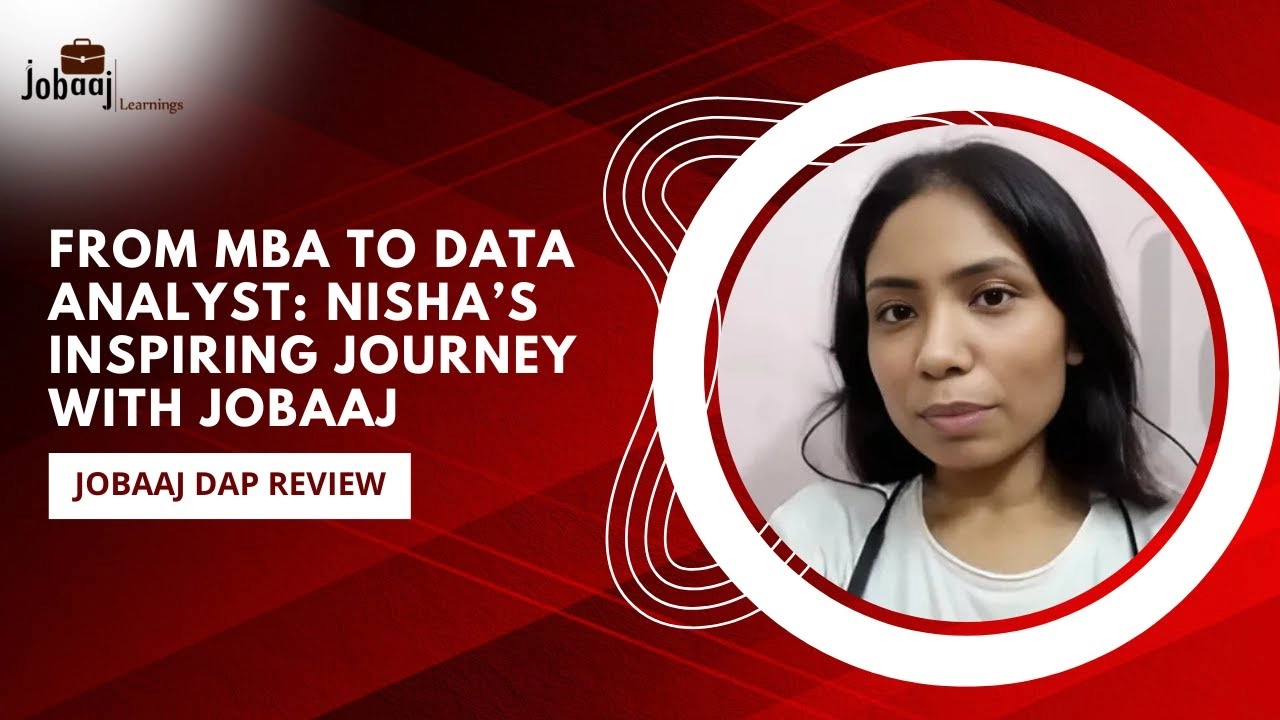
"The first round focused mainly on my knowledge of French, with vocabulary questions... They didn't ask too many questions beyond those topics, mainly focusing on my proficiency in French and Excel." — Nisha Saini
Nisha Saini is 22 and lives in New Delhi. She graduated with a BA in English, completed an MBA in Data Science from Amity University online, and took a Data Analyst course with Jobaaj Learnings covering Power BI, advanced Excel, Tableau, Python and libraries including NumPy, Pandas and Matplotlib. She is now a Data Analyst (French) at Numerator — a work-from-home role.
The single most important fact on this page, and it is easy to miss: her role required French, and the first interview round was about French vocabulary rather than data. Her language ability is a decisive part of why she got this specific job, and it is not something any analytics course provided. If you are reading this to judge what the course delivers, weigh that heavily.
If you are searching “is Jobaaj Learnings genuine”, “is Jobaaj real or fake” or “can a BA graduate become a data analyst”, this account is useful for a different reason: it shows what an entry-level analyst job actually uses on day one. Read it alongside the other conversations in our Interview Series and the wider feedback on the reviews page.
Key Takeaways: Nisha's Jobaaj Learnings Review
- Profile: 22, New Delhi. BA in English, then an MBA in Data Science (Amity, online). PCB with web development at school, plus early Java and Python.
- What she learned on the course: Power BI, advanced Excel, Tableau, Python, AI, and NumPy, Pandas and Matplotlib.
- Her portfolio project: a Netflix dataset comparing movies and TV shows, visualised with Pandas, NumPy, Matplotlib and Power BI. She says it stood out on her resume.
- The role is French-language. Round one was French vocabulary — a skill the course did not provide.
- Three interview rounds: French → an Excel project using advanced functions → a discussion of Excel, Power BI and her other tools.
- What the job actually uses: “for now, I'll be focusing mostly on advanced Excel” — Power BI perhaps after a couple of months.
- Outcome: Data Analyst (French) at Numerator, work-from-home. Salary not disclosed.
- Her roadmap: advanced Excel first, then Power BI, then Python with sustained practice, then NumPy/Pandas, with Tableau optional alongside Power BI.
Who Is Nisha Saini? English Graduate, Data Science MBA
Nisha's path into data is not linear:
- Class 12: PCB — Physics, Chemistry, Biology — with web development, and early exposure to Java and Python
- Graduation: BA in English
- Postgraduate: MBA in Data Science, Amity University, online
- Then: a Data Analyst course covering the practical tooling
She credits the early exposure for making the MBA choice viable: “I had already learned languages like Java and Python. So, with that base knowledge, I decided to pursue an MBA.”
The Project That Stood Out
Nisha names one portfolio piece as decisive:
"I analyzed Netflix data, comparing movies and TV shows by visualizing it with Pandas, NumPy, and Matplotlib. This project stood out on my resume and helped me during the interview."
Two things make it work as a portfolio piece. The dataset is one everybody understands, so the analysis is immediately legible to an interviewer. And the comparison — movies against TV shows — is a real question with a real answer, not a dashboard for its own sake.
The Interview: French First, Data Second
| Round | What it covered |
|---|---|
| 1 | French — primarily vocabulary questions |
| 2 | A project to solve using advanced Excel functions — SUMIF, IF and others |
| 3 | Discussion of her skills in Excel, Power BI and other tools |
Her own summary of the emphasis: “They didn't ask too many questions beyond those topics, mainly focusing on my proficiency in French and Excel.”
Read that carefully. The two things this employer actually tested were French and Excel — not Python, not machine learning, not Tableau. The French she brought herself. The Excel came from the course. That is an honest division of credit, and we are stating it rather than letting the syllabus imply more.
What the Job Actually Uses
Nisha's answer about her day-to-day tooling is the most quietly useful thing in this series for anyone choosing what to learn:
"Yes, for now, I'll be focusing mostly on advanced Excel. We might use PowerBI after a couple of months, but initially, Excel will be the main tool."
She learned Power BI, Tableau, Python, AI, NumPy, Pandas and Matplotlib. Her job, on joining, is advanced Excel.
That is not an argument against learning the rest — the wider skill set is what makes a candidate competitive on paper and mobile later. But it is a corrective to the assumption that an entry-level analyst role means Python and machine learning from day one. Two other candidates in this series report the same: Sufiyan Ahmad says roughly 90% of his work is SQL, and Kavya's Deloitte interview included a timed Excel test.
Her Learning Roadmap for Aspiring Analysts
Asked what a beginner should focus on, Nisha gives an ordered plan rather than a list:
- Master advanced Excel first. Everything else is easier afterwards.
- Then Power BI — her framing: “it's just a more advanced version of Excel,” so the transition is short.
- Then Python, heavily. She singles it out as requiring deeper understanding and consistent practice rather than a one-time pass.
- NumPy and Pandas as priorities alongside Python, since they carry the actual analysis and visualisation work.
- Tableau optionally — similar to Power BI, worth learning if visualisation is your interest.
Pros and Cons, Based on Nisha's Account
What worked:
- A broad practical toolkit — Excel, Power BI, Tableau, Python and the core libraries
- Advanced Excel strong enough to solve a live project round
- A portfolio project that she says stood out on her resume and helped in the interview
- A work-from-home analyst role at 22, from a BA in English
What this account shows honestly:
- Her French was decisive — the first round was about it, and the course did not provide it.
- The job runs on Excel initially, not on the more advanced tools she learned.
- She holds an MBA in Data Science alongside the course, so the training was not her only qualification.
- No salary is disclosed, no rating was asked for, and she raises no criticism — so there is none to report.
- She had prior programming exposure from school, which she credits for making the MBA feasible.
Data Analyst Interview Questions and Model Answers
Describe using advanced Excel functions to solve a problem.
Answer: Analysing sales data across regions — VLOOKUP to merge datasets that shared a key, IF and SUMIF to calculate regional growth against conditions, and pivot tables to summarise it into something reportable. The functions are simple individually; the skill is choosing which combination answers the question without a manual step in the middle.
How would you explain a complex analysis to a non-technical stakeholder?
Answer: Lead with charts rather than method, and with the takeaway rather than the process. They need the “what” and the “why” — the trend, the comparison, what it means for a decision. The methodology matters to whoever reviews the work, not to whoever acts on it.
How do you ensure accuracy with large datasets?
Answer: Validate before analysing — check for missing and incorrect values, handle outliers deliberately rather than silently, remove duplicates. Then cross-check the result against another source, or verify a sample manually. An error found at the validation stage is a correction; found after reporting, it is a credibility problem.
Why does data visualisation matter?
Answer: Because patterns that are invisible in rows become obvious in a chart. On my Netflix project, visualising the comparison between movies and TV shows surfaced trends that would have taken far longer to spot in the raw data — and made them explainable to someone who had not seen the dataset.
What's the difference between Pandas and NumPy?
Answer: NumPy is built for numerical arrays and efficient mathematical operations. Pandas works on structured, labelled data in DataFrames, handles mixed data types, and has the built-in functions for merging, grouping and reshaping that real analysis needs. In practice you use both — Pandas for the manipulation, NumPy underneath it for the maths.
How do you handle missing data?
Answer: Understand why it is missing first, because that determines what you are allowed to do. Fill with mean, median or mode where the distribution supports it; drop rows or columns where the gaps are extensive enough that imputation would be invention. Where the missingness is genuinely random and the dataset is large, predictive imputation is defensible — but say so in the writeup either way.
What Nisha's Journey Suggests
- An unrelated degree isn't a barrier. A BA in English, an MBA in Data Science, and an analyst role at 22.
- A second language can be the differentiator. Hers was tested before her data skills were — language-specific analyst roles are a real and under-noticed market.
- Learn Excel properly first. It was tested in her interview and it is what her job runs on.
- Build one legible portfolio project. A familiar dataset with a real question beats several dashboards nobody can interpret.
- Expect to use less than you learned, at first. The rest is what makes the next move possible.
Full Podcast Transcript
The complete conversation, unedited.
Podcaster: So today we have Nisha Saini with us, who is not only a member of the Jobaaj Learnings community but also starting her career as a Data Analyst at Numerator. We'll discuss her skill set, educational background, the questions she faced in her interview, and more. Nisha, welcome, and thank you for joining us. Can you please introduce yourself to our community?
Nisha: Thank you for having me. My name is Nisha, I'm 22 years old, and I live in New Delhi. I recently completed my MBA in Data Science from Amity University online. Additionally, I completed a Data Analyst course from Jobaaj Learnings, where I learned key skills like PowerBI, advanced Excel, Tableau, Python, AI, and libraries like NumPy, Pandas, and Matplotlib. Thanks to these skills, I secured my job at Numerator. The role is a Data Analyst (French), but it's a work-from-home opportunity, which I'm very happy about.
Podcaster: That's fantastic, Nisha! Before your MBA, what was your graduation in?
Nisha: I graduated with a BA in English.
Podcaster: Great! So, after completing your BA, you decided to pursue an MBA and ended up in Data Analytics, which is exactly what you were aspiring for?
Nisha: Yes, that's right. In my 12th grade, I had PCB (Physics, Chemistry, Biology) with web development, and I had already learned languages like Java and Python. So, with that base knowledge, I decided to pursue an MBA.
Podcaster: That's interesting! Now, could you tell us about any projects you worked on and showcased in your portfolio to land this job?
Nisha: Certainly! I worked on several projects, including one using PowerBI. I analyzed Netflix data, comparing movies and TV shows by visualizing it with Pandas, NumPy, and Matplotlib. This project stood out on my resume and helped me during the interview.
Podcaster: That sounds impressive! Could you walk us through your interview process? How many rounds were there, and what were the main topics or questions asked in each round?
Nisha: The interview process consisted of three rounds. The first round focused mainly on my knowledge of French, with vocabulary questions. Then, they gave me a project to solve using Excel's advanced functions, like SUMIF, IF, and other formulas. The final round was more about discussing my skills in Excel, PowerBI, and other tools. They didn't ask too many questions beyond those topics, mainly focusing on my proficiency in French and Excel.
Podcaster: Interesting! Do you have any idea about the tools and technologies you'll be using in your job role?
Nisha: Yes, for now, I'll be focusing mostly on advanced Excel. We might use PowerBI after a couple of months, but initially, Excel will be the main tool.
Podcaster: Great! If you had to provide a roadmap for students aspiring to become data analysts, especially those who are just starting out, what skills should they focus on?
Nisha: My advice would be to start with mastering advanced Excel. Once you are comfortable with that, transitioning to PowerBI will be easier since it's just a more advanced version of Excel. Focus heavily on Python, as it requires a deeper understanding and consistent practice. For libraries like NumPy and Pandas, they're essential for data visualization and analysis, so they should be a priority too. Lastly, Tableau is another tool that's very similar to PowerBI, so if you're interested in visualization, both are worth learning.
Frequently Asked Questions
Is Jobaaj Learnings genuine, or is it fake?
This page documents one recorded case: Nisha Saini, a 22-year-old BA in English with an MBA in Data Science, hired as a Data Analyst (French) at Numerator in a work-from-home role. Employer, role and interview rounds are named on camera. Her French was tested first and was not taught by the course — a limit on what this evidences. See the wider review set on the reviews page.
Did the course get her the job?
Partly. The Excel round she cleared came from the training. But the first round tested her French, which she brought herself, and she also holds an MBA in Data Science. The credit is genuinely split.
Can a BA in English become a data analyst?
Nisha did, at 22 — via an MBA in Data Science, a practical analytics course, and early programming exposure from school.
Which tool should I learn first?
Her answer is advanced Excel, and her own experience supports it: Excel was tested in her interview and is the main tool in her job. Power BI comes next because it builds on the same thinking, then Python with consistent practice.
Do entry-level data analyst jobs use Python and machine learning?
Not necessarily on day one. Nisha learned Python, Tableau, AI and the core libraries — and says her role initially runs mostly on advanced Excel, with Power BI possibly after a couple of months.
Are there analyst jobs that need a foreign language?
Yes — hers is explicitly a Data Analyst (French) role, and the first interview round was French vocabulary. A second language is a genuine differentiator in a crowded analyst market.
Join 5,00,000+ Subscribers
Be a part of our ever growing community.
Related reads
Hansika's Jobaaj Learnings Review: From MSc Graduate to Data Analyst at DRRT

Shrey Koradiya's Jobaaj Learnings Review: From B.Tech Fresher to Data Analyst at Exiler