Categories








































Nishant's Jobaaj Learnings Review: From BBA Fresher to Financial Analyst at Tres Vista

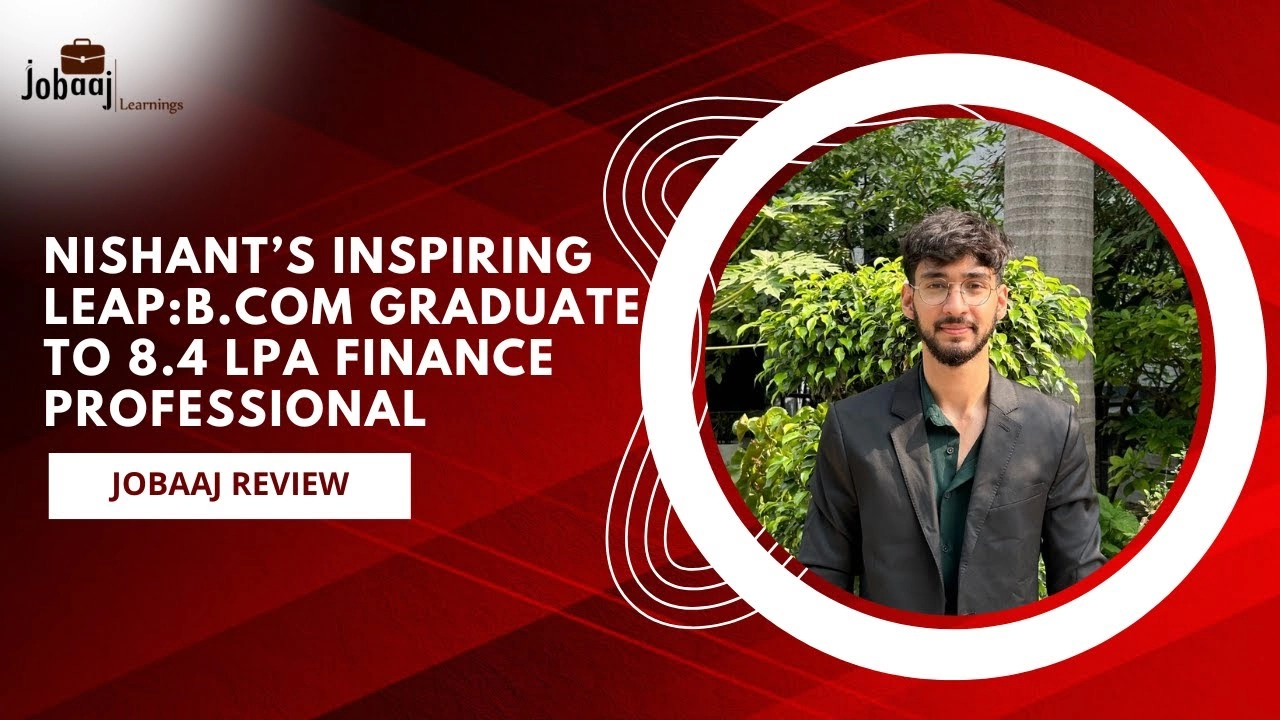
"I must say I had a great overall experience. Vishakha ma'am guided me throughout the journey. She was always there to support me and give me the right advice." — Nishant, who rated Jobaaj's services 10/10 in this conversation
Nishant was born and brought up in New Delhi and completed his BBA from GYMS. He had no full-time work experience — only a two-month summer internship at Planet Track Globals — when he began applying for jobs. He enrolled in Jobaaj Learnings' Investment Banking Program, where he learned financial modeling and worked on several practical projects, and separately completed a financial accounting and analysis course from IIM Bangalore. He is now working as a Financial Analyst at Tres Vista.
If you have searched “is Jobaaj real or fake”, “is Jobaaj Learnings genuine” or “is Jobaaj Learnings worth it”, treat this page as one data point, not a verdict. It is a recorded, on-camera conversation with one placed student. What it puts on record is checkable: a named company (Tres Vista), a named role (Financial Analyst), a named placement coordinator (Vishakha), a described interview process, and a stated timeline. What a single review cannot tell you is what happened to students who did not get placed, or what the outcome rate across the whole cohort looks like. Read this alongside the full set of student feedback on the Jobaaj Learnings reviews page and the other conversations in our Interview Series before you decide.
Key Takeaways: Nishant's Jobaaj Learnings Review
- Profile: BBA graduate from GYMS, based in New Delhi; a fresher with one two-month internship (Planet Track Globals, MS Excel and Microsoft tools).
- Before Jobaaj: applied on his own for roughly four to five months; most openings he found asked for an MBA or a CFA, and he was weighing whether to sit for CAT instead.
- Training: Jobaaj Learnings' Investment Banking Program — financial modeling plus several practical projects; also holds a financial accounting and analysis course from IIM Bangalore.
- Outcome: placed at Tres Vista as a Financial Analyst.
- Process: three to four rounds — an aptitude/logical/verbal reasoning test, a resume screening call, a technical interview, and a mixed technical + HR round.
- Placement support named: coordinator Vishakha sourced the opportunity, told him what was likely to be asked and how to prepare, and relayed updates from the company's HR team.
- His rating: 10 out of 10; said he would recommend the platform to friends, most of whom only knew Naukri.com.
- Reported problems: none. He did not raise any friction point in this conversation — which is a limit of the interview, not proof that none existed.
Who Is Nishant? His Background Before Jobaaj Learnings
Nishant was born and raised in New Delhi and did his graduation in BBA from GYMS. In his own words, his profile at the point of applying looked like this:
- Degree: BBA (GYMS).
- Programme: Jobaaj Learnings' Investment Banking Program, where he learned financial modeling and investment banking and completed several practical projects on financial modeling.
- Additional certification: a financial accounting and analysis course from IIM Bangalore.
- Work experience: a two-month summer internship at Planet Track Globals, where he worked mainly on MS Excel and other Microsoft tools.
That is the entire experience column on his CV. There is no prior full-time finance role, no MBA and no CFA — which matters, because those three gaps are exactly what made his job search difficult.
The Job Hunt Before Jobaaj: Five Months and an MBA/CFA Wall
Nishant applied on his own for about four to five months. His description of the blocker is specific: “everyone was asking for an MBA or CFA degree, so I was confused about what path to take.” He was actively considering giving up on the job search and sitting for the CAT exam instead.
This is the part of the story worth reading carefully if you are in the same position. The problem he describes is not a lack of skills — by that point he already had the financial modeling training and the IIM Bangalore course. It was a screening problem: as a fresher without a postgraduate qualification, his applications were not reaching the interview stage.
The Outcome: Financial Analyst at Tres Vista
Nishant is now placed at Tres Vista as a Financial Analyst. Tres Vista is a financial-services outsourcing firm whose analysts work on financial modeling, valuation and research support for investment firms — the same skill set his programme was built around.
On being placed there as a fresher, his reaction was: “Honestly, it feels great! ... I felt lucky to be placed here.”
What Jobaaj Learnings Actually Did, According to Nishant
Stripping out the general praise, these are the concrete actions Nishant attributes to Jobaaj Learnings in this conversation:
- Sourced the opportunity. The Tres Vista role reached him as a response from Vishakha of the Jobaaj placement team — not through his own applications.
- Named, single point of contact. One coordinator (Vishakha) handled his case start to finish, rather than a rotating support queue.
- Interview preparation specific to the role. In his words: “She told me exactly what things they would likely ask and how to prepare.”
- Relayed company-side updates. He was kept updated on what was coming from the employer's HR team between rounds — the stage where candidates applying alone usually go dark.
- Transparent communication. Asked directly whether the communication between him and the company was clear and transparent, he answered yes.
- The training itself. Financial modeling and investment banking coursework plus several practical projects, which is what he had to defend in the technical rounds.
Note the split: the coursework built the skills, but what he credits for the placement is the sourcing and the round-by-round preparation. For a fresher stuck behind an MBA/CFA filter, those are two different problems, and he needed both solved.
Inside the Tres Vista Interview Process
Nishant described three to four rounds. Broken down as he listed them:
| Stage | What it involved |
|---|---|
| 1. Technical/aptitude test | Aptitude questions, logical reasoning and verbal reasoning |
| 2. Resume screening call | A call walking through his resume |
| 3. Technical interview | Core technical round |
| 4. Technical + HR | A mix of technical questions and HR questions |
The takeaway for anyone preparing: the first filter at this firm was not finance knowledge at all — it was an aptitude and reasoning test. Two of the four stages were technical, and the technical questioning continued into the final round.
Investment Banking Interview Questions to Prepare For
Can you explain a financial model you have worked on? What challenges did you face?
Model answer: During my investment banking program, I built a financial model for a hypothetical company — projecting future revenue, analysing historical data and estimating financial outcomes. The hardest part was ensuring the assumptions held up, particularly around market trends. I handled that by doing proper market research and validating each assumption against industry benchmarks.
How do you approach financial analysis, and what tools do you use?
Model answer: I start with the company's financial health, then work through the financial statements — balance sheet, income statement and cash flow statement. My main tool is MS Excel, where I build the models and use advanced functions like pivot tables and macros to handle large datasets efficiently.
Describe a time you analysed financial data and presented it to a group.
Model answer: In my internship I analysed a company's financial performance and presented the findings to senior management. I kept it clear by organising the data into simple charts and graphs, double-checked every calculation, and rehearsed the delivery so I could explain complex figures simply.
How would you build a Discounted Cash Flow (DCF) model?
Model answer: Project the company's free cash flows for the next 5–10 years using historical financials and assumptions about revenue growth, operating margins and capital expenditure. Calculate the terminal value using either a perpetuity growth method or an exit multiple. Discount both the projected cash flows and the terminal value back to present value using the company's weighted average cost of capital (WACC), then sum them to arrive at enterprise value.
What is an LBO model and how would you build one?
Model answer: An LBO model evaluates acquiring a company using a significant amount of debt. Start by analysing the target's financials to understand historical performance and forecast cash flows. Determine an appropriate debt structure based on its credit profile, then forecast interest expense and debt repayment across the investment horizon — typically five to seven years. Calculate IRR and multiple on invested capital (MOIC) to assess returns, and run sensitivity analysis to test how changes in exit multiples or interest rates affect the outcome.
How do you calculate WACC, and why does it matter?
Model answer: WACC is the average rate of return a company is expected to pay its shareholders and debt holders, weighted by the proportion of debt and equity in its capital structure:
WACC = (E/V × Re) + [(D/V × Rd) × (1 − Tc)]
- E = market value of equity
- V = total market value of equity and debt
- Re = cost of equity
- D = market value of debt
- Rd = cost of debt
- Tc = corporate tax rate
It matters because WACC is the discount rate in a DCF model. A lower WACC indicates a less risky company with cheaper capital; a higher WACC points to a riskier company paying more for its capital.
Pros and Cons, Based on Nishant's Account
What he said worked:
- The opportunity itself came through the placement team, after five months of his own applications had not converted.
- Preparation was targeted — he was briefed on what the company was likely to ask.
- Communication with the employer was routed through his coordinator and stayed, in his words, clear and transparent.
- The programme's practical financial modeling projects gave him something concrete to discuss in two technical rounds.
- He rated the service 10/10 and said he would recommend it to friends.
Nishant's Tips If You're Considering Jobaaj Learnings
- Don't let the MBA/CFA filter decide for you. Nishant spent four to five months being screened out for not having a postgraduate degree, and nearly diverted to CAT. He got the role without either.
- Prepare for reasoning tests, not just finance. His first round at Tres Vista was aptitude, logical reasoning and verbal reasoning — before any finance question was asked.
- Build projects you can talk about. The practical financial modeling projects from the programme were what carried him through the technical rounds.
- Use your coordinator as the channel to the company. He credits knowing what was coming next — from both the interview panel and HR — as a large part of why the process felt smooth.
Full Podcast Transcript
The complete conversation, unedited.
Podcaster: Hi Nishant.
Nishant: Hello ma'am.
Podcaster: So how are you?
Nishant: I'm good. What about you?
Podcaster: I'm great. So can you please give me a brief introduction about yourself, like your educational background, any work experience, or internship experience?
Nishant: Okay, sure. So my name is Nishant, and I was born and brought up in New Delhi. I did my graduation in BBA from GYMS. Moreover, I joined an Investment Banking Program, where I learned financial modeling and investment banking. I worked on several practical projects related to financial modeling. I also completed a financial accounting and analysis course from IIM Bangalore. Additionally, I did a two-month summer internship at Planet Track Globals, where I learned a lot about MS Excel and overall Microsoft tools.
Podcaster: Great! And in which company have you been placed, and for what role?
Nishant: I have been placed in Tres Vista as a Financial Analyst.
Podcaster: Okay, great. So, as you mentioned, you're a fresher. How do you feel being placed in such a reputed company and for such a great role?
Nishant: Honestly, it feels great! I was searching for a job for about four to five months, and everyone was asking for an MBA or CFA degree, so I was confused about what path to take. I was considering whether I should give my CAT exam or just keep applying for jobs. Then I got a response from Vishakha ma'am regarding this opportunity at Tres Vista. I felt lucky to be placed here.
Podcaster: And may I know who was connected with you from Jobaaj's placement team?
Nishant: Vishakha ma'am.
Podcaster: Okay, and how many rounds were there in your interview?
Nishant: There were three to four rounds. The first round was a technical one, where they asked aptitude questions, logical reasoning, and verbal reasoning. After that, I had a resume screening call. Then there were two interview rounds—first was technical, and the second was a mix of technical and HR questions.
Podcaster: Okay. So, how do you feel Jobaaj helped you secure this position, and what were the main points that they helped you with?
Nishant: First of all, I shared this platform with all my friends since they were unaware of it. They only knew about platforms like Naukri.com. I must say I had a great overall experience. Vishakha ma'am guided me throughout the journey. She was always there to support me and give me the right advice.
Podcaster: Did she help you with interview preparation as well? How did she guide you?
Nishant: Yes, she did. She told me exactly what things they would likely ask and how to prepare. She also kept me updated about everything from the HR team.
Podcaster: Was she communicating between you and the company clearly and transparently?
Nishant: Yes, ma'am. She was always clear and transparent with her communication.
Podcaster: Great! So, as you mentioned, your friends didn't know about Jobaaj. Would you suggest this platform to other candidates and students?
Nishant: Definitely, ma'am. I'll surely share it with them.
Podcaster: And how would you rate Jobaaj's services out of 10?
Nishant: 10, ma'am.
Podcaster: That's great!
Frequently Asked Questions
Is Jobaaj Learnings genuine, or is it fake?
This page documents one verifiable case: Nishant, a BBA fresher, placed as a Financial Analyst at Tres Vista, with the placement coordinator named and the interview process described on camera. That is evidence of a real placement, not proof of a rate. Weigh it against the full review set on the reviews page.
Can you get an investment banking role without an MBA or CFA?
Nishant did. He holds a BBA, a financial accounting and analysis course from IIM Bangalore, and the Investment Banking Program — and was hired as a Financial Analyst. He also spent four to five months being screened out for lacking an MBA or CFA before that happened, so it is possible rather than easy.
What does Jobaaj Learnings' placement support actually involve?
In Nishant's case: the opportunity was sourced and sent to him by a placement coordinator, he was briefed on the questions the company was likely to ask and how to prepare, and he was kept updated on communication from the employer's HR team between rounds.
How many interview rounds did Tres Vista have?
Three to four. An aptitude test covering logical and verbal reasoning, a resume screening call, a technical interview, and a final round mixing technical and HR questions.
How long did it take Nishant to get placed?
He described roughly four to five months of searching on his own before the Tres Vista opportunity reached him through the Jobaaj placement team. He did not state a separate figure for how long the programme itself took.
Is the Investment Banking Program worth it for a fresher?
Nishant's answer, on his own experience, was 10/10 — he credits the practical financial modeling projects for the technical rounds and the placement team for the opportunity itself. One student's rating is a starting point for your research, not a substitute for it. Compare more accounts in the Interview Series.
Join 5,00,000+ Subscribers
Be a part of our ever growing community.
Related reads
Ankit's Jobaaj Learnings Review: From Inventory to Remote Financial Controller at Blue Polaris
Vedant Jobaaj Learnings Review: From CFA Level 1 to Associate Analyst at CareEdge Advisory