Categories














/content/learnings/assets/header/ManagementConsulting.svg)
/content/learnings/assets/header/InvestmentBanking.svg)


























A college degree no longer requires every student to sit in a physical classroom five or six days a week.
Universities now offer complete undergraduate and postgraduate programmes through online learning platforms. Students can attend live or recorded classes, submit assignments digitally and complete assessments without following a traditional campus routine.
This flexibility has made online degrees attractive to working professionals, parents, students living far from major universities and learners who want to study while managing other responsibilities.
However, flexibility is only one part of the decision.
A regular degree provides campus life, direct interaction, practical exposure and structured learning. An online degree offers convenience and greater control over time, but it also requires discipline and careful verification of the university’s recognition.
This guide compares online and regular degrees by validity, learning experience, cost, placements, networking and career value so that you can choose the right mode for your situation.
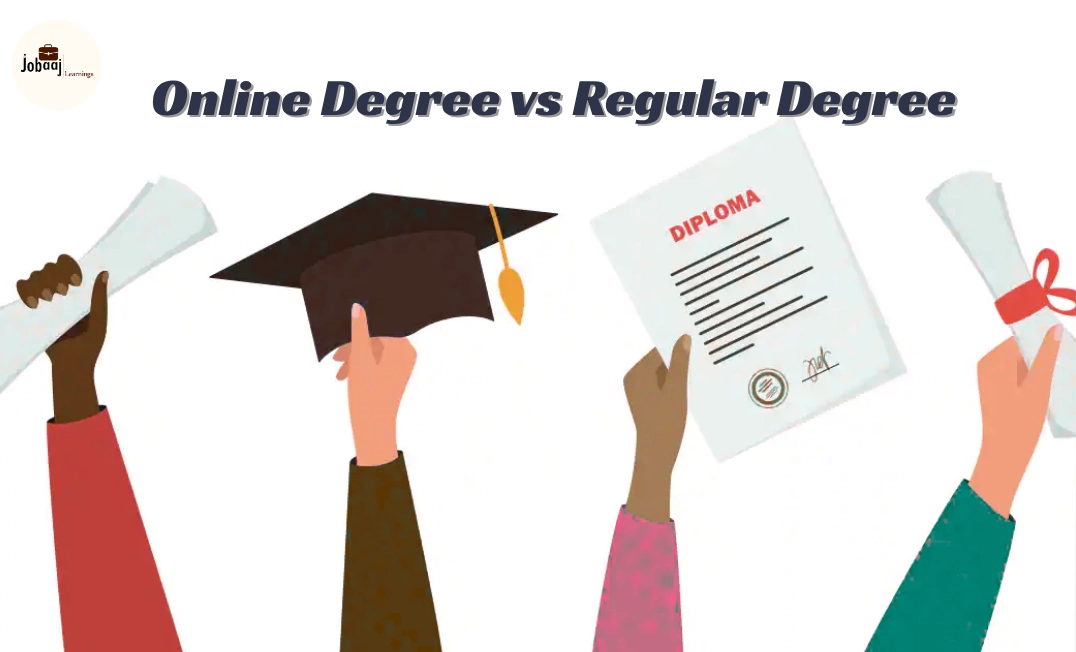
Online Degree vs Regular Degree
An online degree is generally better for students who need flexibility, want to continue working or cannot relocate for college.
A regular degree is generally more suitable for students who want classroom learning, campus activities, practical facilities, direct faculty interaction and a traditional college experience.
In India, an undergraduate or postgraduate online degree can be treated as equivalent to the corresponding conventional degree when it follows UGC requirements and is awarded by a higher education institution recognised or entitled to offer that exact programme in online mode.
This does not mean that every online course advertised on the internet is a valid degree. Students must check the university, programme, mode and admission session on the official UGC Distance Education Bureau portal before enrolling.
What Is an Online Degree?
An online degree is a complete undergraduate or postgraduate qualification delivered primarily through the internet.
Classes, study materials, discussions, assignments and student support are provided through a learning management system. Examinations may be conducted through secure online proctoring, approved test centres or another method specified by the university.
Depending on the institution, students may receive:
- Live online lectures
- Recorded classes
- Digital textbooks and study materials
- Discussion forums
- Online assignments and quizzes
- Virtual doubt-clearing sessions
- Academic mentoring
- Online examinations
- Digital access to libraries and career services
An online degree is different from a short online course. A certificate from an educational platform may help you learn a skill, but it does not automatically carry the status of a recognised bachelor’s or master’s degree.
For the qualification to be recognised in India, the university and programme must meet the applicable UGC requirements.
What Is a Regular Degree?
A regular degree, also called a conventional or on-campus degree, requires students to attend a college or university physically according to a fixed academic schedule.
Teaching usually takes place through classroom lectures, tutorials, laboratories, workshops and face-to-face discussions.
Students also participate in activities beyond the formal syllabus, including:
- College societies
- Group projects
- Presentations
- Sports and cultural events
- Internships
- Industry visits
- Competitions
- Campus placements
- Informal interaction with classmates and faculty
A regular degree provides a more structured environment. Students are expected to attend classes, follow the institution’s timetable and complete academic requirements within a physical campus system.
Is an Online Degree Valid in India?
Yes, an online degree can be valid in India.
UGC regulations state that recognised undergraduate and postgraduate degrees awarded through online or open and distance learning modes are to be treated as equivalent to corresponding degrees offered through the conventional mode.
However, three conditions are especially important:
- The university must be authorised to award degrees.
- The institution must be recognised or entitled to offer the programme online.
- The exact programme must be approved for the academic session in which the student takes admission.
Recognition for one year does not automatically prove recognition for every future admission session. The UGC-DEB FAQ specifically advises students to verify the recognition status for the session in which they are enrolling.
This is why students should not depend only on statements such as UGC approved written on an advertisement.
Are All Courses Allowed in Online Mode?
No. Some programmes cannot normally be offered completely through online or distance learning because they require extensive laboratories, clinical work, field training, professional supervision or regulated practical experience.
The UGC-DEB lists several prohibited or restricted disciplines, including programmes connected with engineering, medicine, nursing, dental education, pharmacy, architecture, law and other hands-on professional fields. Research programmes such as M.Phil and PhD are also prohibited through online and ODL modes.
Rules may also involve professional councils or regulatory bodies in addition to the UGC.
Before joining a professional or technical programme, check:
- The UGC-DEB programme list
- The university’s official approval
- The relevant professional council
- Practical and internship requirements
- Eligibility for professional registration
A university being recognised does not mean it can offer every degree online.
Online Degree vs Distance Degree
Online and distance education are often treated as the same, but their delivery methods can differ.
An online degree is delivered primarily through digital systems. Classes, learning materials, communication and assessments are usually managed online.
A distance degree may rely on a combination of printed study material, self-learning, online resources, learner support centres and occasional contact sessions.
|
Feature |
Online degree |
Distance degree |
|
Primary delivery |
Internet-based learning |
Self-learning through mixed resources |
|
Live classes |
Frequently available |
May be limited |
|
Printed material |
Usually optional |
Often commonly used |
|
Digital interaction |
Generally higher |
Depends on the institution |
|
Learning centres |
Usually unnecessary |
May be used for support or examinations |
|
Technology requirement |
Reliable internet and device essential |
Can be relatively less technology-dependent |
Students should check whether a programme is officially classified as Online or Open and Distance Learning instead of assuming both modes follow identical rules.
Learning Experience
Online Degree Learning Experience
Online students learn through recorded lectures, live sessions, digital notes and independent study.
This mode gives learners greater control over where and, in some programmes, when they study. Recorded classes can be paused and revisited, which may help students who need more time to understand a concept.
The challenge is maintaining consistency.
There may be no teacher physically present to check whether the student attends class, completes a reading or follows a study routine. Learners who delay tasks may quickly fall behind.
Online learning works best for people who can:
- Plan their weekly schedule
- Study without constant supervision
- Participate actively in virtual discussions
- Ask for help when needed
- Avoid distractions at home
- Meet digital submission deadlines
Regular Degree Learning Experience
Regular students follow a timetable and learn in a shared classroom.
Questions can be discussed immediately, and faculty members can observe whether students are struggling. Classroom debates, presentations and peer discussions may also improve communication and teamwork.
The structured environment can be helpful for students who find independent learning difficult.
However, regular programmes provide less scheduling flexibility. Students must organise work, travel and personal commitments around the institution’s calendar.
Flexibility and Time Management
Flexibility is the strongest advantage of an online degree.
A working professional may attend recorded classes after office hours. A parent may study when family responsibilities are complete. A student in a smaller city may enrol in a university without relocating.
However, flexible does not mean effortless.
Online students still need to complete lectures, projects, assignments and examinations. A poorly managed flexible schedule can become more stressful than a fixed timetable.
Regular degrees offer less flexibility, but the fixed structure can make it easier to build a consistent routine. Students know when classes, examinations and activities will take place.
Fees and Overall Cost
Online degrees are often more affordable because students may avoid expenses related to:
- Hostel accommodation
- Daily transportation
- Relocation
- Campus maintenance
- Printed study material
- Meals outside the home
Tuition can also be lower, although this varies considerably by university and programme.
A regular degree may involve higher overall expenditure, particularly when a student moves to another city. However, the cost may include access to campus infrastructure, laboratories, libraries, student organisations and placement activities.
Students should compare the total cost rather than tuition alone.
For an online programme, also consider spending on:
- A laptop or computer
- Reliable internet
- Software subscriptions
- Examination fees
- Optional campus visits
- Travel to examination centres, where applicable
A cheaper programme is not automatically better if its academic support, teaching quality or recognition is weak.
Faculty Interaction and Student Support
Regular students can interact with teachers before or after class, during office hours and through campus activities.
This accessibility can make mentoring feel more natural.
Online programmes use video meetings, email, chat, discussion boards and digital office hours. Strong universities may provide responsive faculty support, while weaker programmes may offer mostly recorded content with limited personal assistance.
Before selecting an online university, ask:
- How frequently are live classes conducted?
- Are recordings available?
- Can students speak directly with faculty?
- How quickly are doubts answered?
- Is academic mentoring provided?
- Does the university offer technical support?
- Are student complaints handled through a formal system?
The quality of support can make a major difference to the online learning experience.
Networking and Campus Life
A regular college naturally creates opportunities to meet classmates, seniors, faculty, recruiters and visiting professionals.
Students may build friendships and professional relationships through projects, clubs, internships, events and everyday campus interaction.
Online students can also build networks, but they must be more intentional.
They may need to participate actively in:
- Virtual group projects
- Alumni communities
- Online seminars
- Professional networking platforms
- Industry events
- Student discussion groups
- Local meetups and internships
An online degree provides access to a class, but it does not automatically create a strong professional network. Students must take the initiative.
Practical Exposure
Regular degrees generally provide better physical access to laboratories, workshops, studios, equipment and supervised practice.
This is especially important for subjects that depend on experiments, fieldwork, technical equipment or direct professional training.
Online programmes work more naturally for subjects that can be taught and assessed digitally, such as:
- Business administration
- Commerce
- Economics
- Computer applications
- Data-related subjects
- Humanities
- Communication
- Management
- Selected social sciences
Even in these fields, students should look for projects, case studies, simulations and internships.
A degree provides academic knowledge, but employers often expect evidence that a candidate can apply that knowledge.
Examinations and Assessments
Online programmes may use:
- Online proctored examinations
- Timed quizzes
- Digital assignments
- Case studies
- Projects
- Presentations
- Viva examinations
- Approved examination centres
Regular programmes commonly use classroom tests, written examinations, practical assessments, assignments and presentations conducted on campus.
The difficulty of a degree should not be judged by its mode. A credible online degree still requires attendance, study, assignments and supervised assessment.
Students should be cautious of institutions promising a degree with no classes, no examinations or unrealistically easy completion. Such claims may indicate poor quality or an invalid programme.
Placements and Employment Opportunities
A recognised online degree can satisfy the educational qualification requirement for many jobs and higher education opportunities.
However, recognition alone does not guarantee employment.
Recruiters may also consider:
- University reputation
- Subject knowledge
- Communication skills
- Internships
- Work experience
- Projects and portfolios
- Technical abilities
- Interview performance
- Relevance of the degree to the role
Regular colleges may offer stronger campus placement opportunities because recruiters visit the institution and students receive direct access to placement drives.
Online universities may provide virtual career services, résumé workshops, job portals and placement assistance. The quality of these services varies widely.
Before enrolling, check actual placement support instead of trusting broad claims such as 100% placement assistance. Ask for recruiter names, eligibility rules, placement reports and the types of roles previously offered.
Is an Online Degree Accepted for Government Jobs?
A recognised online degree may be considered for jobs where the eligibility requirement accepts a corresponding recognised undergraduate or postgraduate qualification.
The degree must have been awarded by an institution authorised to offer the exact programme in that mode and session.
However, every recruitment notification can set its own conditions. Some positions may require a specific discipline, practical qualification, professional registration or approved mode of study.
Candidates should read the official recruitment notification rather than assuming that one general rule applies to every government examination or post.
Can You Pursue Higher Education After an Online Degree?
A recognised online undergraduate degree can generally be used to apply for postgraduate education, while a recognised online postgraduate degree may support further academic or professional opportunities.
Admission still depends on the receiving institution’s requirements.
A university may consider:
- Minimum marks
- Required subjects
- Entrance examination scores
- Programme duration
- Credit requirements
- Professional council rules
- Institution-specific eligibility
Students planning to study abroad should also check how the foreign university or credential-evaluation agency treats the qualification.
UGC equivalence within India does not automatically determine the admission policy of every foreign institution.
Advantages of an Online Degree
Greater Flexibility
Students can study without following a full-time campus routine. This is especially useful for working professionals and learners with family responsibilities.
No Need to Relocate
A student can access programmes from universities located in other cities without paying for accommodation or shifting away from home.
Opportunity to Continue Working
Professionals can earn a degree without taking a long career break. They can also apply what they learn directly in the workplace.
Potentially Lower Cost
Reduced travel and living expenses can make higher education more accessible.
Wider Programme Access
Students are not limited to colleges available in their immediate location.
Limitations of an Online Degree
Limited Campus Experience
Online students may miss college events, clubs, sports and daily social interaction.
Greater Need for Self-Discipline
Without a fixed physical routine, procrastination and irregular study can become serious problems.
Uneven Placement Support
Some universities offer strong career services, while others provide limited recruiter access.
Limited Practical Facilities
Subjects requiring laboratories, equipment or supervised practice may not suit fully online learning.
Dependence on Technology
A stable internet connection, suitable device and basic digital skills are essential.
Advantages of a Regular Degree
Structured Learning
A fixed timetable can help students maintain consistency and complete academic work on time.
Direct Faculty Access
Students can ask questions and receive feedback through face-to-face interaction.
Campus Networking
Regular colleges make it easier to build relationships with classmates, alumni, professors and recruiters.
Better Practical Exposure
Students can use laboratories, libraries, workshops and other physical facilities.
Campus Placement Opportunities
Well-established colleges may attract companies for internships and graduate recruitment.
Limitations of a Regular Degree
Less Flexibility
Students must attend according to a fixed schedule, making it difficult to manage a full-time job.
Higher Overall Expense
Tuition, accommodation, transportation and relocation may increase the total cost.
Location Restrictions
Students may need to leave their home city to access a suitable institution.
Time Commitment
Daily classes, travel and campus requirements can consume a significant part of the day.
Who Should Choose an Online Degree?
An online degree may suit you when you:
- Are already employed
- Cannot relocate for college
- Need a flexible study schedule
- Have family or personal responsibilities
- Are comfortable using digital platforms
- Can study independently
- Want to change or strengthen your career without leaving work
- Have verified that the exact programme is recognised
Online study can also work well for students who already have practical experience and primarily need academic knowledge or a formal qualification.
Who Should Choose a Regular Degree?
A regular degree may be a better choice when you:
- Have recently completed Class 12
- Want a complete college experience
- Need direct academic supervision
- Learn better through classroom discussion
- Want access to laboratories or equipment
- Value clubs, sports and cultural activities
- Depend on campus placements
- Want to build a professional network through daily interaction
For many young students entering higher education for the first time, regular college provides academic learning as well as social and personal development.
How to Verify an Online Degree Before Admission
This is the most important step in choosing an online programme.
1. Check the UGC-DEB Programme List
Search for the university and exact programme on the official UGC Distance Education Bureau portal.
The portal provides session-wise information about institutions recognised or entitled to offer online and ODL programmes.
2. Verify the Admission Session
Confirm that recognition applies to the academic session in which you are enrolling.
Do not rely on an approval document from an older year.
3. Match the Exact Programme Name
A university may be approved for an online BBA but not necessarily for every other programme it advertises.
Check the full programme title and mode.
4. Avoid Franchise Admissions
Enrol through the university’s official admission system.
UGC cautions students against unauthorised franchising arrangements in online and distance education.
5. Create Your DEB ID
Learners taking admission in online or ODL programmes are required to create a DEB ID using their Academic Bank of Credits ID. The system is intended to help ensure that students enrol only in recognised or entitled institutions and programmes.
6. Check Additional Regulatory Approval
For regulated fields, verify requirements with the relevant statutory or professional body.
7. Save Admission Documents
Keep copies of:
- Recognition details
- Fee receipts
- Admission confirmation
- Programme brochure
- Student registration
- DEB ID
- Academic records
These documents may be useful for employment, further education or verification.
Conclusion
An online degree and a regular degree can both lead to valuable educational and career opportunities.
A recognised online degree offers flexibility, accessibility and the ability to study without leaving employment or relocating. It can be an excellent choice for disciplined learners whose chosen subject can be taught effectively through digital platforms.
A regular degree offers structured learning, direct interaction, campus networking, practical facilities and stronger access to traditional college placements. It is often a better fit for younger students seeking a complete academic and social experience.
The degree mode should not be your only consideration.
The university’s recognition, curriculum, faculty, academic support, practical learning and career services matter just as much.
Choose an online degree when flexibility is essential and you can manage independent learning responsibly.
Choose a regular degree when you need classroom structure, practical resources, campus exposure and direct access to placements.
Most importantly, never pay an admission fee until you have confirmed the university, exact programme, mode and academic session through the official UGC-DEB records.
Frequently asked questions
Is an online degree equal to a regular degree in India?
A UGC-recognised undergraduate or postgraduate online degree is treated as equivalent to the corresponding conventional degree when it is awarded by an institution authorised to offer that exact programme online. Students must verify the university, programme and admission session on the official UGC-DEB portal before enrolling.
Are online degrees accepted for private-sector jobs?
Many employers accept recognised online degrees, but recruitment decisions also depend on the university, role, skills, experience and interview performance. Some companies may prefer candidates with practical exposure or strong institutional backgrounds. Students should therefore build projects, internships and job-relevant skills alongside the degree.
Can I apply for government jobs with an online degree?
A recognised online degree may satisfy the educational requirement for government jobs that accept the corresponding qualification. However, candidates must read the specific recruitment notification because some roles require particular subjects, professional approvals, practical training or other eligibility conditions.
Is an online degree suitable for freshers?
An online degree can work for freshers who are disciplined and have a clear plan for gaining internships, projects and social exposure. However, students who need classroom supervision, campus placements, laboratories and regular peer interaction may receive a more complete learning experience through a regular degree.
How can I check whether an online degree is UGC approved?
Visit the official UGC Distance Education Bureau portal and search for the institution, exact programme, online mode and relevant academic session. Students should also create the required DEB ID, avoid unauthorised admission agents and verify any additional professional council requirements before paying fees.

Join 5,00,000+ Subscribers
Be a part of our ever growing community.