Categories








































Prashant's Jobaaj Learnings Review: From 5 Years of Experience to Data Analytics

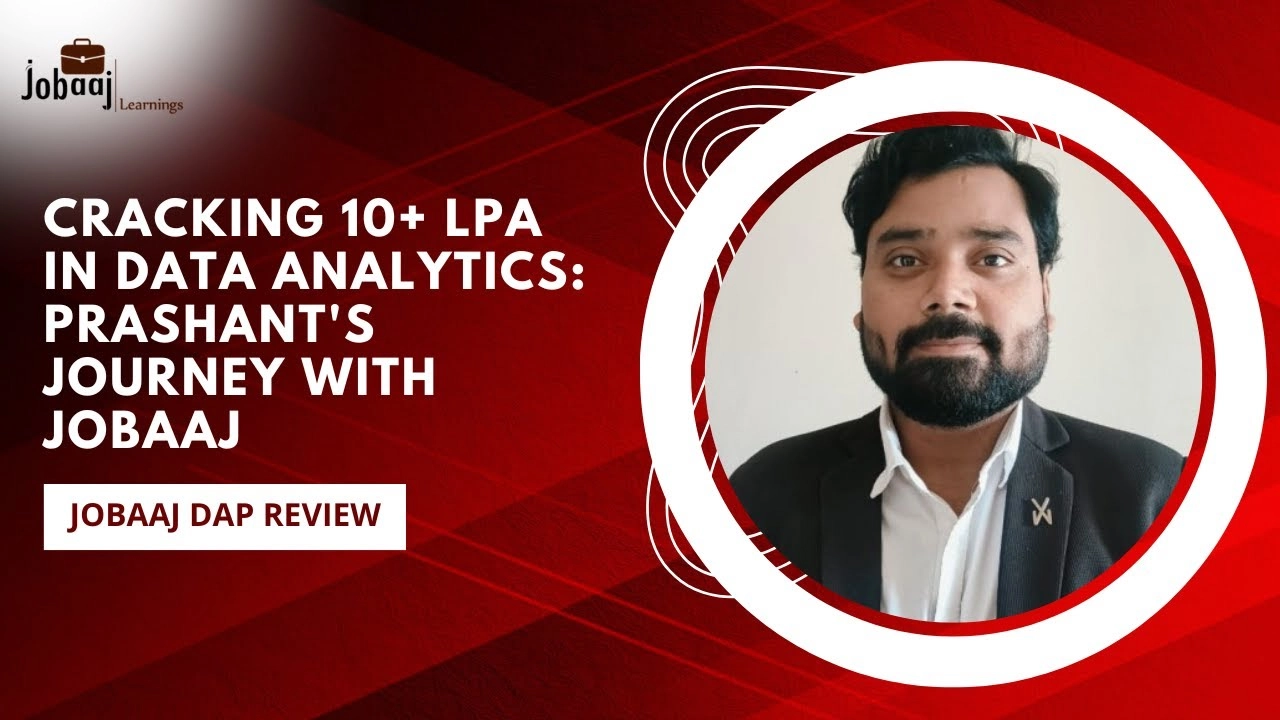
"Institutes can only give you 80–90% of the knowledge. The remaining 10% comes from your effort. Without that extra push, you won't succeed in the job market." — Prashant
Prashant had five years of experience in the data industry, a B.Tech and an MBA in IT when he enrolled in Jobaaj Learnings' Data and Business Analytics Program. He was not unemployed and not struggling to find work — he was struggling to be paid what he thought he was worth. After adding Python, statistics, machine learning and Tableau to a Power BI, Excel and SQL base, he was placed on a ₹10 LPA package.
If you are searching “is Jobaaj Learnings genuine”, “is Jobaaj real or fake” or “will a course get me a higher salary”, Prashant answers that last question more bluntly than anyone else in this series. Asked about people who expect a high salary simply for paying for a course, his reply was: “If you think that way, you're only fooling yourself.” He also confirms he faced rejections along the way. Read it alongside the other conversations in our Interview Series and the wider feedback on the reviews page.
Key Takeaways: Prashant's Jobaaj Learnings Review
- Profile: B.Tech plus an MBA in IT, with five years of experience in the data industry before enrolling.
- His problem wasn't unemployment. “I wasn't struggling to get a job, but I wasn't getting the package I expected.”
- The diagnosis: his skills were Power BI, Excel and SQL — which he calls basic tools.
- What he added: Python, statistics, machine learning and Tableau — and that is when shortlists started arriving.
- He faced rejections during the search, and says the placement team's support through them mattered.
- What the coordinator taught him: how to approach scenario-based questions and project work — a way of thinking he says he had never considered in five years.
- The placement team worked on his soft skills, communication and attitude, not just his profile.
- Outcome: a ₹10 LPA package. Employer not named.
- His warning: a course gives you 80–90%; the last 10% is your own effort, and without it you will not succeed.
Who Is Prashant? Experienced, Employed, and Underpaid
Prashant's starting position is different from almost everyone else in this series:
- B.Tech and an MBA in IT — a technical education
- Five years in the data industry
- In work, not searching out of necessity
His problem, stated precisely:
"Honestly, I wasn't struggling to get a job, but I wasn't getting the package I expected. Even though I had five years of experience, the companies I was applying to weren't offering the right salary."
That is a salary ceiling, not an employability problem — and the two need different solutions.
Why Five Years of Experience Hit a Ceiling
Prashant's own explanation is the most useful diagnosis in this series for mid-career professionals:
| Before | After |
|---|---|
| Power BI | Python |
| Excel | Statistics |
| SQL | Machine learning |
| — which he calls “basic tools” | Tableau |
His account of the effect: “These skills not only helped me get shortlisted by several companies, but they also grabbed the attention of hiring managers. That's when I realized why I wasn't getting the desired package before.”
And the mechanism behind the stagnation, which will be familiar to anyone several years into a job:
"While working in my previous job, I was just performing tasks but not learning new things."
Five Years In, He Still Found New Concepts
Prashant is candid about how much he did not know, despite the experience and the technical degrees:
"Despite that, I realized there were many concepts I wasn't familiar with. When I joined the course, I was surprised to learn about these areas that exist in the data world."
The specific gap he names is not a tool but a method — how to approach scenario-based questions and project work:
"She helped me understand how to approach these tasks and deliver them effectively, which made a huge difference in my interviews. I had never thought about approaching problems this way."
Five years of doing the work, and the framework for presenting that work was new. That distinction — between doing analysis and structuring the answer — comes up across this series.
The Line That Sets This Review Apart
Asked about people who assume that paying for a course entitles them to a high salary, Prashant does not soften it:
"If you think that way, you're only fooling yourself. It's not just about paying for a course and expecting results. Attitude plays a huge role. If you're not willing to learn, grow, and put in the effort, you'll never make it. Institutes can only give you 80–90% of the knowledge. The remaining 10% comes from your effort. Without that extra push, you won't succeed in the job market."
We are giving that its own section because it is the most useful thing on the page. A student in a placement podcast telling prospective students that the institute supplies at most 90% of what they need, and that the rest is on them, is the opposite of a sales message. Read it before you read the ₹10 LPA figure.
The Placement Support — Including Through Rejections
Prashant names three coordinators — Saniya, Vishakha and Vinnie — and is specific that the support went past sending job leads:
- They analysed where he was lacking rather than just processing his profile.
- They worked on his soft skills, communication and attitude.
- They supported him through rejections — which he confirms he faced.
- They kept pushing him to keep applying and gave feedback after attempts.
His summary: “Their support gave me the confidence I needed, especially when I faced rejections... helping me believe in myself even when I didn't.”
Note that a candidate with five years of experience and two degrees was still being rejected. That is worth registering if you are earlier in your career and assuming experience removes that.
The Outcome: ₹10 LPA
Prashant was placed on a ₹10 LPA package — the figure the conversation is built around. What is not stated:
- The employer is not named.
- His previous salary is not given, so the size of the increase is unknown.
- His job title in the new role is not stated.
Read ₹10 LPA as a figure for a professional with five years of relevant experience, a B.Tech and an MBA, who added four new technical skills. It is not a course outcome on its own.
Pros and Cons, Based on Prashant's Account
What worked:
- Python, statistics, machine learning and Tableau — the skills that moved him past a salary ceiling
- A method for approaching scenario-based questions and project work that he had not encountered in five years
- Coordinators who diagnosed his weaknesses rather than only forwarding roles
- Work on soft skills, communication and attitude
- Persistent encouragement through a run of rejections
- A ₹10 LPA outcome
What his account shows honestly:
- He faced rejections despite five years of experience and two degrees.
- The course supplies 80–90% at most, by his own estimate — the rest is your effort.
- His prior stagnation was partly self-inflicted — performing tasks without learning.
- No employer, job title or previous salary is disclosed, so the increase cannot be sized.
- He raises no criticism of the programme itself — his hard words are aimed at students' expectations.
Data Analytics Interview Questions and Model Answers
Describe a Power BI project with a large dataset.
Model answer: A sales analysis across multiple regions on a dataset of over a million rows. I optimised first — removing duplicates and dropping columns the report did not need — and used Power Query so only the necessary data loaded into the model. Bar and line charts for the trends, slicers so stakeholders could filter by region and period themselves. The performance work matters as much as the visuals; a dashboard nobody waits for is a dashboard nobody uses.
Describe using SQL to extract and analyse data.
Model answer: Analysing customer purchase behaviour across customer, transaction and product tables. Joins to combine them, filters for the transaction thresholds that mattered, and aggregation by customer segment. The output identified purchasing patterns the business used to target high-value customers — the query was the easy half; deciding the segmentation was the analysis.
What is data normalisation and why does it matter?
Model answer: Rescaling values to a common range without distorting the relationships between them. It matters when features are measured on different scales — income against product price, say — because a machine learning model will otherwise let the larger-scale feature dominate. It also matters when merging data from different sources, so the values are genuinely comparable.
How would machine learning apply in a business scenario?
Model answer: Churn prediction is the clearest case — train on historical behaviour, engagement and feedback to identify which customers are likely to leave while there is still time to act. Demand forecasting is another: predicting future volumes from historical sales so inventory and staffing follow the demand rather than lagging it.
What's the difference between supervised and unsupervised learning?
Model answer: Supervised learning trains on labelled data where the correct output is known, so the model learns a mapping it can apply to new cases — spam classification, for instance. Unsupervised learning works on unlabelled data and looks for structure the data already contains, such as clustering customers by purchasing behaviour without deciding the segments in advance.
LEFT JOIN versus INNER JOIN?
Model answer: INNER JOIN returns only rows matching in both tables. LEFT JOIN returns every row from the left table, with NULLs where the right table has no match — which is how you find what is missing, not just what pairs up. That difference is usually the point of the question.
Prashant's Advice for Freshers and Job Seekers
- Keep learning and upgrading. His own stagnation came from performing tasks without adding skills.
- Analyse your weaknesses and address them rather than applying more widely with the same profile.
- Publish your projects on GitHub. Evidence beats description.
- Optimise your LinkedIn profile and stay active there.
- Understand what recruiters actually assess: “Recruiters don't just look at resumes — they look at the whole package. So, show what you can do, not just what you know.”
- Expect to supply the last 10% yourself. His central point, and the one he is most insistent about.
Full Podcast Transcript
The complete conversation, unedited.
Podcaster: Good afternoon, everyone! We are back with another lovely placement story. We have with us Mr. Prashant today. Mr. Prashant, how are you?
Prashant: I'm doing well. Thank you for having me on this session, and it's been a pleasure to be associated with Jobaaj Learnings.
Podcaster: Okay, Prashant, could you please introduce yourself to our audience?
Prashant: Before joining Jobaaj, I had five years of experience in the data industry. Despite that, I realized there were many concepts I wasn't familiar with. When I joined the course, I was surprised to learn about these areas that exist in the data world. For example, the coordinator, Kashish, not only supported me but also explained scenario-based questions and project work. She helped me understand how to approach these tasks and deliver them effectively, which made a huge difference in my interviews. I had never thought about approaching problems this way, and this knowledge cleared up a lot of confusion for me.
Podcaster: So, you had five years of experience, but you still found new concepts in the course?
Prashant: Yes, exactly.
Podcaster: That's really interesting! Now, can you tell us about your educational background?
Prashant: I have a technical background with a B.Tech in Bachelor's and an MBA in IT. Even though I had technical education, there were still gaps in my knowledge. After joining Jobaaj, I learned many new concepts that I was unaware of.
Podcaster: Now, coming back to the job market, many people think that after five years of experience, one is completely settled. Do you think that's true?
Prashant: Honestly, I wasn't struggling to get a job, but I wasn't getting the package I expected. Even though I had five years of experience, the companies I was applying to weren't offering the right salary. My skills were mainly in Power BI, Excel, and SQL, which are basic tools. However, after completing the course, I learned about Python, statistics, machine learning, and Tableau. These skills not only helped me get shortlisted by several companies, but they also grabbed the attention of hiring managers. That's when I realized why I wasn't getting the desired package before.
Podcaster: So, the key takeaway here is that we need to keep upskilling, right?
Prashant: Yes, that's right. While working in my previous job, I was just performing tasks but not learning new things. Once I joined Jobaaj, learning became a part of my journey, and it made all the difference.
Podcaster: Now, many people believe that once they pay for a course, they don't need to do much else. They expect a high salary right after completing it. What are your thoughts on this?
Prashant: If you think that way, you're only fooling yourself. It's not just about paying for a course and expecting results. Attitude plays a huge role. If you're not willing to learn, grow, and put in the effort, you'll never make it. Institutes can only give you 80-90% of the knowledge. The remaining 10% comes from your effort. Without that extra push, you won't succeed in the job market.
Podcaster: I completely agree with you, Prashant. Now, let's talk about the placement process.
Prashant: Saniya, Vishakha, and Vinnie were a huge part of my placement journey. They didn't just process my profile and send me job leads; they also analyzed where I was lacking and worked with me to improve my soft skills, communication, and attitude. Their support gave me the confidence I needed, especially when I faced rejections. They kept pushing me to apply for jobs and provided feedback, helping me believe in myself even when I didn't.
Podcaster: That's amazing! It's clear that they went above and beyond for you.
Prashant: Yes, absolutely. They really treated me like family and gave me the guidance I needed to keep moving forward.
Podcaster: Now, let's wrap up with one final question. As someone who landed a job with a 10 LPA package, what advice would you give to freshers or unemployed individuals trying to break into the industry or find better opportunities?
Prashant: My advice is simple: keep learning and upgrading your skills. If you're a fresher or even someone who's been unemployed, analyze your weaknesses and address them. Publish your projects on GitHub, optimize your LinkedIn profile, and stay active on platforms like LinkedIn. Recruiters don't just look at resumes — they look at the whole package. So, show what you can do, not just what you know.
Frequently Asked Questions
Is Jobaaj Learnings genuine, or is it fake?
This page documents one recorded case: Prashant, a data professional with five years' experience, a B.Tech and an MBA, who took the Data and Business Analytics Program and was placed on a ₹10 LPA package. He states on camera that he faced rejections and that an institute can supply only 80–90% of what you need. His employer is not named. See the wider review set on the reviews page.
Will a course automatically get me a higher salary?
No — and Prashant is the most direct person in this series on the point. His words: “If you think that way, you're only fooling yourself.” He puts the institute's contribution at 80–90% and says the remaining 10% is your own effort.
Which skills raised his salary?
Python, statistics, machine learning and Tableau — added to a base of Power BI, Excel and SQL, which he describes as basic tools. He says the new skills are what generated shortlists and caught hiring managers' attention.
Is the course useful if you already have experience?
In his case, yes. Five years in the data industry and two technical degrees, and he still found concepts he had not encountered — particularly how to structure answers to scenario-based questions.
Did he face rejections?
Yes. He describes the placement team supporting him through them and pushing him to keep applying — despite five years of experience and two degrees.
What does he recommend besides the course?
Publish your projects on GitHub, optimise your LinkedIn profile and stay active there, and analyse your own weaknesses honestly. His framing: show what you can do, not just what you know.
Join 5,00,000+ Subscribers
Be a part of our ever growing community.
Related reads
Hansika's Jobaaj Learnings Review: From MSc Graduate to Data Analyst at DRRT
Shrey Koradiya's Jobaaj Learnings Review: From B.Tech Fresher to Data Analyst at Exiler