Categories














/content/learnings/assets/header/ManagementConsulting.svg)
/content/learnings/assets/header/InvestmentBanking.svg)


























Proof-of-Work vs Proof-of-Stake: Key Differences, How They Work, and Blockchain Applications

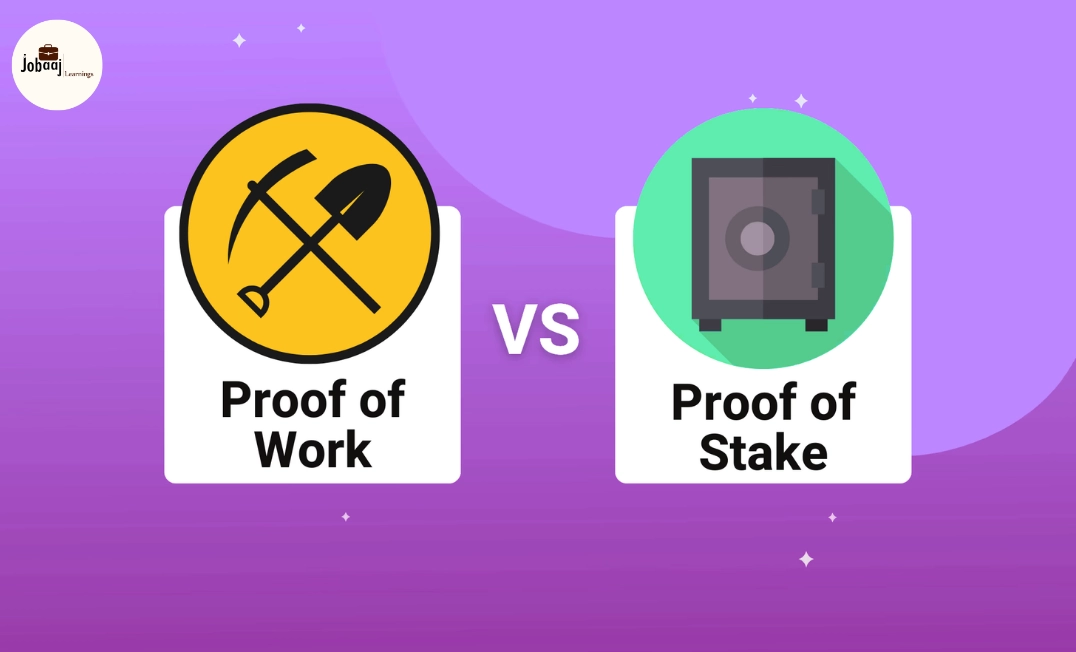
Blockchain technology relies on consensus mechanisms to validate transactions and secure the network. Two of the most widely discussed methods are Proof-of-Work (PoW) and Proof-of-Stake (PoS). Both are designed to achieve the same goal secure, decentralized verification of transactions but they operate in fundamentally different ways.
Exploring a career in Web Development? Apply now!
Understanding these mechanisms is crucial for anyone exploring cryptocurrencies, blockchain networks, or decentralized applications. This guide explains how each system works, compares their strengths and weaknesses, and highlights real-world examples.
How Proof-of-Work (PoW) Works
Proof-of-Work is the original consensus mechanism, famously used by Bitcoin. Its operation is based on computational effort:
- Transaction Verification: Users broadcast transactions to the network.
- Mining: Special nodes called miners solve complex cryptographic puzzles. Solving the puzzle proves the miner’s “work.”
- Block Addition: The first miner to solve the puzzle adds a new block to the blockchain.
- Reward: Miners receive cryptocurrency rewards and transaction fees.
Key Points:
- Security comes from computational difficulty. Altering a block requires recalculating the proof-of-work for that block and all subsequent blocks a practically impossible task for large networks.
- Mining requires significant energy and hardware investment.
- Network control is based on who contributes the most computational power.
How Proof-of-Stake (PoS) Works
Proof-of-Stake, used by networks like Ethereum 2.0 and Cardano, relies on ownership of cryptocurrency (stake) rather than computational power:
- Validators Selection: Participants who “stake” their coins are chosen to validate transactions.
- Block Creation: A selected validator proposes a new block based on their stake.
- Verification: Other validators approve the block.
- Rewards: Validators earn rewards proportional to their stake.
Key Points:
- Security comes from financial commitment. Validators risk losing their staked coins if they attempt malicious activity.
- PoS is energy-efficient because it doesn’t rely on massive computations.
- Influence is based on stake ownership, not computing resources.
Comparing Proof-of-Work and Proof-of-Stake
|
Feature |
Proof-of-Work (PoW) |
Proof-of-Stake (PoS) |
|
Validation Method |
Solving complex computational puzzles |
Ownership/stake in the network |
|
Energy Consumption |
Very high; requires mining hardware |
Low; no heavy computation required |
|
Security Basis |
Computational difficulty |
Financial commitment; staked coins at risk |
|
Network Control |
More computing power = more influence |
More staked coins = more influence |
|
Transaction Speed |
Slower due to mining time |
Faster; block selection is stake-based |
|
Examples |
Bitcoin, Litecoin |
Ethereum 2.0, Cardano, Polkadot |
|
Pros |
Extremely secure, proven track record |
Energy-efficient, scalable, environmentally friendly |
|
Cons |
Expensive, energy-intensive, slower |
Wealth-based centralization risk, newer model with less historical testing |
Real-World Implications
- Bitcoin continues to use PoW due to its proven security, but energy consumption is a growing concern.
- Ethereum transitioned to PoS with its “Merge” update to reduce energy use by over 99% and improve scalability.
- PoS is being adopted by many new networks aiming for eco-friendly and faster blockchain solutions.
Advantages and Trade-Offs
Proof-of-Work
- Advantages:
- Extremely secure
- Battle-tested over a decade
- Resistant to centralization of stake
- Limitations:
- High energy and hardware costs
- Slower transaction speeds
- Environmental concerns
Proof-of-Stake
- Advantages:
- Energy-efficient and eco-friendly
- Faster block confirmation
- Lower entry barrier for participation (no expensive mining rigs)
- Limitations:
- Potential for wealth-based centralization
- Less proven than PoW for extremely large networks
- Requires robust staking mechanisms to ensure fairness
Choosing Between PoW and PoS
The choice depends on the network’s goals:
- Security and trust: PoW remains the gold standard for maximum security.
- Scalability and sustainability: PoS is preferred for networks focusing on efficiency, environmental impact, and higher transaction throughput.
- Hybrid Approaches: Some networks combine PoW and PoS features to balance security and efficiency.
Conclusion
Proof-of-Work and Proof-of-Stake are the backbone of blockchain security and trust. While PoW relies on computational effort to validate transactions, PoS uses financial commitment to ensure integrity. Each has strengths and weaknesses, and their adoption depends on factors like security, speed, scalability, and environmental considerations.
Understanding these mechanisms is essential for anyone exploring blockchain, cryptocurrency investments, or decentralized applications, as they shape the efficiency, security, and sustainability of the network.
Dreaming of a Web Development Career? Start with Web Development Certificate with Jobaaj Learnings.
Frequently asked questions
How does Proof-of-Work secure a blockchain?
PoW requires miners to solve complex computational puzzles to validate transactions. The effort and energy involved make it extremely difficult to tamper with the blockchain.
How does Proof-of-Stake validate transactions?
PoS relies on validators who lock up (stake) their coins. Blocks are proposed and verified based on stake, with penalties for malicious behavior ensuring security.
What are the main differences between PoW and PoS?
PoW depends on computational power and energy-intensive mining, while PoS relies on coin ownership and financial commitment, making it more energy-efficient and faster.
Which cryptocurrencies use PoW and PoS?
Bitcoin and Litecoin use PoW, while Ethereum 2.0, Cardano, and Polkadot use PoS or PoS-based mechanisms.
Which system is better for scalability?
PoS generally allows faster transaction processing and better scalability compared to PoW, which is slower and more energy-intensive.
Join 5,00,000+ Subscribers
Be a part of our ever growing community.