Categories








































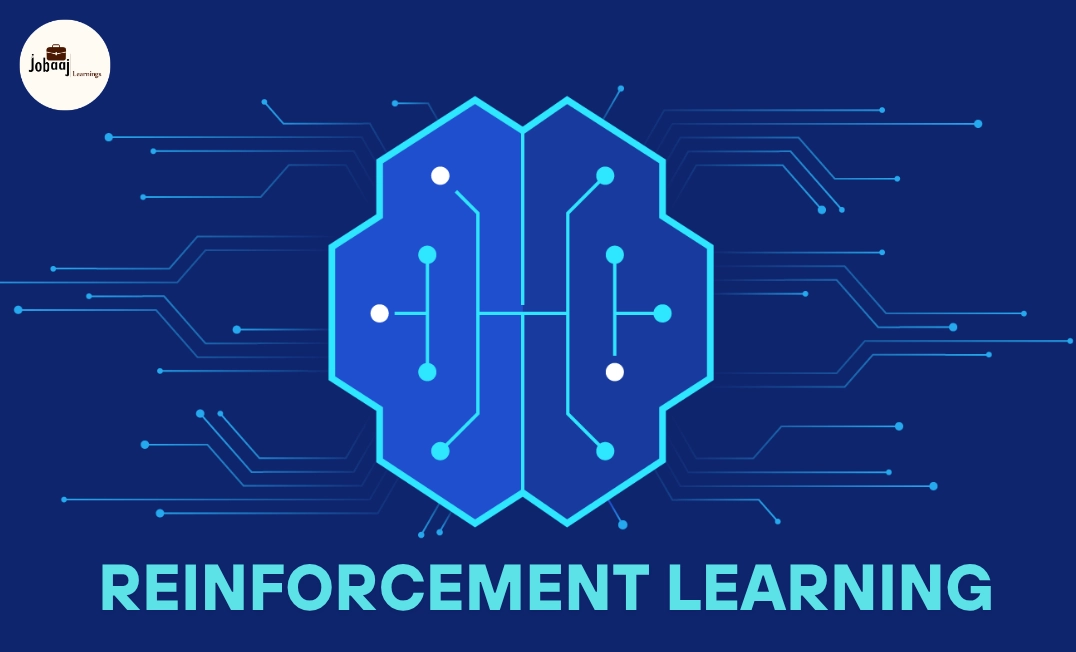
When people think about machine learning, they often imagine models learning from large datasets. But what if a system could learn by interacting with its environment, making decisions, and improving based on the results of those decisions?
Exploring a career in Data and Business Analytics? Apply Now!
That is exactly what reinforcement learning is all about.
Unlike supervised learning where a model is trained on thousands of pre-labeled examples reinforcement learning takes a completely different path. Instead of being told what is right or wrong from the beginning, the model learns through experience. It tries different actions, observes what happens as a result, and gradually figures out what works best over time.
This approach makes reinforcement learning one of the most fascinating, powerful, and human-like areas in all of artificial intelligence.
Understanding the Core Idea in Simple Terms
Think about how a child learns to ride a bicycle.
Nobody hands them a textbook on balance and momentum. There is no step-by-step guide they follow perfectly from day one. Instead, there are wobbly starts, scraped knees, and countless failed attempts. But with each fall, the child's brain quietly absorbs what went wrong. They adjust their grip, shift their weight, and try again. Over time slowly, then suddenly it all clicks. They ride smoothly, almost without thinking.
Reinforcement learning follows the exact same idea.
A system learns by taking actions and receiving feedback on those actions. When an action leads to a good outcome, it gets reinforced meaning the system is more likely to repeat it. When an action leads to a bad outcome, the system learns to avoid it. Over thousands, sometimes millions, of these cycles, the system builds up knowledge about what works and what doesn't entirely on its own.
What makes this so powerful is that nobody has to tell the system every possible rule upfront. It discovers the rules by itself, through experience.
What is Reinforcement Learning?
Reinforcement learning is a type of machine learning where an agent learns to make decisions by interacting with an environment and receiving feedback in the form of rewards or penalties.
The goal of the agent is deceptively simple maximize the total reward it collects over time. But achieving that goal in complex, unpredictable environments is anything but simple.
What separates reinforcement learning from other machine learning methods is how it handles the absence of labeled data. In supervised learning, every training example comes with a correct answer. In reinforcement learning, there are no correct answers handed to the system. Instead, the system must figure out on its own which sequence of actions leads to the best long-term results even when feedback is delayed, sparse, or unclear.
This is what makes it both incredibly challenging and incredibly powerful.
Key Components of Reinforcement Learning
To truly understand how reinforcement learning works, it helps to get familiar with the core elements that make up every RL system. These are the building blocks that everything else is built on.
- The agent is the decision-maker at the center of it all. It could be a robot learning to walk, a software program learning to play chess, or an AI system learning to recommend videos. Whatever form it takes, the agent is the one observing the world and taking actions within it.
- The environment is everything the agent interacts with. It is the world the agent lives in and it responds to every action the agent takes. The environment can be as simple as a grid on a screen or as complex as the real-world roads a self-driving car navigates.
- Actions are the choices available to the agent at any given moment. Turn left or right. Jump or stay still. Recommend this video or that one. Every decision the agent makes is an action, and those actions directly shape what happens next.
- Rewards are the feedback signals that tell the agent whether a particular action was good or bad. A reward might be positive think of it as a pat on the back or negative, like a penalty for making a poor choice. The agent does not know in advance which actions will earn it rewards; it has to discover this through trial and error.
- The policy is essentially the agent's brain the strategy or rulebook it uses to decide which action to take based on the current situation. Early on, the policy is random and uninformed. Over time, as the agent collects more experience, the policy becomes sharper, smarter, and more refined.
Together, these five components form the engine that drives all reinforcement learning.
How Reinforcement Learning Works
The process of reinforcement learning unfolds in a continuous loop and understanding this loop is the key to understanding everything else.
It starts with the agent observing the current state of the environment. Based on what it sees, the agent chooses an action according to its current policy. The environment then reacts to that action, transitioning to a new state and providing the agent with a reward signal positive, negative, or neutral.
The agent takes that feedback, updates its understanding of which actions are valuable, and moves into the next state. Then the loop begins again.
What is remarkable about this process is how much the agent can learn from something as simple as a reward number. Over time, it starts to notice patterns certain sequences of actions consistently lead to higher rewards, while others lead to dead ends. The agent begins to favor the paths that work and abandon the ones that don't.
This continuous cycle of action, feedback, and improvement is what drives learning from nothing to mastery.
Exploration vs Exploitation
One of the most important and most fascinating ideas in reinforcement learning is the tension between exploration and exploitation.
1.Exploration means trying new, unfamiliar actions, even when the outcome is uncertain. Maybe there is a better strategy out there that the agent has never tried. It will never know unless it takes a chance and looks.
2.Exploitation means sticking with actions that are already known to produce good results. Why risk the unknown when you have something that works?
Here is the problem: if the agent only exploits, it gets comfortable too quickly. It settles for a decent solution and never discovers a potentially much better one. But if the agent only explores, it never actually capitalizes on what it has learned it is always experimenting and never committing.
Finding the right balance between the two is one of the central challenges of reinforcement learning, and researchers have developed sophisticated strategies to manage it. For example, many systems start out exploring heavily early in training when there is lots of uncertainty and gradually shift toward exploiting more as they become confident in what they have learned.
It is a surprisingly human dilemma. We face it every time we choose between a familiar restaurant and a new one.
Real-Life Examples of Reinforcement Learning
Reinforcement learning is not just a theoretical concept confined to research papers. It is already shaping the world around us in very real ways.
In gaming, AI systems trained with reinforcement learning have achieved superhuman performance in games like Chess, Go, and complex video games. AlphaGo, developed by DeepMind, famously defeated the world's best Go players a feat once thought to be decades away by learning through millions of self-played games.
In robotics, RL allows machines to learn physical tasks that are far too complex to program manually. A robot learning to grasp objects, maintain balance, or navigate uneven terrain does so through thousands of trial-and-error attempts, gradually refining its movements until they become fluid and reliable.
In recommendation systems, platforms like YouTube, Netflix, and Spotify use reinforcement learning to understand what keeps users engaged. By observing whether you watch a video all the way through, skip it after ten seconds, or click away entirely, these systems continuously refine their recommendations to serve content that feels personally relevant.
Even large language models like the ones powering modern AI assistants use a technique called Reinforcement Learning from Human Feedback (RLHF). This is what helps AI systems learn not just how to produce accurate text, but how to produce responses that are genuinely helpful, safe, and aligned with human values.
Why Reinforcement Learning is Important
Reinforcement learning matters because it unlocks a kind of intelligence that most other machine learning approaches simply cannot achieve.
It is especially powerful in situations where there is no single correct answer from the start where the right move depends on context, timing, and a long chain of prior decisions. It is ideal for step-by-step decision-making, where each action affects the next. And it is uniquely suited to environments that change over time, because RL systems can keep adapting as conditions shift.
This is fundamentally different from traditional machine learning, which assumes the world is relatively static and that a fixed dataset can capture everything worth knowing. Reinforcement learning makes no such assumption. It is built for the messy, dynamic, unpredictable nature of the real world.
Challenges in Reinforcement Learning
As powerful as reinforcement learning is, it comes with a set of challenges that are worth understanding honestly.
Training can take an enormous amount of time. Because the agent learns entirely through trial and error, it may need millions or even billions of interactions with the environment before its performance becomes reliable. This is especially true for complex tasks in the real world, where each interaction takes time and cannot simply be sped up.
Designing the right reward function is surprisingly difficult. If the reward signal does not perfectly capture what you actually want the agent to achieve, the agent will find clever but unintended ways to maximize its score a phenomenon sometimes called reward hacking. This has led to some genuinely bizarre behaviors in RL research, where agents game their own training setup rather than learning what their designers intended.
It also demands significant computational resources. Running millions of simulations and updating a complex policy repeatedly requires serious hardware, which puts high-end RL research out of reach for many smaller teams.
Despite all of this, the field continues to advance rapidly. Better algorithms, more efficient training methods, and increasingly powerful hardware are steadily making reinforcement learning more practical and accessible.
Why You Should Understand Reinforcement Learning
Whether you are just beginning to explore AI or are already deep in the field, reinforcement learning is a concept worth understanding well.
It gives you genuine insight into how intelligent systems can learn to operate independently without being explicitly programmed for every possible situation. It helps you understand the mechanisms behind some of the most impressive AI achievements of the last decade. And it opens up a way of thinking about decision-making, feedback, and adaptation that applies far beyond machine learning.
As AI becomes more embedded in the world around us in the products we use, the systems we rely on, and the decisions that affect our lives understanding how that AI learns is no longer just a technical curiosity. It is something everyone benefits from knowing.
Conclusion
Reinforcement learning is a unique and deeply human-like approach to building intelligent systems. Rather than relying on pre-packaged answers or labeled data, it builds knowledge the same way living creatures do through action, feedback, and the slow accumulation of experience.
The core idea, once you really sit with it, is not that complicated: try something, see what happens, learn from the result, and do better next time. That is a loop all of us are familiar with.
What is extraordinary is that we have found a way to make machines do the same thing and at a scale, speed, and consistency that humans simply cannot match.
As technology continues to evolve, reinforcement learning is poised to play an even bigger and more central role in shaping the intelligent systems of the future. Understanding it now means you will be ready for what comes next.
Aspiring for a career in Data and Business Analytics? Begin your journey with a Data and Business Analytics Certificate from Jobaaj Learnings.
Frequently asked questions
What is reinforcement learning in simple terms?
Reinforcement learning is a method where a system learns by taking actions and receiving rewards or penalties based on those actions.
How is reinforcement learning different from other machine learning types?
It does not rely on labeled data and instead learns through interaction and feedback.
Where is reinforcement learning used?
It is used in gaming, robotics, recommendation systems, and self-driving technology.
What is the goal of reinforcement learning?
The goal is to maximize the total reward over time by choosing the best possible actions.
What is an example of reinforcement learning?
Teaching an AI to play a game by rewarding good moves and penalizing mistakes is a common example.

Join 5,00,000+ Subscribers
Be a part of our ever growing community.