Categories














/content/learnings/assets/header/ManagementConsulting.svg)
/content/learnings/assets/header/InvestmentBanking.svg)


























/content/learnings/assets/header/programs/1.png)
/content/learnings/assets/header/programs/4.png)

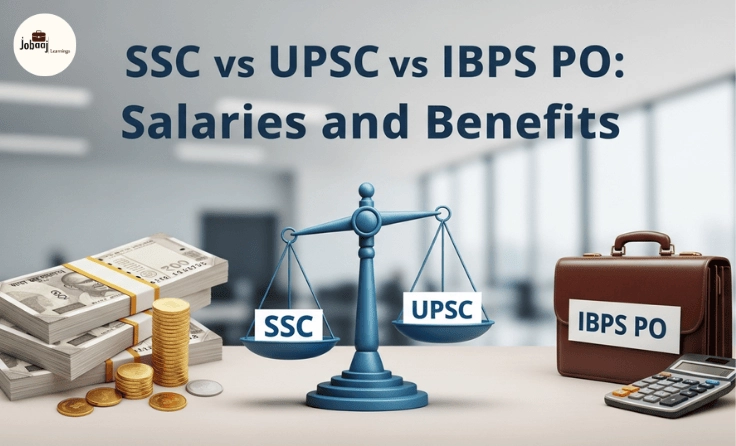
Choosing between a career in government services is one of the most important decisions for any student in India. With various exams like the SSC (Staff Selection Commission), UPSC (Union Public Service Commission), and IBPS PO (Institute of Banking Personnel Selection Probationary Officer), it can be challenging to weigh the pros and cons.
One of the most crucial factors in this decision-making process is salary and benefits. What will your earnings be like? What perks and benefits come with each role? While all three offer prestigious positions, they come with varying pay structures, allowances, and growth opportunities.
In this blog, we’ll break down the salaries and benefits of SSC, UPSC, and IBPS PO, along with the work culture and growth prospects in each career.
1. SSC (Staff Selection Commission)
The SSC exams are popular among candidates looking for stable government jobs in various ministries and departments. The Staff Selection Commission recruits candidates for posts like Clerks, Assistants, Inspectors, and more.
Salary and Pay Structure:
-
Grade Pay: SSC jobs are classified based on pay grades. For example, posts like SSC CGL (Combined Graduate Level) have a pay scale ranging from Rs. 25,000 to Rs. 45,000 per month.
-
Basic Salary: For Group C posts like Tax Assistant or Clerk, the salary can range from Rs. 20,000 to Rs. 35,000 per month.
-
Group B posts like Section Officer and Assistant have a salary range of Rs. 35,000 to Rs. 55,000 per month.
-
Grade Pay: The pay scales for various posts are aligned with Pay Band 1 and Pay Band 2, ranging from Rs. 5,200 to Rs. 20,200.
Allowances and Benefits:
-
Dearness Allowance (DA): Based on the cost of living, DA is around 30-35% of the basic salary.
-
House Rent Allowance (HRA): Depending on the city, the HRA can be 8%-24% of the basic salary.
-
Travel Allowance (TA): This is provided based on travel requirements, along with medical and leave benefits.
-
Pension: As a government employee, SSC officers are eligible for pension benefits after retirement.
-
Leave: Employees are entitled to earned leave (usually 30 days per year) and casual leave (around 12 days per year).
Growth and Promotions:
-
There are regular promotions within the SSC structure, such as promotions to Assistant Section Officer, Deputy Commissioner, and more.
-
After 5-7 years, employees can expect promotions with additional allowances and higher-grade pay.
2. UPSC (Union Public Service Commission)
The UPSC exam is the gateway to the highest echelons of government service in India. Careers like Indian Administrative Service (IAS), Indian Police Service (IPS), Indian Foreign Service (IFS), and Indian Revenue Service (IRS) all fall under the UPSC’s recruitment umbrella.
Salary and Pay Structure:
-
IAS, IPS, IFS: Officers in these prestigious services get a basic salary ranging from Rs. 56,100 to Rs. 2,50,000 per month (depending on the level of seniority and posting). The basic pay increases with the rank, from level 10 (junior administrative officer) to level 18 (cabinet secretary).
-
Grade Pay: The salary structure follows the 7th Pay Commission, with Rs. 56,100 as the entry-level salary, and can rise to Rs. 2,50,000 for senior positions.
Allowances and Benefits:
-
Dearness Allowance (DA): DA is typically around 30%-35% of the basic salary.
-
House Rent Allowance (HRA): HRA varies based on the city of posting, with 8%-24% of the basic salary.
-
Travel Allowance (TA): Government officers are provided with a monthly travel allowance and official travel expenses.
-
Pension: One of the significant benefits is pension, which is available after retirement.
-
Leave: Officers are entitled to 30 days of earned leave, along with casual leave and medical leave.
Other Perks:
-
Officers get official residences, cars, and other facilities based on their rank and position.
-
Regular foreign postings for IFS officers come with additional allowances.
Upcoming government exams 2026
Growth and Promotions:
-
UPSC officers enjoy rapid career advancement. For instance, an IAS officer can rise from the position of Sub-Divisional Magistrate (SDM) to District Magistrate (DM), and eventually reach positions like Cabinet Secretary.
-
With promotions, salary packages increase, including additional allowances and higher pension benefits.
-
International postings and handling important national projects provide officers with prestige and influence.
3. IBPS PO (Institute of Banking Personnel Selection Probationary Officer)
IBPS PO is a highly competitive exam for banking jobs, offering a well-paying career with growth opportunities in the public sector.
Salary and Pay Structure:
-
Basic Salary: The salary for an IBPS PO starts at around Rs. 36,000 - Rs. 40,000 per month (depending on the bank and the city of posting).
-
In-Hand Salary: After deductions like taxes, provident fund, and insurance, the in-hand salary typically ranges between Rs. 50,000 to Rs. 70,000 per month for a fresh PO.
Allowances and Benefits:
-
Dearness Allowance (DA): As per the latest update, DA is approximately 30-35% of the basic salary.
-
House Rent Allowance (HRA): Depending on the posting city, HRA is around 8%-24% of the basic salary.
-
Special Allowance: A special allowance is given, which typically ranges between Rs. 4,000 to Rs. 7,000 per month.
-
Bonus: A performance-based bonus is also given annually to IBPS POs.
-
Medical Allowance: Free medical benefits for the employee and family.
-
Leave: IBPS POs are entitled to leave benefits such as sick leave, casual leave, and earned leave (usually around 15-20 days per year).
Growth and Promotions:
-
IBPS PO offers excellent career growth. With promotions, a PO can progress to the position of Assistant Manager, then Deputy Manager, and ultimately Branch Manager.
-
After serving for a few years, employees can be promoted to higher managerial roles, with salary hikes, including allowances and bonuses.
-
Transfer opportunities across India add to the career versatility in IBPS.
Conclusion
Choosing between SSC, UPSC, and IBPS PO boils down to your career aspirations and lifestyle preferences. Here’s a quick overview of what each path offers:
|
Factor |
SSC |
UPSC |
IBPS PO |
|
Starting Salary (in INR) |
Rs. 20,000 - Rs. 55,000 |
Rs. 56,100 - Rs. 2,50,000 |
Rs. 36,000 - Rs. 40,000 |
|
Allowances |
DA, HRA, TA, Medical, Pension |
DA, HRA, TA, Travel, Housing, Pension |
DA, HRA, Special Allowance, Medical, Bonus |
|
Work-Life Balance |
Generally balanced, 9 AM - 5 PM |
Unpredictable, may require long hours |
Generally balanced, with weekends off |
|
Job Security |
High (government posts) |
Very high (lifetime job security) |
High (government bank jobs) |
|
Growth Opportunities |
Steady growth, promotions available |
Rapid promotions in IAS, IPS, IFS, etc. |
Career progression to managerial roles |
|
Prestige |
High, but less influential than UPSC |
Very high, with significant societal impact |
High, especially in leadership roles in banks |
In the end, your choice depends on your interest in public service, your career goals, and whether you prioritize work-life balance, financial growth, or impact. Each career has its unique rewards, and whichever you choose, you’ll be set for a fulfilling and respected career.
Frequently asked questions
What is the salary of an IBPS PO in India?
The starting salary of an IBPS PO is between Rs. 36,000 and Rs. 40,000 per month, with in-hand salary ranging from Rs. 50,000 to Rs. 70,000 after deductions.
What are the main benefits of a career in civil services (UPSC)?
Civil services offer high prestige, job security, and opportunities to impact national policies. Benefits include a stable salary, allowances, pension, medical benefits, and housing.
How does the salary of an IAS officer compare to an IBPS PO or SSC employee?
An IAS officer's salary starts at Rs. 56,100 per month and increases with rank, whereas an IBPS PO and SSC employee’s starting salary ranges from Rs. 20,000 to Rs. 40,000, depending on the role.
Which job has better growth prospects, SSC, UPSC, or IBPS PO?
UPSC offers the fastest growth, especially in IAS, IPS, and IFS roles. IBPS PO offers significant career growth in banking, while SSC offers steady growth within the government framework.
Are the benefits of working in a government job in India better than in the private sector?
Government jobs offer strong job security, pension, medical benefits, and other perks that are hard to match in the private sector. However, salaries in private companies may be higher, depending on the industry.
Which is better: SSC, UPSC, or IBPS PO?
It depends on what you value work-life balance and financial rewards may make IBPS PO a good choice, while prestige and public service impact may make UPSC more appealing. SSC offers job security and steady growth in various administrative roles.

Join 5,00,000+ Subscribers
Be a part of our ever growing community.