Categories








































Every investor wants to know whether a stock is worth buying. But looking at the stock price alone doesn’t tell the full story. A ₹200 stock might be expensive, while a ₹1,000 stock could be a great deal—it all depends on how much profit the company makes.
That’s where stock valuation techniques come in, and among them, the Price-to-Earnings (P/E) ratio is one of the most popular and powerful tools.
What Is the Price-to-Earnings (P/E) Ratio?
The P/E ratio is a simple number that shows how much investors are willing to pay today for one unit of a company’s earnings.
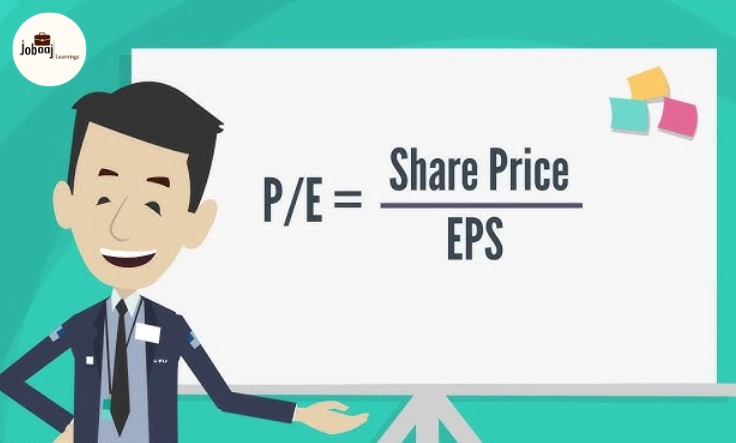
Formula:
P/E Ratio = Price per Share ÷ Earnings per Share (EPS)
For example:
If a company’s share price is ₹300 and its earnings per share (EPS) are ₹30, then:
P/E = 300 ÷ 30 = 10
That means investors are paying ₹10 for every ₹1 the company earns.
A higher P/E usually means investors expect higher growth in the future. A lower P/E can mean the stock is undervalued—or that investors expect slower growth.
Why the P/E Ratio Matters So Much
The P/E ratio is valuable because it connects two critical elements—market price and profitability. It’s not just a number; it reflects investor confidence, market sentiment, and expectations about future performance.
-
It helps investors compare similar companies.
-
It reveals if the stock price justifies the company’s earnings.
-
It highlights how optimistic or cautious the market feels about a business.
In short, the P/E ratio turns complicated financial data into an easy-to-read indicator of value.
Types of P/E Ratios: Understanding the Context
There are two main ways to calculate and interpret the P/E ratio:
1. Trailing P/E (Based on Past Earnings)
This version uses the company’s actual earnings over the past 12 months.
It’s factual, reliable, and based on real data.
Example: If a company earned ₹50 per share last year and the stock is ₹500, the trailing P/E is 10.
2. Forward P/E (Based on Future Earnings)
This uses projected earnings for the next 12 months. It’s based on analysts’ or company forecasts.
While it reflects future growth expectations, it’s also more uncertain since forecasts can change.
In practice, investors look at both. If the forward P/E is lower than the trailing P/E, it often suggests the company is expected to grow.
How to Interpret the P/E Ratio
The P/E ratio tells you how much confidence investors have in the company’s future, but it’s relative—meaning it makes sense only when compared properly.
-
High P/E (above 25–30): Investors expect strong future growth. These are often fast-growing tech or pharma companies.
-
Moderate P/E (around 15–25): Indicates stable, consistent companies with average growth.
-
Low P/E (below 10): Might be undervalued—or a warning sign of poor performance or risk.
Example:
If Company A has a P/E of 40 and Company B has a P/E of 10, that doesn’t mean B is automatically better. Company A might be in a high-growth sector like technology, while B could be in a slow-moving industry like manufacturing.
Context is everything.
P/E Ratio in Real-World Examples
Let’s take two hypothetical companies:
-
TechSpark Ltd. — Price: ₹1,000 | EPS: ₹20 → P/E = 50
-
SteelCore Ltd. — Price: ₹300 | EPS: ₹30 → P/E = 10
TechSpark’s high P/E shows investors expect rapid future growth, while SteelCore’s low P/E shows limited growth expectations.
However, if TechSpark fails to meet earnings expectations, its stock could drop sharply—showing why P/E should never be used alone.
Advantages of Using the P/E Ratio
-
Easy to Calculate: Just two numbers—price and EPS—make it beginner-friendly.
-
Quick Comparison: Lets you compare valuations across similar companies.
-
Market Sentiment Gauge: Reflects investor optimism or caution.
-
Growth Insight: When paired with the PEG ratio, it reveals whether a stock’s growth is worth the price.
Limitations of the P/E Ratio
Despite its simplicity, the P/E ratio has several blind spots:
-
It ignores debt. A highly leveraged company can appear cheap despite being risky.
-
It can be distorted. Temporary profits or losses can make the ratio misleading.
-
Different sectors, different norms. What’s high in one industry could be normal in another.
-
It doesn’t consider growth. A company growing earnings rapidly might justify a higher P/E.
That’s why professional investors use it alongside other metrics like PEG Ratio, Debt-to-Equity, and Return on Equity (ROE).
Struggling with stock charts?
Start now with Jobaaj Learnings' Technical Analysis Crash Course.
Comparing P/E Across Industries
Each industry has its own “normal” P/E range. For example:
|
Industry |
Typical P/E Range |
Interpretation |
|
Technology |
25–60 |
High growth expectations |
|
Banking & Finance |
10–20 |
Moderate, stable growth |
|
FMCG |
20–40 |
Consistent earnings, steady demand |
|
Manufacturing |
8–15 |
Slower growth, higher capital use |
So before judging a stock, always check how its P/E compares within its own industry.
P/E Ratio and the Market Cycle
The average market P/E also moves with economic cycles:
-
Bull Markets: Rising optimism pushes P/E ratios higher as investors expect strong future earnings.
-
Bear Markets: Fear lowers P/E ratios, even for solid companies, as earnings and confidence fall.
This is why seasoned investors use the P/E of the overall market (like Nifty 50 or S&P 500) to judge whether stocks in general are overpriced or cheap.
Beyond the Basics: The PEG Ratio
The PEG ratio (Price/Earnings to Growth) refines the P/E by factoring in growth.
PEG = P/E ÷ Annual EPS Growth Rate
A PEG close to 1 suggests fair value.
Below 1 indicates undervaluation, and above 1.5 may signal overvaluation.
For instance, a company with a P/E of 20 and growth of 20% has a PEG of 1—considered healthy.
How to Use the P/E Ratio in Stock Valuation
-
Step 1: Check the company’s current P/E ratio.
-
Step 2: Compare it with its historical P/E (5-year average).
-
Step 3: Compare it with peers in the same industry.
-
Step 4: Evaluate earnings consistency and future growth.
-
Step 5: Look at the broader market trend.
This approach helps you avoid falling for “cheap-looking” or “hyped-up” stocks.
Conclusion
The Price-to-Earnings ratio is a cornerstone of stock valuation because it blends price and performance into one simple metric. It helps you understand what investors are paying for profits—and whether that price makes sense.
However, no ratio tells the whole story. Combine the P/E with other financial indicators and a good understanding of the company’s fundamentals.
Remember, investing is part numbers, part patience. Use the P/E ratio to guide your decisions, not dictate them.
Frequently asked questions
What is the P/E ratio?
The P/E ratio compares a company's stock price to its earnings per share (EPS). It's a key metric used to assess whether a stock is overvalued or undervalued.
How is the P/E ratio calculated?
The P/E ratio is calculated by dividing the current market price of a stock by its earnings per share (EPS). A higher EPS generally leads to a lower P/E ratio.
What does a high P/E ratio mean?
A high P/E ratio can suggest investors expect high future growth. However, it could also mean the stock is overvalued. Consider other factors before investing.
What does a low P/E ratio mean?
A low P/E ratio might indicate the stock is undervalued or that investors are pessimistic about the company's future prospects. Further investigation is crucial.
Are there different types of P/E ratios?
Yes, there's the trailing P/E (based on past earnings) and the forward P/E (based on projected earnings). Each offers a different perspective on a company's valuation.

Join 5,00,000+ Subscribers
Be a part of our ever growing community.