Categories








































Imagine you’re a young data scientist excited to dive into the world of data. You've heard all about Python, a programming language revered in the data science community for its flexibility and ease of use. But there’s a catch — to truly leverage the power of Python, you need to learn the right libraries. Without them, it’s like having a car but no wheels to drive it.
Exploring a career in Data Analytics? Apply Now!
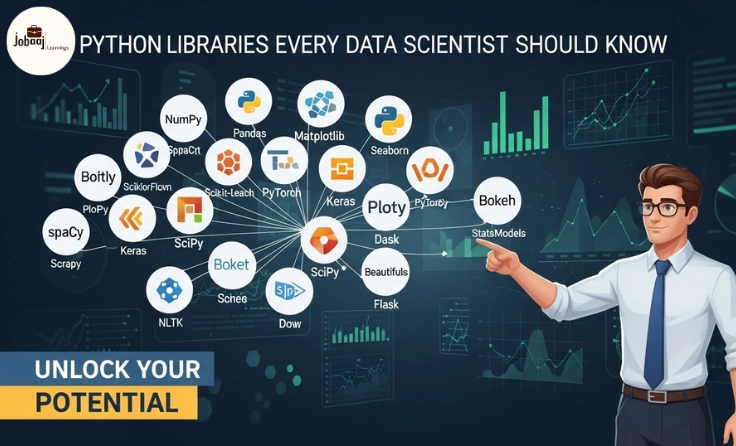
I remember the first time I started learning about data science. I knew the basics of Python, but the sheer number of available libraries overwhelmed me. Which ones should I focus on? Well, after experimenting with different tools, I realized that some Python libraries are absolute game-changers for data scientists. In this blog, I’ll walk you through the top Python libraries that every data scientist should know and use.
1. Pandas: The Data Manipulation Master
If there’s one library that should be at the top of every data scientist’s list, it’s Pandas. This library is designed for data manipulation and analysis. Pandas provides fast, flexible, and easy-to-use data structures, which are perfect for handling and analyzing large datasets.
-
DataFrames: Pandas introduces the DataFrame — a two-dimensional, size-mutable, and potentially heterogeneous tabular data structure with labeled axes (rows and columns). It’s similar to an Excel spreadsheet but more powerful.
-
Data Cleaning: It allows you to handle missing data, filter rows and columns, group and aggregate data, and perform complex data transformations.
If you want to work with structured data (e.g., CSV, Excel, SQL databases), Pandas is your go-to tool.
2. NumPy: The Foundation for Numerical Computing
If you plan to work with numbers, NumPy is a must-have library. NumPy provides support for large, multi-dimensional arrays and matrices, along with a collection of high-level mathematical functions to operate on these arrays.
-
Array Operations: NumPy arrays are much faster than Python’s built-in lists, especially for large data sets. This makes NumPy ideal for numerical computations.
-
Linear Algebra: If you need to perform operations like matrix multiplication, eigenvalue problems, or other mathematical operations, NumPy offers efficient methods.
It is the foundation upon which other libraries like Pandas and Scikit-learn are built, making it essential for data science.
3. Matplotlib: Data Visualization Simplified
As a data scientist, your ability to communicate insights visually is as important as the analysis itself. Matplotlib is one of the most popular Python libraries for creating static, animated, and interactive visualizations.
-
Graphs and Plots: Whether it’s a simple line graph, a bar chart, or a more complex heatmap, Matplotlib allows you to create a wide variety of plots.
-
Customization: You can customize almost everything — from the axes and titles to colors and labels — giving you complete control over your visualizations.
If you’re working with data visualization, Matplotlib should be your first choice.
4. Scikit-learn: Machine Learning Made Easy
For any data scientist venturing into machine learning, Scikit-learn is an indispensable library. It provides simple and efficient tools for data mining and data analysis.
-
Preprocessing: Scikit-learn helps you prepare your data for modeling, offering tools for scaling, encoding, and splitting datasets.
-
Algorithms: Whether you’re working with classification, regression, or clustering, Scikit-learn offers a wide range of algorithms like decision trees, k-nearest neighbors, and support vector machines.
-
Model Evaluation: It also offers functions to evaluate your models using cross-validation and metrics like accuracy and precision.
Scikit-learn is perfect for quick prototyping and implementing machine learning algorithms.
5. TensorFlow: Deep Learning Power
For those diving into deep learning and neural networks, TensorFlow is a must-learn library. Developed by Google, TensorFlow makes it easy to build and train machine learning models, especially for complex tasks like image recognition, natural language processing, and more.
-
Neural Networks: TensorFlow excels at building deep neural networks with multiple layers.
-
TensorFlow 2.0: The latest version of TensorFlow is easier to use, thanks to the integration with Keras, a high-level neural networks API, making it more user-friendly for beginners.
-
Scalability: TensorFlow supports both CPU and GPU processing, allowing you to train models on massive datasets efficiently.
If you want to get into deep learning, TensorFlow should be your go-to library.
6. Seaborn: Advanced Data Visualization
While Matplotlib is great for basic plots, Seaborn extends it to provide more advanced and aesthetically pleasing visualizations.
-
Statistical Plots: Seaborn integrates seamlessly with Pandas DataFrames and provides advanced statistical plots like heatmaps, violin plots, and pair plots.
-
Better Aesthetics: Seaborn’s default themes and color palettes make it easier to create visually appealing charts without much effort.
If you need beautiful, informative visualizations with less effort, Seaborn is the library for you.
Conclusion: Harnessing the Power of Python Libraries
Python’s libraries provide everything you need to be successful in the world of data science. Whether you're manipulating data with Pandas, crunching numbers with NumPy, visualizing insights with Matplotlib, or diving into machine learning with Scikit-learn or TensorFlow, these tools will empower you to unlock the full potential of your data.
As you continue your journey in data science, remember that these libraries are not just tools — they are the building blocks that will allow you to perform complex analyses, create compelling visualizations, and build cutting-edge machine learning models. Master these libraries, and you’ll be well on your way to becoming a successful data scientist.
Dreaming of a Data Analytics Career? Start with Data Analytics Certificate with Jobaaj Learnings.
Frequently asked questions
What are Python libraries for data science?
Python libraries for data science are pre-built code packages that provide functionality to help you work with data, perform statistical analysis, create visualizations, and build machine learning models. Some common libraries include Pandas, NumPy, Matplotlib, and Scikit-learn.
Why is Pandas so important for data science?
Pandas is a critical library for data science because it simplifies data manipulation and analysis. It allows you to clean, transform, and analyze data easily using DataFrames, which is crucial for working with real-world datasets.
What is the difference between Matplotlib and Seaborn?
Matplotlib is the basic library for plotting in Python, offering flexibility but requiring more code. Seaborn is built on top of Matplotlib and offers easier-to-use functions for creating more complex, aesthetically pleasing statistical plots with less effort.
Can I use Python libraries for machine learning?
Yes, libraries like **Scikit-learn**, **TensorFlow**, and **Keras** are specifically designed for machine learning in Python. These libraries provide tools for building, training, and evaluating machine learning models.
Which Python library is best for deep learning?
For deep learning, **TensorFlow** and **Keras** are the most widely used Python libraries. They provide tools to create complex neural networks and deep learning models for tasks like image recognition and natural language processing.
How do I get started with Python for data science?
To get started with Python for data science, begin by learning basic Python programming. Then, focus on libraries like Pandas for data manipulation, NumPy for numerical computing, and Matplotlib for data visualization. Gradually explore machine learning with Scikit-learn and deep learning with TensorFlow.

Join 5,00,000+ Subscribers
Be a part of our ever growing community.