Categories














/content/learnings/assets/header/ManagementConsulting.svg)
/content/learnings/assets/header/InvestmentBanking.svg)


























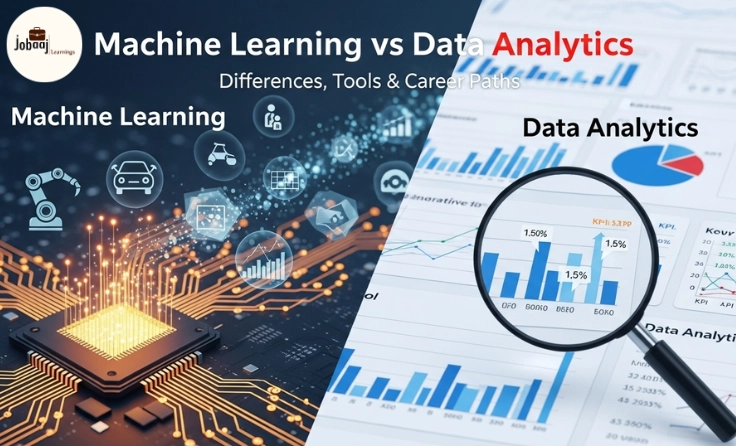
Imagine you’re at the helm of a ship, sailing into uncharted waters. You have two paths to choose from. The first one is about analyzing the past to understand the tides and currents—this is Data Analytics. The second path is about building a smart ship that can predict the best route ahead and adapt to changing conditions on its own—this is Machine Learning. Both paths are powerful, but which one should you take?
Exploring a career in Data Analytics? Apply Now!
As technology continues to advance, Machine Learning and Data Analytics are becoming integral parts of the data-driven world. These fields have a lot in common, but they also have key differences that make them unique. If you're starting your career or looking to pivot into tech, it's crucial to understand these fields, the tools involved, and the career opportunities they offer.
What is Data Analytics?
Data Analytics is all about examining raw data to uncover insights, patterns, and trends that can drive better decision-making. Think of it as a detailed analysis of historical data to understand "what happened" and "why it happened."
Key Features:
-
Descriptive Analytics: Helps understand past trends.
-
Diagnostic Analytics: Identifies reasons behind events.
-
Predictive Analytics: Uses historical data to make predictions.
-
Prescriptive Analytics: Provides recommendations for future actions.
Tools Used:
-
Excel: A simple but effective tool for basic data analysis.
-
SQL: Essential for querying databases and organizing data.
-
Tableau: A tool for data visualization and dashboard creation.
-
Power BI: Microsoft's analytics tool for visualizing data.
What is Machine Learning?
Machine Learning is a subset of Artificial Intelligence (AI) that enables systems to learn from data, make decisions, and improve over time without being explicitly programmed. It’s like teaching a computer to think and adapt.
Key Features:
-
Supervised Learning: The model is trained on labeled data.
-
Unsupervised Learning: The system detects patterns in data without labels.
-
Reinforcement Learning: The model learns by receiving feedback through actions.
Tools Used:
-
TensorFlow: A popular tool for building machine learning models.
-
Scikit-learn: A Python library that provides simple and efficient tools for data mining and machine learning.
-
Keras: A high-level neural networks API.
-
PyTorch: An open-source machine learning library used for applications such as natural language processing.
Machine Learning vs Data Analytics: Key Differences
|
Aspect |
Data Analytics |
Machine Learning |
|
Purpose |
To analyze past data and provide insights |
To build models that predict and learn from data |
|
Focus |
Data patterns and trends |
Algorithms that improve over time |
|
Skills Required |
Statistics, SQL, data visualization |
Programming, algorithms, deep learning |
|
Tools |
Excel, SQL, Tableau, Power BI |
TensorFlow, PyTorch, Scikit-learn |
|
Job Roles |
Data Analyst, Business Intelligence Analyst |
Machine Learning Engineer, Data Scientist |
Key Takeaway: While Data Analytics is focused on deriving insights from past data, Machine Learning aims to create intelligent systems that can make predictions and decisions.
Career Paths in Data Analytics and Machine Learning
Both fields offer promising career paths. However, the skills and job roles differ.
Data Analytics Career Path:
-
Data Analyst: Analyzes datasets and generates actionable insights.
-
Business Intelligence Analyst: Works with data to inform business strategies.
-
Data Scientist: Combines statistical analysis and machine learning to make predictions.
Machine Learning Career Path:
-
Machine Learning Engineer: Designs and builds algorithms that allow machines to learn from data.
-
AI Researcher: Focuses on improving machine learning models and developing new algorithms.
-
Data Scientist: Uses both data analytics and machine learning techniques to solve complex problems.
Conclusion: Which Path Should You Choose?
As technology evolves, both Data Analytics and Machine Learning will continue to play pivotal roles in shaping the future. If you're passionate about insights and data-driven decisions, Data Analytics could be the right path. If you’re excited about creating intelligent systems that predict and learn from data, then Machine Learning might be your calling.
The good news? You don’t necessarily have to choose one. As data scientists often do, you can combine both fields and leverage the power of analytics and machine learning in your career. Whichever you choose, these fields offer endless possibilities and opportunities to innovate and grow.
Dreaming of a Data Analytics Career? Start with Data Analytics Certificate with Jobaaj Learnings.
Frequently asked questions
What is the difference between Data Analytics and Machine Learning?
Data Analytics focuses on analyzing past data to uncover insights, while Machine Learning focuses on creating algorithms that can learn from data and predict future outcomes.
Which field offers better career opportunities: Data Analytics or Machine Learning?
Both fields offer excellent career opportunities, but Machine Learning tends to have higher salaries and more specialized roles. Data Analytics, on the other hand, has broader applications and a more accessible entry point.
What skills do I need for Data Analytics?
For Data Analytics, you need skills in statistics, SQL, and data visualization tools like Tableau and Power BI.
What are the career paths for Machine Learning?
Career paths for Machine Learning include roles like Machine Learning Engineer, AI Researcher, and Data Scientist.
Can I transition from Data Analytics to Machine Learning?
Yes! If you already have a background in statistics and data analysis, you can transition to Machine Learning by learning programming and machine learning algorithms.
What tools are commonly used in Data Analytics?
Excel, SQL, Tableau, and Power BI are some of the most popular tools used in Data Analytics to analyze and visualize data.

Join 5,00,000+ Subscribers
Be a part of our ever growing community.