Categories








































Manan Shah's Jobaaj Learnings Review: From B.Tech Fresher to Data Analyst at Exciler

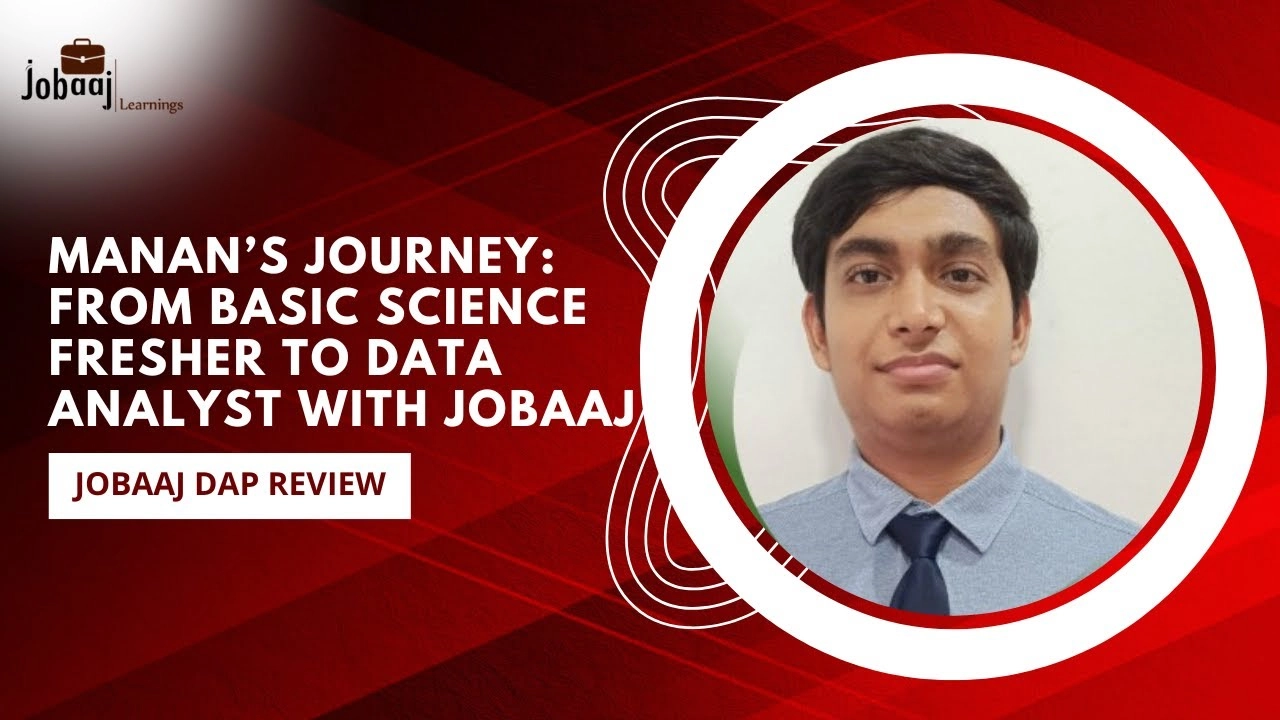
"The first interview was pretty normal, but the interviewer felt I was relying too much on AI tools for my responses. I was rejected, but I got valuable feedback, which helped me improve my communication and vocabulary." — Manan Shah
Manan Shah is from Vadodara, Gujarat and graduated with a BTech in July 2025. He was a fresher — one virtual internship, no full-time experience — and his degree had covered data analytics only in theory. He enrolled in Jobaaj Learnings' Data and Business Analytics Program, sat six or seven interviews, and was hired as a Data Analyst at Exciler, an Ahmedabad IT company working in data and AI.
If you are searching “is Jobaaj Learnings genuine”, “is Jobaaj real or fake” or “can a BTech fresher get a data analyst job”, the most useful thing here is the rejection. Manan was turned down in his first interview because the interviewer thought he was leaning on AI tools for his answers — a failure mode almost no candidate expects, and one worth reading before your own first interview. Read it alongside the other conversations in our Interview Series and the wider feedback on the reviews page.
Key Takeaways: Manan's Jobaaj Learnings Review
- Profile: BTech graduate, July 2025, from Vadodara. A fresher with one virtual internship and no full-time experience.
- The gap: his degree covered data analytics, front-end, full-stack, cybersecurity and cloud — “mostly theoretical”, with little practical exposure.
- What he learned: Power BI, Tableau, SQL, Excel, Python and MySQL Workbench — tools he says college never put in front of him.
- Rejected in his first interview for appearing to rely on AI tools in his answers.
- He used the feedback to work on communication and vocabulary, and says it changed the later interviews.
- Six or seven interviews in total.
- Placement support: resume, LinkedIn and Naukri profile work, then applying through both platforms.
- Outcome: Data Analyst at Exciler, Ahmedabad — roughly two to three months after graduating. Salary not disclosed.
Who Is Manan Shah? A 2025 BTech Graduate with Theory and No Practice
Manan is from Vadodara, Gujarat and graduated in July 2025. His account of what his degree gave him is one many engineering graduates will recognise:
"During my BTech, we mostly covered theoretical concepts — topics like data analytics, front-end development, full-stack development, cybersecurity, and cloud computing. However, we didn't get much practical exposure."
Note the breadth — five domains touched, none of them practised. His own conclusion: “I realized that to secure a full-time role, I needed hands-on experience.”
He had one virtual internship in data science and analytics, and no full-time work experience.
What He Learned That College Hadn't Covered
- Power BI
- Tableau
- SQL and MySQL Workbench
- Excel
- Python
His description of the coordinator's role is specific rather than general: Kashish “guided me with project evaluation, helped me fine-tune dashboards, and gave valuable feedback on my formulas and overall project work.”
Formula-level feedback on dashboards is the kind of correction that is hard to get from a recorded course, and it is what turns a tutorial follow-along into something defensible in an interview.
The Rejection: Relying Too Much on AI
This section deserves its own space because it is the most current, least-anticipated lesson in this entire series:
"The first interview was pretty normal, but the interviewer felt I was relying too much on AI tools for my responses. I was rejected, but I got valuable feedback, which helped me improve my communication and vocabulary. I worked on those areas, and it made a huge difference in the later interviews."
Three things worth extracting:
- Interviewers are now watching for this. Answers that sound assembled rather than understood get flagged, and it costs the offer.
- The diagnosis was communication, not knowledge. What he fixed was how he expressed himself — vocabulary and delivery — not what he knew.
- The feedback only helped because he acted on it. He names it as the turning point for every interview that followed.
Worth reading alongside Harsh's account elsewhere in this series, where he used ChatGPT deliberately to research HR questions and understand what interviewers were looking for. The distinction matters: using AI to prepare is fine; sounding like AI in the room is not.
Six or Seven Interviews
Manan gives a figure, which is more than most reviews do: around six to seven interviews before he was placed.
That is consistent with the middle of the range recorded elsewhere in this series — Prasanjit also cites six or seven, and the interviewers themselves describe three to five as typical. Uma Maheshwari's single-interview offer is the outlier, not the norm.
What the Placement Support Did
Manan's sequence:
- He completed his projects and mock interviews.
- His profile was handed over to the placement coordinator.
- She explained the entire placement process to him.
- They worked on his resume, LinkedIn profile and Naukri profile.
- They then applied through LinkedIn and Naukri.
Note that the applications went out through public job platforms rather than a private employer network — the value being added is profile quality and volume, not exclusive access.
The Outcome: Data Analyst at Exciler
Manan joined Exciler, which he describes as an IT company based in Ahmedabad focused on data and AI. His role:
"The company works with clients who have data in different formats, and my job will be to clean, analyze, and generate insights using different BI tools."
He was placed roughly two to three months after graduating — fast for a fresher, though it followed six or seven interviews and a rejection. No salary figure is disclosed.
Pros and Cons, Based on Manan's Account
What worked:
- Hands-on tooling — Power BI, Tableau, SQL, Excel, Python — that his BTech had only described
- Project-level feedback down to formulas and dashboard construction
- Mock interviews before the real ones
- Resume and profile work across LinkedIn and Naukri
- Portfolio projects he could point to on his CV as a fresher
- An offer two to three months after graduation
What his account shows honestly:
- He was rejected in his first interview — for sounding too reliant on AI tools.
- Six or seven interviews before an offer.
- His communication needed work, which the course had not fixed and employer feedback did.
- Applications went through public job boards, so the advantage was profile quality rather than exclusive openings.
- No salary is disclosed, and he was not asked for a rating.
Data Analyst Interview Questions and Model Answers
What tools have you worked with?
Answer: Power BI, Tableau, Excel, Python, SQL and MySQL Workbench — used for data cleaning, visualisation and dashboard building on real project work rather than exercises. Say which tool you used for which stage; naming six tools without that structure sounds rehearsed.
Describe a challenging data analysis project.
Answer: A retail sales dataset with missing values, duplicates and inconsistent formats throughout. I cleaned it in Python — removing duplicates and imputing the gaps where that was defensible — then built a Power BI dashboard around the sales metrics and trends that actually informed decisions. Most of the work was in the cleaning; the dashboard was the last hour.
What is data cleaning and why does it matter?
Answer: Identifying and correcting inaccuracies so a dataset is accurate, complete and usable — handling missing values, removing duplicates, and making data types consistent across columns. It matters because dirty data produces confident wrong answers, and business decisions get made on them.
How do you make visualisations effective for stakeholders?
Answer: Start from what the stakeholder is trying to decide, not from what the data can show. Choose chart types that match the question, keep colour meaningful rather than decorative, and make dashboards interactive so people can drill into their own segment instead of requesting a new version.
What's the difference between INNER JOIN and LEFT JOIN?
Answer: INNER JOIN returns only rows matching in both tables — anything unmatched disappears. LEFT JOIN keeps every row from the left table and fills the right table's columns with NULL where there is no match, which is how you find records that are missing a counterpart.
Explain database normalisation.
Answer: Organising a database to reduce redundancy and dependency by splitting large tables into smaller related ones. The point is that a fact stored in one place cannot contradict itself — updates, deletes and inserts stay consistent. The normal forms, 1NF through 3NF, each remove a specific kind of redundancy.
Manan's Advice for Job-Hunting Graduates
- Never give up. His first interview ended in rejection; the offer came several interviews later.
- Keep building projects for your portfolio. As a fresher, projects are the only evidence you have.
- Keep learning new tools. His BTech named five domains and practised none of them.
- Act on interview feedback. He names it as the specific reason the later interviews went better.
- Don't let AI answer for you. Implied by his rejection, and worth stating plainly — prepare with it if you like, but the answers in the room have to be yours.
Full Podcast Transcript
The complete conversation, unedited.
Podcaster: Good afternoon, everyone. We are back with another lovely placement story. Today, we have with us Mr. Manan Shah. How are you, Mr. Shah?
Manan: Yeah, I'm very much fine, thank you.
Podcaster: So, Manan, I've been informed that you've landed a fantastic role as a Data Analyst, right?
Manan: Yes, that is correct.
Podcaster: Congratulations! For our audience, could you please introduce yourself and tell us more about your background?
Manan: Okay, so I'm Manan, from Vadodara, Gujarat. I recently graduated in July 2025 with a BTech degree. I was looking for a full-time role in the IT field, particularly in Data Analytics. While searching online, I found Jobaaj Learnings and their job guarantee program. After researching and realizing how valuable the program could be, I decided to enroll in their Data Analyst placement program.
Podcaster: And just to clarify, you're a fresher, correct?
Manan: Yes, I am a fresher. I had done a virtual internship in data science and data analytics before but didn't have any full-time job experience.
Podcaster: Now, in your BTech, did you get exposure to data analytics concepts? Was there any practical learning involved? And what made you choose Jobaaj Learnings?
Manan: During my BTech, we mostly covered theoretical concepts — topics like data analytics, front-end development, full-stack development, cybersecurity, and cloud computing. However, we didn't get much practical exposure. I realized that to secure a full-time role, I needed hands-on experience, which is why I decided to join Jobaaj Learnings.
Podcaster: What did you learn from your program coordinator, Kashish, and Jobaaj that you didn't cover in your BTech?
Manan: During my time at Jobaaj Learnings, I got to learn various data analytics tools like Power BI, Tableau, SQL, Excel, Python, MySQL Workbench, and many more. These are industry-standard tools that I wasn't exposed to in college. Kashish was a huge help during my projects — she guided me with project evaluation, helped me fine-tune dashboards, and gave valuable feedback on my formulas and overall project work. This practical exposure was a game-changer.
Podcaster: Can you break down what your projects were like?
Manan: In data analytics projects, we focus on analyzing data to generate insights that help businesses solve problems and improve services for their customers. For example, I worked with Power BI and Tableau to collect data, clean it, and then analyze it to create dashboards. The main steps included cleaning the data, analyzing it, and visualizing it through dashboards to uncover meaningful insights.
Podcaster: Okay, so when you say "cleaning the data," what exactly does that mean?
Manan: When we collect data, it often contains null values, duplicates, or missing information. Data cleaning involves removing duplicates, filling in missing values, and ensuring the data types are consistent across columns. This ensures the dataset is clean and ready for analysis.
Podcaster: Then you went into placements, working with Vishakha, correct? What was that process like?
Manan: Yes, after completing my projects and mock interviews, my profile was handed over to Vishakha for placement purposes. She explained the entire placement process to me and helped me work on my resume, LinkedIn profile, and other job portals like Naukri.com. We then started applying through LinkedIn and Naukri.
Podcaster: How many interviews did you face?
Manan: I've faced around six to seven interviews so far.
Podcaster: And how was your first interview? Since you didn't have much experience, what was that like?
Manan: The first interview was pretty normal, but the interviewer felt I was relying too much on AI tools for my responses. I was rejected, but I got valuable feedback, which helped me improve my communication and vocabulary. I worked on those areas, and it made a huge difference in the later interviews.
Podcaster: That's a great learning experience. So, which company did you get placed with?
Manan: I got placed at Exciler, an IT company based in Ahmedabad that focuses on data and AI.
Podcaster: What will your role be as a Data Analyst there?
Manan: As a Data Analyst, my role will involve analyzing company data and generating insights. The company works with clients who have data in different formats, and my job will be to clean, analyze, and generate insights using different BI tools.
Podcaster: Now, what's your impression of Vishakha and the placement team?
Manan: Vishakha and the entire placement team were fantastic. They worked tirelessly on my profile and supported me throughout the placement process. I'm really impressed with their efforts.
Podcaster: As a final question, you're a BTech fresher who landed a job just two to three months after graduation. Many people struggle to find jobs even after completing their degrees. What advice do you have for them?
Manan: My advice would be to never give up. Keep working hard, continuously improve your skills, and learn new tools. Keep building projects to add to your portfolio, and eventually, you'll land a job. It's all about perseverance and consistent effort.
Frequently Asked Questions
Is Jobaaj Learnings genuine, or is it fake?
This page documents one recorded case: Manan Shah, a July 2025 BTech graduate and fresher, hired as a Data Analyst at Exciler in Ahmedabad after six or seven interviews. He describes being rejected in his first interview on camera. Employer and city are named; no salary is disclosed. See the wider review set on the reviews page.
Why was he rejected in his first interview?
The interviewer felt he was relying too much on AI tools for his responses. The feedback led him to work on his communication and vocabulary, which he says changed the later interviews.
Can you use AI to prepare for interviews?
To prepare, yes — another candidate in this series describes using it to research HR questions. But Manan's rejection shows the line: answers that sound generated rather than understood get noticed, and they cost offers.
How many interviews does it take?
Six or seven, in his case. That matches another account in this series and sits close to the three-to-five range the interviewers themselves describe as typical.
Is a BTech enough for a data analyst job?
Not on its own, in his experience. His degree covered data analytics, full-stack, cybersecurity and cloud — but mostly in theory. What he needed was hands-on work with Power BI, Tableau, SQL, Excel and Python.
How does the placement support find jobs?
In his case, by improving his resume and his LinkedIn and Naukri profiles, then applying through those platforms — profile quality and volume rather than access to hidden openings.
Join 5,00,000+ Subscribers
Be a part of our ever growing community.
Related reads
Hansika's Jobaaj Learnings Review: From MSc Graduate to Data Analyst at DRRT
Shrey Koradiya's Jobaaj Learnings Review: From B.Tech Fresher to Data Analyst at Exiler