Categories








































Hansika's Jobaaj Learnings Review: From MSc Graduate to Data Analyst at DRRT

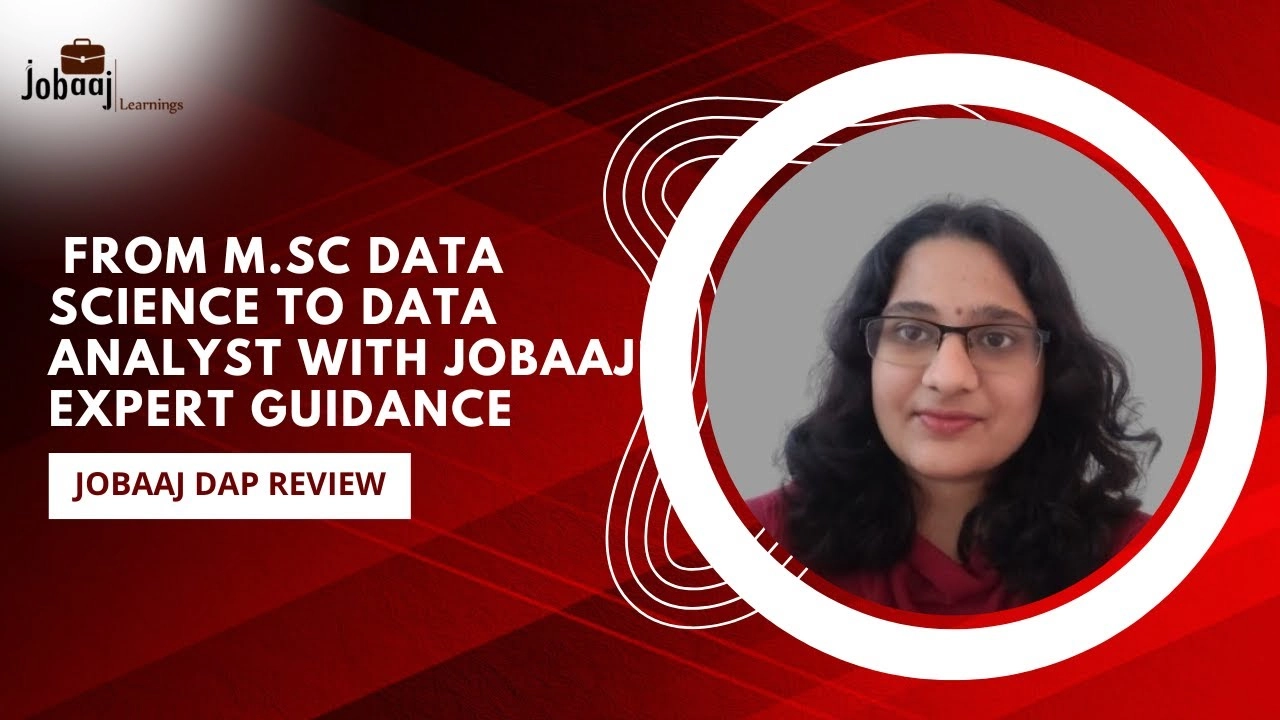
"I was actively looking for a full-time role, and even though I had some interview calls, I couldn't get the offer letter until I reached out to Jobaaj." — Hansika
Hansika is from Mumbai. She holds a Bachelor's in Economics and an MSc in Behavioural and Data Science, and completed two internships after her master's. She was getting interview calls but no offers — until she reached out to Jobaaj Learnings. She is now a Data Analyst at DRRT, a legal firm handling confidential shareholder data.
If you are searching “is Jobaaj Learnings genuine”, “is Jobaaj real or fake” or “why am I getting interviews but no offers”, Hansika's case is precisely that last problem. Her account is also refreshingly unvarnished about the outcome: the role is largely Excel work plus administrative tasks written into the contract, and she says plainly that she had wanted to be placed outside Mumbai. Read it alongside the other conversations in our Interview Series and the wider feedback on the reviews page.
Key Takeaways: Hansika's Jobaaj Learnings Review
- Profile: Bachelor's in Economics, then an MSc in Behavioural and Data Science, plus two internships taken after a break.
- Her exact problem: interview calls, but no offer letters.
- Outcome: Data Analyst at DRRT — a legal firm handling confidential data on shareholders and their dealings.
- What the job involves: uploading raw data, consolidating it and analysing it in Excel, plus administrative tasks specified in the contract.
- Four interview rounds across a two-month process, with the interview phase itself taking two to three weeks.
- Only two companies interviewed her through the placement process — a third was dropped when the DRRT offer arrived.
- She wanted to be placed outside Mumbai, and says so.
- The job market was tight at the time, by her own description.
- Her advice: master Excel first, and talk to working professionals on LinkedIn one to one.
Who Is Hansika? Qualified, Interviewing, and Not Converting
Hansika's academic and early professional record is solid:
- Bachelor's in Economics — heavy on statistics
- MSc in Behavioural and Data Science — with a strong data science and analytics focus
- Two internships, taken after a break following her master's
Her move into analytics was, in her words, “a natural progression” rather than a switch — economics gave her the statistics, the MSc gave her the field.
And still:
"I was actively looking for a full-time role, and even though I had some interview calls, I couldn't get the offer letter."
That is a specific and common failure state, and it is different from not being shortlisted. Her profile was getting her in the room; something after that was not closing.
The Role: Excel, and Administrative Tasks in the Contract
Hansika describes her employer plainly: “It's a legal firm that handles confidential data related to shareholders and their dealings.” And her role:
"My role involves uploading raw data, consolidating it, and analyzing it in Excel. There are also some administrative tasks mentioned in the contract that I'll handle as well."
We are keeping that second sentence exactly as she said it, because most placement write-ups would cut it. The job is Excel-based data work plus contractually specified administrative duties. That is a real, paid analyst role in a specialised legal-data domain — and it is not a pure analytics seat. Read it as it is.
Her own summary of the analyst role at the firm: “mainly revolves around handling and analyzing data in Excel.” Three candidates in this series — Hansika, Nisha Saini and Sufiyan Ahmad — independently report that their day-to-day work is one tool, not the full stack they trained on.
The Interview: Four Rounds Across Two Months
| Round | What it involved |
|---|---|
| 1. HR screening | An initial call |
| 2. In person, Mumbai office | A technical test and a short interview |
| 3. HR, US team | A second HR round, with the overseas team |
| 4. Department head, US team | Final round |
Total elapsed: about two months, with the interview phase itself running two to three weeks. The gap between those two figures is waiting — which is where most candidates lose momentum, and where she says the placement team kept the process alive.
She Interviewed at Two Companies, Not Ten
Hansika is precise about volume, and it is lower than most accounts in this series:
"I gave interviews for two companies – DRRT and another company in Bangalore. I didn't consider the third one because I had already received the DRRT offer before the interview happened."
Two interview processes, one offer. That is a very different funnel from Kanishk Goyal's 100–150 applications or Manan Shah's six or seven interviews — and worth noting alongside her own observation that the job market was tight at the time.
The Honest Note: She Wanted to Leave Mumbai
Asked whether being placed in her home city was convenient, Hansika does not simply agree:
"Yes, it's convenient, but I did want to be placed outside the city."
A small line, and the only note of disappointment in the conversation. It is worth surfacing rather than burying: the outcome met the requirement but not the preference. If location matters to you, state it early and ask how it will be weighted.
What the Placement Team Actually Did
Hansika names four specific things, and one of them is unusual:
- Reached out to partner companies — which she frames as mattering “especially when the job market was tight.”
- Rewrote her CV, incorporating her internship experience and, in her words, ensuring it was done professionally.
- Kept the process alive when the employer went quiet. “Even when DRRT took time to respond, the Jobaaj team helped me stay in touch with them.”
- Provided job leads through LinkedIn, simplifying the search.
The third is the one to note. A two-month process with a silent stretch in the middle is where most self-directed candidates assume rejection and stop following up. Someone chasing on your behalf is the difference between a stalled application and an offer.
She names Vishakha as her contact: “She shared leads, checked in on my interview progress, and made sure I stayed updated.”
Pros and Cons, Based on Hansika's Account
What worked:
- Access to partner companies during a tight job market
- A professionally rewritten CV that made use of her internships
- Persistent follow-up when the employer went quiet mid-process
- Job leads through LinkedIn
- An offer after a run of interviews that had produced none
What her account shows honestly:
- The role includes administrative tasks written into the contract alongside the analytics.
- The work is largely Excel, not the wider analytics stack.
- She wanted to be placed outside Mumbai and was not.
- The market was tight — her own framing, and only two companies interviewed her.
- The process took two months, including a period where the employer went silent.
- No salary is disclosed and no rating was asked for or given.
Data Analyst Interview Questions and Model Answers
What technical skills do you have, and how have you applied them?
Model answer: Excel to an advanced standard — consolidation, lookups, pivot tables and cleaning — plus the statistical grounding from an economics and behavioural data science background. Applied on internship work rather than only in coursework, which is where you learn that most of the job is getting messy inputs into a usable shape.
How do you consolidate raw data from multiple sources?
Model answer: Standardise the structure first — column names, data types, date formats — so the sources are actually comparable, then combine on a reliable key. The failure mode is joining on a field that looks unique and is not, so I validate row counts before and after and check for unexpected duplicates.
How do you handle confidential data?
Model answer: Treat access as the control, not the file — work only within approved systems, never move data to personal storage, and share outputs rather than underlying records. In a legal or financial context, the audit trail matters as much as the analysis, so document what was accessed and why.
Why does Excel still matter if you know Python?
Model answer: Because it is what the business already uses. Data arrives in it, stakeholders read it, and the first version of almost any analysis happens in it. Python scales the work later; Excel is what makes the first day useful.
Describe analysing data for a non-technical audience.
Model answer: Establish what decision the output supports before choosing how to present it. Lead with the finding, keep the visual simple, and hold the method in reserve for whoever asks. If the audience has to work out what the chart is arguing, the analysis has not finished.
Why do you want this role?
Model answer: Because it is analysis with real consequence attached — specialised data where accuracy is not optional. My background is economics and behavioural data science, so working with structured, sensitive datasets is what I have been trained for rather than a stretch.
Hansika's Advice for Non-Technical Candidates
- Master Excel first. Her words: “it's crucial at every stage of data analytics. Even if you're aiming to work with Python or machine learning, you'll always deal with Excel in the beginning.” Her own job proves the point.
- Talk to working professionals on LinkedIn. One-to-one conversations, not just following content.
- Use those conversations to test fit. Her reasoning is that they tell you what the role actually entails and whether it suits you — before you commit to it.
- Get your CV professionally rewritten. Hers was the thing that changed between interviews-without-offers and an offer.
- Keep following up when an employer goes quiet. Silence in a two-month process is not a rejection.
Full Podcast Transcript
The complete conversation, unedited.
Podcaster: Hi, how are you, Hansika? And congratulations on being placed as a data analyst.
Hansika: I'm good. Yeah.
Podcaster: Can you please give me a brief about the company that you've been placed in and what kind of work does it do?
Hansika: It's a legal firm that handles confidential data related to shareholders and their dealings. So, that's what the company is about. The data analyst role mainly revolves around handling and analyzing data in Excel.
Podcaster: What is the name of the company?
Hansika: It's DRRT.
Podcaster: Okay, great! And can you give a brief about what roles and responsibilities you have in your data analyst role?
Hansika: My role involves uploading raw data, consolidating it, and analyzing it in Excel. There are also some administrative tasks mentioned in the contract that I'll handle as well.
Podcaster: Great! And can you tell me a bit about yourself? What is your educational background, and do you have any work experience or internships?
Hansika: Sure. I did my bachelor's in Economics and then my MSc in Behavioral and Data Science. After my MSc, I took a break and did internships. I was actively looking for a full-time role, and even though I had some interview calls, I couldn't get the offer letter until I reached out to Jobaaj, who helped me secure a role at DRRT.
Podcaster: Why did you choose data analytics? What inspired you to pursue this field?
Hansika: It was a natural progression for me. Economics involved a lot of statistics, and when I did my MSc, it had a strong focus on data science and analytics. I developed an interest in it and decided to pursue a career in data analytics.
Podcaster: What advice would you give to people from non-tech backgrounds who want to get into data analytics?
Hansika: My advice is to start by mastering Excel – it's crucial at every stage of data analytics. Even if you're aiming to work with Python or machine learning, you'll always deal with Excel in the beginning. I'd also suggest reaching out to professionals on LinkedIn and having one-on-one conversations. These interactions will give you a much better understanding of what the role entails and whether it's a good fit for you.
Podcaster: Now, could you tell us about your interview process? How many rounds were there?
Hansika: The first round was an HR screening call. The second round required me to visit their Mumbai office for a technical test and a small interview. The third round was an HR round with the US team, and the fourth round was with the department head of the US team. Overall, there were four rounds, and the entire process took about two months, with the interview phase lasting about 2-3 weeks.
Podcaster: How many interviews have you given since being with Jobaaj?
Hansika: I gave interviews for two companies – DRRT and another company in Bangalore. I didn't consider the third one because I had already received the DRRT offer before the interview happened.
Podcaster: Where are you from?
Hansika: I'm from Mumbai, India.
Podcaster: That's great! It must be very convenient for you to be placed in Mumbai, right?
Hansika: Yes, it's convenient, but I did want to be placed outside the city.
Podcaster: How did the placement team at Jobaaj help you in securing this position and during the interview process?
Hansika: Jobaaj was really helpful in reaching out to their partner companies, especially when the job market was tight. They also helped me craft my CV, incorporating my previous internship experiences, and ensured it was done professionally. Even when DRRT took time to respond, the Jobaaj team helped me stay in touch with them. They also provided job leads through LinkedIn, which simplified the job search for me.
Podcaster: Who were you connected with from the Jobaaj placement team?
Hansika: I was connected with Vishakha.
Podcaster: Was Vishakha helpful in supporting you during the placement process?
Hansika: Yes, Vishakha was great! She shared leads, checked in on my interview progress, and made sure I stayed updated. Overall, it was a smooth process.
Frequently Asked Questions
Is Jobaaj Learnings genuine, or is it fake?
This page documents one recorded case: Hansika, an MSc in Behavioural and Data Science who was getting interview calls but no offers, placed as a Data Analyst at DRRT after a four-round, two-month process. Employer, domain, rounds and coordinator are named on camera, and she volunteers that the role includes administrative duties. No salary is disclosed. See the wider review set on the reviews page.
Why do I get interview calls but no offers?
That was Hansika's exact problem. What changed for her was a professionally rewritten CV that made proper use of her internships, access to partner companies, and someone following up when an employer went quiet mid-process.
What does the DRRT data analyst role involve?
Uploading raw data, consolidating it and analysing it in Excel at a legal firm handling confidential shareholder data — plus administrative tasks specified in the contract.
How many interview rounds were there?
Four: an HR screening call, an in-person technical test and short interview at the Mumbai office, an HR round with the US team, and a final round with the US department head. About two months in total.
Which skill should a non-technical candidate learn first?
Excel, in Hansika's view — and her own job supports it. Her point is that even if you are aiming at Python or machine learning, the early work will be in Excel regardless.
How do you find out whether a role suits you before applying?
Her advice: reach out to professionals on LinkedIn and have one-to-one conversations. They tell you what the job actually involves and whether it is a good fit — which a job description will not.
Join 5,00,000+ Subscribers
Be a part of our ever growing community.
Related reads
Shrey Koradiya's Jobaaj Learnings Review: From B.Tech Fresher to Data Analyst at Exiler
Manan Shah's Jobaaj Learnings Review: From B.Tech Fresher to Data Analyst at Exciler