Categories








































Shrey Koradiya's Jobaaj Learnings Review: From B.Tech Fresher to Data Analyst at Exiler

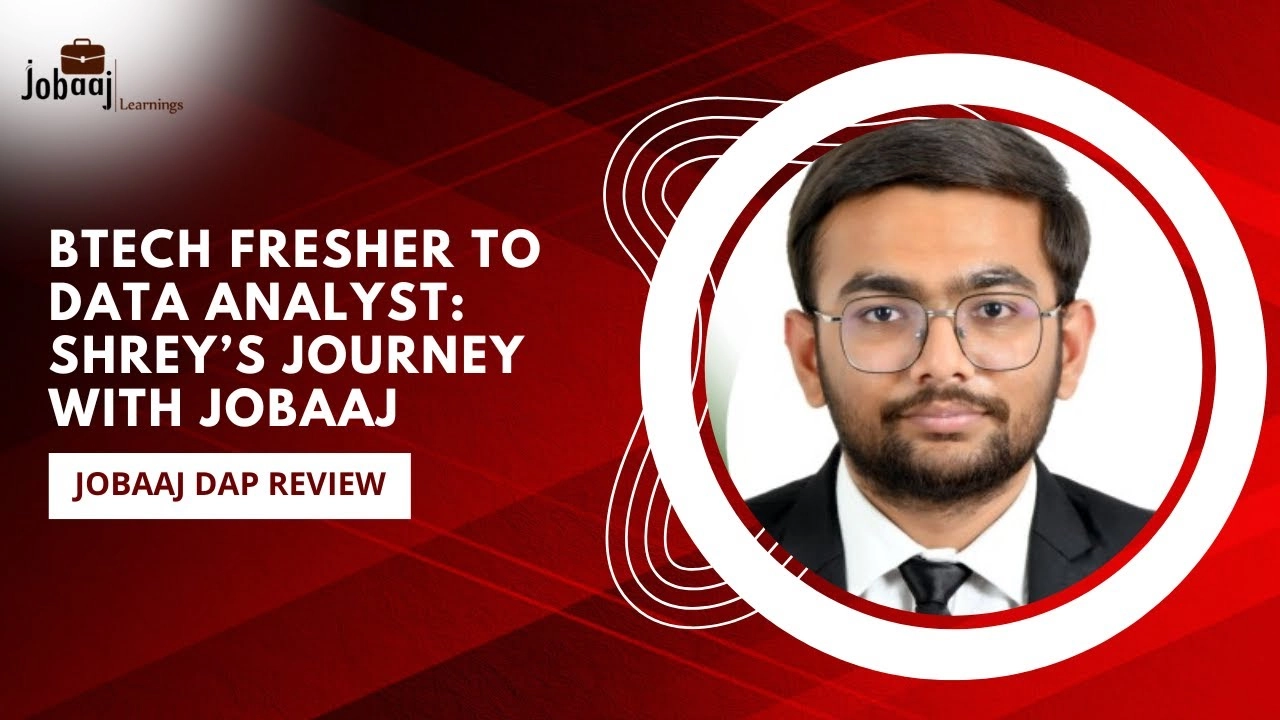
"I didn't get placed in my college's placement year either, but I kept working on my skills. It's a matter of time... Just be calm, work on your weaknesses, and wait for the right opportunity. It's a patience game." — Shrey Koradiya
Shrey Koradiya is from Vadodara, Gujarat and completed a B.Tech in Information Technology at Parul University as a 2025 pass-out. He had no prior relevant experience and was not placed during his college's placement year. He enrolled in Jobaaj Learnings' Data and Business Analytics Program in March, and is now a Data Analyst at Exiler, a data solutions startup in Ahmedabad.
If you are searching “is Jobaaj Learnings genuine”, “is Jobaaj real or fake” or “what if I didn't get campus placement”, Shrey's account is the one for that last case — he missed campus placements entirely and was hired roughly five months later. His placement moved unusually fast, and he explains why in a way that is genuinely useful: a startup's three-interview one-day process, entered through a referral. Read it alongside the other conversations in our Interview Series and the wider feedback on the reviews page.
Key Takeaways: Shrey's Jobaaj Learnings Review
- Profile: B.Tech in Information Technology, Parul University, 2025 pass-out. No prior relevant experience.
- He missed campus placements. He states it plainly — he was not placed during his college's placement year.
- Why he needed the programme: college covered many subjects with “little focus on any one specific field”, alongside exams and cultural commitments.
- Timeline: enrolled in March, started 25 April, completed the learning in June, then worked through assignments.
- Profile build took 7–10 days — LinkedIn and resume built from scratch by the placement team.
- Offer within roughly 10–15 days of the placement process starting.
- Third or fourth interview overall — he had sat a couple before.
- The Exiler process was one day, with three interviews back to back, entered via a referral.
- Outcome: Data Analyst at Exiler, Ahmedabad. Salary not disclosed.
Who Is Shrey Koradiya? A 2025 Graduate Who Missed Campus Placement
Shrey completed a B.Tech in Information Technology at Parul University, Vadodara, graduating in 2025. Asked whether he had prior relevant experience, his answer was a flat no.
And later in the conversation, unprompted, comes the detail that reframes the whole story:
"I didn't get placed in my college's placement year either, but I kept working on my skills."
That is the starting point most placement stories omit. He was not choosing between offers — he had none.
Why a B.Tech Wasn't Enough
Shrey's explanation is specific and does not blame the college:
"In college, we get to learn a variety of subjects, but there is little focus on any one specific field. With so many other commitments — like cultural events and exams — I didn't have in-depth exposure to any particular field such as data analytics."
His conclusion: “After graduating, I realized the importance of focusing on a single skill.”
Breadth without depth is a recurring theme across this series — Manan Shah describes his BTech touching five domains and practising none of them. Both graduated from Vadodara, and both ended up at the same Ahmedabad company.
The Timeline, Month by Month
| When | What happened |
|---|---|
| March | Enrolled |
| 25 April | Started the programme |
| June | Completed the learning; assignments began |
| After assignments | Placement team began building his profile — 7–10 days on LinkedIn and resume |
| Roughly 10–15 days later | Job offer |
Around five months from enrolling to being placed — and the interviewer's own reaction in the conversation is that this is unusually quick.
What the Assignments Were For
Shrey is clear that the assignments were not busywork:
"These assignments covered a variety of tools like Excel and PowerBI, and other important skills. Each assignment was designed to help us practice and showcase projects that would be helpful during interviews."
Two purposes, both stated: practice, and projects to show. For a fresher with no work history, the second is the only evidence available.
Why His Placement Was So Fast — His Own Explanation
Asked why some candidates take much longer, Shrey does not credit himself. He credits the type of employer:
"It really depends on the company and the role you're applying for. For example, MNCs often have longer processes, while walk-in interviews at smaller companies might be faster. In my case, Exiler is a startup, and their interview process was completed in one day. They don't conduct walk-ins, but I got a referral from Jobaaj. It was a one-day process with three interviews in a row."
This is the most useful calibration in the piece, and it is his, not ours. His speed came from three things stacking: a startup rather than an MNC, a single-day process with three back-to-back rounds, and a referral that got him in the door. Anyone targeting large multinationals should expect a materially longer process regardless of how good their profile is. Elsewhere in this series, Kanishk Goyal describes 100–150 applications and Kavya a five-round process at a Big Four firm.
The Company: Exiler, Ahmedabad
Shrey describes his employer in his own words:
"Exiler is a data solutions company. They interact with clients to collect data, preprocess it, and then provide insights based on the client's requirements. Depending on the need, they can provide direct insights or visualizations to help businesses grow and make informed decisions."
Worth noting as a cross-reference: Manan Shah, also a 2025 BTech graduate from Vadodara featured elsewhere in this series, describes being placed at the same Ahmedabad data and AI company. Two candidates, the same programme, the same employer — which is a genuine signal that the placement pipeline concentrates around particular firms.
No salary figure is disclosed.
Pros and Cons, Based on Shrey's Account
What worked:
- Focused depth in one field, after a degree that gave him breadth without it
- Assignments designed to double as interview-ready projects
- A LinkedIn profile and resume built from scratch in 7–10 days
- Applications through LinkedIn and other portals
- A referral into a company that does not run open walk-ins
- An offer around five months after enrolling, with no prior experience
What his account shows honestly:
- He missed campus placement entirely — the programme was a recovery route, not an upgrade.
- He had sat a couple of interviews before this one; it was his third or fourth.
- His speed was employer-specific. A startup with a one-day process, not a typical hiring cycle.
- The referral mattered. Exiler does not run walk-ins — he would not have reached that process on his own.
- No salary is disclosed and no rating was asked for or given.
Data Analyst Interview Questions and Model Answers
What is data preprocessing and why does it matter?
Answer: Cleaning and transforming raw data into a form that can actually be analysed. Raw data arrives with errors, missing values and irrelevant fields, all of which skew results if left alone. In practice I have used Excel and SQL for it — cleaning, filling missing values, and standardising formats so the same field means the same thing throughout.
How would you visualise sales performance for a business?
Answer: Start from the metrics the business acts on — total sales, growth, and performance by region or product. In Power BI: line charts for trends over time, bar charts for comparisons, and a breakdown by region or category. Then filters, so stakeholders can drill into their own period or segment rather than asking for a new report each time.
What's the difference between inner, left and right join?
Answer: Inner join returns only rows matching in both tables. Left join returns everything from the left table with NULLs where the right has no match. Right join is the mirror — everything from the right table, NULLs on the left. The outer joins are how you find what is missing, which is usually the more interesting question.
Explain normalisation and why it matters.
Answer: Organising data across smaller related tables to reduce redundancy and dependency. The purpose is data integrity — eliminating duplicate data so the same fact cannot be stored inconsistently in two places, and making updates, inserts and deletes behave predictably.
How do you handle missing values?
Answer: Work out whether the gaps are random or systematic first, because that decides what is defensible. Impute with mean, median or mode where the distribution allows it; drop rows or columns where too much is missing to fill honestly. Either way, document what was done — a silent imputation is an invented number.
Why should we hire a fresher for this role?
Answer: Because I can show the work rather than describe it. I have built projects end to end — collecting, cleaning, analysing and visualising — and I chose this field deliberately after my degree rather than drifting into it. That means the tools are current and the interest is genuine.
Shrey's Advice for Graduates Still Searching
- Keep trying. His first point, from someone who missed campus placement.
- Debrief every interview. “If you feel like you missed something, work on it.”
- Don't be discouraged by rejections. His third or fourth interview is the one that converted.
- Pick one field and go deep. He blames breadth without depth for where he started.
- Understand what kind of employer you're targeting. MNCs run long processes; startups can finish in a day.
- It's a patience game. His own phrase, and the honest summary.
Full Podcast Transcript
The complete conversation, unedited.
Podcaster: Everyone, we are back with another podcast featuring a successful placement. Today, we have Mr. Shrey Koradiya with us. How are you, Shrey?
Shrey: I'm fine, sir. How are you?
Podcaster: I'm doing well, thank you. So, Shrey, can you introduce yourself to our audience?
Shrey: Hello, everyone. My name is Shrey Koradiya, and I am from Vadodara, Gujarat. I recently completed my data analytics program with Jobaaj Learnings and I am now placed at Exiler, a company based in Ahmedabad, where I work as a Data Analyst.
Podcaster: Great! So, Shrey, could you tell our audience a bit about Exiler? What does the company do?
Shrey: Exiler is a data solutions company. They interact with clients to collect data, preprocess it, and then provide insights based on the client's requirements. Depending on the need, they can provide direct insights or visualizations to help businesses grow and make informed decisions.
Podcaster: And what is your educational background, Shrey?
Shrey: I completed my Bachelor's in Technology with a specialization in Information Technology from Parul University in Vadodara, and I am a 2025 pass-out.
Podcaster: Did you have any prior relevant experience before getting placed in your current role?
Shrey: No, I did not.
Podcaster: That means you secured a role as a data analyst right after graduation. Now, Shrey, you mentioned that you completed your BTech in IT. What made you decide to enroll in an upskilling program like ours for data analytics?
Shrey: In college, we get to learn a variety of subjects, but there is little focus on any one specific field. With so many other commitments — like cultural events and exams — I didn't have in-depth exposure to any particular field such as data analytics. After graduating, I realized the importance of focusing on a single skill, and that's when I joined the Jobaaj Learnings data analytics program. The program gave me a comprehensive understanding of data analytics, from basics to advanced tools, and helped me build the skills needed for my career. My interest in data analytics was also piqued during college when we studied the importance of data in business growth and decision-making.
Podcaster: When did you enroll in the program with Jobaaj Learnings?
Shrey: I enrolled in March and started the program on April 25th.
Podcaster: That's only five months ago!
Shrey: Yes, that's correct.
Podcaster: During the program, I believe you worked on assignments with your program coordinator, Kashish. What kind of assignments did you work on?
Shrey: I completed my learning in June, and after that, I was given a list of assignments to help me deepen my understanding. These assignments covered a variety of tools like Excel and PowerBI, and other important skills. Each assignment was designed to help us practice and showcase projects that would be helpful during interviews.
Podcaster: And after completing these assignments, you entered the placement process, right?
Shrey: Yes.
Podcaster: How long did the placement process take?
Shrey: The placement team contacted me and started building my profile from scratch. They worked on my LinkedIn and resume, which took about 7-10 days. After that, they started applying to companies on LinkedIn and other portals.
Podcaster: So, in just 10 to 15 days, you had your job offer?
Shrey: Yes, that's right!
Podcaster: That's amazing! Some students face multiple rejections before landing a job. Was this your first interview?
Shrey: I had given a couple of interviews before, but this was my third or fourth one.
Podcaster: So, in less than two weeks, you gave two or three interviews and landed this role? In your opinion, why do you think some people take longer to get placed?
Shrey: It really depends on the company and the role you're applying for. For example, MNCs often have longer processes, while walk-in interviews at smaller companies might be faster. In my case, Exiler is a startup, and their interview process was completed in one day. They don't conduct walk-ins, but I got a referral from Jobaaj. It was a one-day process with three interviews in a row. So, it really depends on the type of company and role.
Podcaster: Now, Shrey, as a BTech graduate who has just landed your first role, what advice would you give to others who are still struggling to find a good job?
Shrey: My advice would be to keep trying. After every interview, if you feel like you missed something, work on it. Don't get discouraged by rejections. I didn't get placed in my college's placement year either, but I kept working on my skills. It's a matter of time. You will get there if you keep improving and staying patient. Everything happens in due time. Just be calm, work on your weaknesses, and wait for the right opportunity. It's a patience game.
Frequently Asked Questions
Is Jobaaj Learnings genuine, or is it fake?
This page documents one recorded case: Shrey Koradiya, a 2025 B.Tech graduate from Parul University who missed campus placement, took the Data and Business Analytics Program, and was hired as a Data Analyst at Exiler in Ahmedabad about five months later. Employer, university and timeline are named on camera. No salary is disclosed. See the wider review set on the reviews page.
What if I didn't get placed during campus placements?
Shrey did not either. His route was to pick one field, go deep on it, build projects he could show, and keep interviewing — he was hired on his third or fourth attempt.
How fast can you get placed?
In his case, an offer roughly 10–15 days after the placement process began. But he attributes that to the employer being a startup running a one-day process, entered through a referral — not to a typical hiring cycle. MNCs, he notes, take much longer.
What did the placement team do?
Built his LinkedIn profile and resume from scratch over 7–10 days, then applied to companies through LinkedIn and other portals — and provided the referral into a company that does not run open walk-ins.
Why isn't a B.Tech enough for a data analyst job?
In Shrey's account, because a degree spreads across many subjects with little depth in any one, and other commitments crowd out the practice. His fix was choosing a single field after graduating and going deep on it.
How long is the programme?
He enrolled in March, started on 25 April, and completed the learning in June — followed by a set of assignments before the placement process began.
Join 5,00,000+ Subscribers
Be a part of our ever growing community.
Related reads
Hansika's Jobaaj Learnings Review: From MSc Graduate to Data Analyst at DRRT
Manan Shah's Jobaaj Learnings Review: From B.Tech Fresher to Data Analyst at Exciler