

 Categories








































Akash's Jobaaj Learnings Review: From Legal Associate to Market Research Associate in Gurgaon

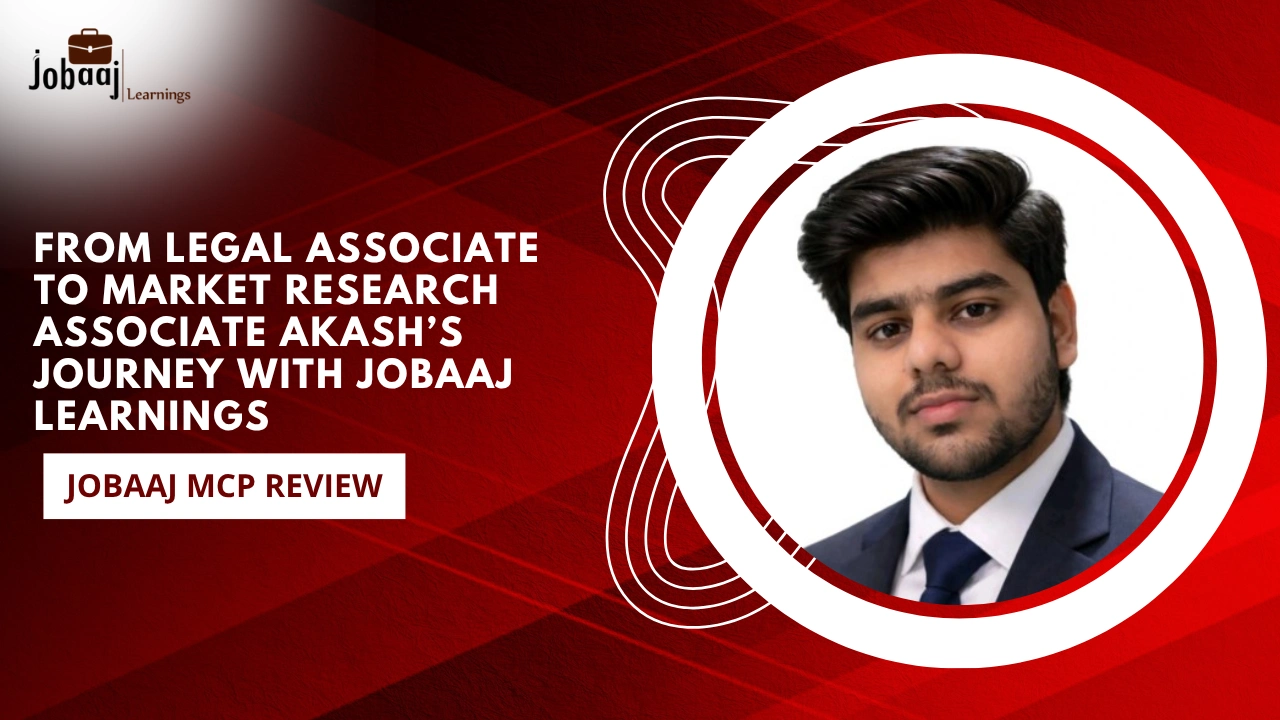
"Genuinely, if they were not finding jobs for me, I would not be able to find any job by myself. They are very supportive and very helpful, all of them." — Akash, on the three placement coordinators who worked with him; he rated Jobaaj Learnings 10/10 in this conversation"
Akash is from Moradabad, Uttar Pradesh, and holds a BBA. After an internship he spent two years as a Legal Associate reviewing client documents for breach data, then started his own venture in the e-waste industry, which he was unable to continue. Neither had anything to do with consulting or research. He enrolled in Jobaaj Learnings' Management Consulting Program after attending one of its free webinars, and has now been selected as a Market Research Associate (secondary research) at a firm in Gurgaon. At the time of recording he had cleared all three rounds but had not yet received the offer letter.
If you have searched "is Jobaaj real or fake", "is Jobaaj Learnings genuine", "Jobaaj Learnings scam" or "is Jobaaj Learnings worth it", treat this page as one data point, not a verdict. It is a recorded, on-camera conversation with one placed student. What it puts on record is checkable: a named role (Market Research Associate), a named location (Gurgaon), three named placement coordinators, a three-round interview process with the actual questions asked, and a candidate who came from a completely unrelated field. Read this alongside the full set of student feedback on the Jobaaj Learnings reviews page and the other conversations in our Interview Series before you decide.
Key Takeaways: Akash's Jobaaj Learnings Review
- Profile: BBA; from Moradabad, UP; one internship; two years as a Legal Associate (document review, breach data); a discontinued e-waste venture. No analyst, consulting or research background.
- Why he switched: wanted to work directly with businesses; consulting aligned most closely with that, so he looked for a practical course.
- How he found Jobaaj: Instagram, then a free webinar, then the Management Consulting Program.
- Outcome: selected as Market Research Associate (secondary research, with some primary research involving C-suite stakeholders per the JD) in Gurgaon. Offer letter pending at recording.
- Process: three rounds — a screening round, a round with the team lead, and a round with the manager. Questions: what is secondary research, what do you do in it, how to do company profiling, the difference between marketing and market penetration. He called them easy.
- Preparation: started with guesstimates and case studies (as the programme advised), then deliberately shifted to preparing for market research as the realistic entry-level role for someone with no analyst background.
- What was new to him: guesstimates and case studies. He learned both in the programme; hard at first, easy with practice.
- Placement support named: three coordinators — Shruti, Ankita and Dolly — who sourced openings and pushed him to keep applying when HR call-backs dried up.
- His rating: 10 out of 10 for the programme, and 10 out of 10 overall. Said he had no complaints.
- Reported problems: none raised — which is a limit of the interview, not proof that none existed.
Who Is Akash? His Background Before Jobaaj Learnings
In his own words, Akash's profile before the programme looked like this:
- Home: Moradabad, Uttar Pradesh.
- Degree: Bachelor of Business Administration.
- Internship: one, after graduation.
- Work experience: two years as a Legal Associate. The job was reviewing clients' legal documents and finding breach data — "totally different" from consulting, as he put it twice.
- Entrepreneurship: started his own venture in the e-waste industry; could not continue with it for reasons he did not go into.
Two years of experience, none of it relevant. That is the profile the rest of this page is about: not a fresher, but a career changer with no analyst background at all.
Why a Legal Associate Moved to Consulting and Market Research
Akash's reasoning was simple. After the venture, he knew he wanted to work directly with businesses. Consulting was the industry that aligned most closely with that, so he looked for a course that would teach him how it actually works in practice. He came across Jobaaj Learnings on Instagram, sat through a free webinar, and enrolled in the Management Consulting Program after understanding what the programmes involved.
Asked how hard the transition was, he separated two things. Understanding businesses was not hard — he had run one. The technical side was: "guesstimates — I didn't know about guesstimates before. Also case studies, how to solve them." He learned both during the programme. At the start they felt difficult; once he began practising, they became easy.
The Outcome: Market Research Associate (Secondary Research), Gurgaon
What Akash stated about the role:
- Role: Market Research Associate, secondary research.
- Location: Gurgaon.
- Status: cleared all rounds; offer letter not yet received at recording.
- Work, as he understands it: researching companies and industries to identify what kind of investment and which industries a client can go into. The JD also mentions speaking with C-suite stakeholders, so he expects a mix of secondary and primary research.
- What he does not yet know: the full set of responsibilities. He said plainly he will find out once he joins.
He did not name the employer.
What Jobaaj Learnings Actually Did, According to Akash
Stripping out the thank-yous, these are the concrete things Akash attributes to the programme and the placement team:
- Taught the two skills he lacked. Guesstimates and case studies were new to him; he learned them in the programme.
- Told him what interviews actually test. The programme advised focusing on guesstimates and case studies because they are commonly asked — which is where he started his preparation.
- Sourced jobs he says he could not have found alone. His words: without the team finding jobs for him, he would not have been able to find one himself.
- Three named coordinators. Shruti, Ankita and Dolly worked with him, rather than a single contact.
- Kept him applying through the quiet stretches. He said he sometimes felt low when HR call-backs stopped coming. The team's advice was to keep trying — apply again and again rather than apply once and wait for a reply.
- Mentors he called genuine. On the recorded and live sessions, he rated the course material and the mentors as very helpful and gave the programme 10/10.
What he did not credit Jobaaj with: the decision to target market research rather than consulting. That was his own read of his profile (see below).
Inside the Interview Process
Akash described three rounds.
| Stage | Who | What was asked |
|---|---|---|
| 1. Screening round | Initial screen | Basic screening |
| 2. Team lead round | TL | What is secondary research; what do you do in secondary research; how do you do company profiling |
| 3. Manager round | Manager | Technical questions, e.g. what is marketing and what is the difference between marketing and market penetration |
His assessment of the difficulty: "It was easy. I would not say it's very hard in general." Note what was not asked, by his account: no guesstimate and no case study, even though those were what he had prepared hardest for. For an entry-level market research seat, the questions were about the job itself.
How Akash Prepared, and Why He Changed Target
Akash's preparation had two phases.
- Phase one: guesstimates and case studies. The programme had told students these are the things most commonly asked in consulting interviews, so he practised them.
- Phase two: a realistic re-target. As he practised, he concluded that someone with no analyst background should start at the most basic entry-level role. In this field that is market research, or at a stretch associate consultant — and the latter is hard to get at entry level. Targeting consulting roles only would, in his words, be hard for him because he had no background. So he prepared for market research.
His generalisation from that: anyone starting without an analyst background should prepare primarily for market research roles. They can try for consulting too, but the focus should be on the entry-level role. The interview he then faced asked exactly the market-research questions he had switched to preparing for.
Market Research Interview Questions to Prepare For
These are the questions Akash reported being asked, with a reference answer for each, followed by the two skills the programme flagged that he prepared for.
What is secondary research?
Model answer: Research built on data that already exists — annual reports, regulatory filings, industry-body statistics, government data, news, paid databases, competitor websites — as opposed to primary research, which generates new data through interviews or surveys. The skill is knowing which sources are reliable for which question, triangulating between them, and being explicit about the date and limitations of every figure.
What do you do in secondary research?
Model answer: Define the question the client needs answered; identify the sources most likely to answer it; extract and clean the data; cross-check across at least two sources; synthesise into a structured output (market size, competitor landscape, trends, risks); and cite everything. In Akash's role that output feeds decisions on which industries and investments a client can pursue.
How do you do company profiling?
Model answer: A standard profile covers: overview (founding, HQ, ownership, leadership), business segments and revenue mix, key financials over three to five years, geographic footprint, products and customers, recent developments (M&A, funding, leadership changes), and a SWOT or competitive position. Sources: annual report, investor presentations, MCA filings for Indian private companies, credible news, and databases if available. Keep a consistent template so profiles are comparable across companies.
What is marketing, and what is the difference between marketing and market penetration?
Model answer: Marketing is the overall set of activities a company uses to understand customers and create, communicate and deliver value to them — product, price, place, promotion. Market penetration is a specific growth strategy (one of the four in the Ansoff matrix): selling more of an existing product in an existing market, measured as your share of the total addressable market. Marketing is the discipline; penetration is one objective it can be pointed at.
Guesstimate: estimate the number of e-waste collection centres needed in a city of 5 million people.
Model answer (structure): Population → households (÷4) → electronic devices per household reaching end of life per year → total e-waste units per year → units one centre can process per day × working days → number of centres. State each assumption aloud, round aggressively, and sanity-check the final number. Akash did not know what a guesstimate was before the programme; it was the first skill he practised.
Case study: a client wants to enter a new industry. How would you assess it?
Model answer (structure): Market attractiveness (size, growth, profitability, regulation), competitive intensity (incumbents, barriers to entry, substitutes), client fit (capabilities, brand, distribution, capital), and entry mode (build, buy, partner). Conclude with a recommendation and the two or three assumptions that would change it. This is the applied version of the secondary research the role actually does.
Pros and Cons, Based on Akash's Account
What he said worked:
- The programme taught him guesstimates and case studies from zero.
- The programme told him which question types to prioritise for interviews.
- Course material and mentors, which he called very helpful and genuine — 10/10 for the programme.
- Three placement coordinators sourcing roles for him — he says he could not have found a job on his own.
- Encouragement to keep applying during stretches with no HR response.
- The end result: a role in the field he was targeting, in Gurgaon, after two years in an unrelated industry.
What he said could be better:
- Nothing. He said he had no qualms with the programme. He did not raise any friction point in this conversation.
What the conversation leaves open:
- The employer is not named.
- The offer letter had not been received when this was recorded.
- He did not state how long the programme or the job search took, or how many applications he made.
- He described periods of feeling low because of no HR call-backs — the search was not quick or linear, even if he does not put a number on it.
Akash's Tips If You're Considering Jobaaj Learnings
- If you have no analyst background, prepare for market research first. His most concrete advice. Entry-level consulting is hard to get without a background; market research is the realistic entry point, and you can still try for consulting alongside.
- Learn guesstimates and case studies even if the entry-level interview doesn't ask them. He prepared them because the programme said to; his interview then asked role-specific questions instead. Both matter — one for consulting rounds, one for research rounds.
- Practise until it stops feeling hard. Guesstimates and cases were difficult at first and easy after practice. He was explicit that the difference was practice, not talent.
- Don't apply once and wait. The placement team's advice when call-backs dried up was to keep applying continuously. He credits that with getting him through the low patches.
- Be honest about what you don't know yet. He said on record that he doesn't fully know his responsibilities until he joins. That is the right posture for a career changer.
Full Podcast Transcript
The conversation, lightly edited for readability.
Podcaster: Akash, thank you so much for joining this podcast and sharing your insights and time with us.
Akash: My pleasure.
Podcaster: First of all, congratulations. How are you feeling after getting placed?
Akash: I'm feeling great. I'm very thankful to Jobaaj and the team who gave me this opportunity so I can follow my dreams — what I was looking for. Very happy.
Podcaster: Before getting started, can you tell us about yourself, your background, and what you've done so far?
Akash: My name is Akash and I'm from Moradabad, Uttar Pradesh. I've done my Bachelor's in Business Administration. I did an internship, and after that I worked for two years in the legal industry. Then I started my own venture in the e-waste industry, but because of some reasons I wasn't able to continue with it. I thought I wanted to work in an industry where I could work directly with businesses — that was my vision at the time. So I started looking for an industry where I could work closely with businesses, and consulting aligned very closely with that. I looked for courses where I could learn practical knowledge about how this works, and I opted for the Jobaaj program. Now I'm here, getting a job.
Podcaster: You have two years of experience. What role were you in before?
Akash: A legal associate role. It's a totally different industry — not related to consulting or anything like that. As a legal associate we had to review clients' legal documents and find their breach data. Something really different.
Podcaster: So you were in finance before?
Akash: No, not finance. The legal industry.
Podcaster: Got it. Now, which role are you placed in?
Akash: I haven't got the offer letter yet, but I think the role is Market Research Associate — secondary research, not primary research.
Podcaster: Do you know what the roles and responsibilities will be?
Akash: In a secondary research role we find out about companies, and we find what kind of investment and what kind of industry our client can go into. We research the industry. There's also a primary research element, because they mentioned in the job description that we have to talk with C-suite stakeholders as well. So I think it's a mix of both. But I'm not fully aware of what responsibilities I'll get — once I join, I'll find out.
Podcaster: You'll get to know everything clearly then. So you were working in legal before and now you'll be in market research. How difficult was the transition?
Akash: For me it wasn't a difficult task, because I'd already been into businesses and I understand how businesses work. That part isn't hard. But the technical things — guesstimates, I didn't know about guesstimates before. Also case studies, how to solve them. I learned those during the program. In the beginning it felt difficult, but then I started practising, and now it's very easy for me.
Podcaster: Practice is very important. If you practise, everything becomes easier than you thought. Can you walk us through your interview process — how many rounds, what kind of questions?
Akash: Three rounds. First a screening round, then the TL takes the second round, and the manager takes the third round. The questions were very easy — what is secondary research, what do we do in secondary research, how do we do company profiling. They also asked what marketing is, and what the difference is between marketing and market penetration. Those kinds of technical questions. It was easy. I wouldn't say it was very hard.
Podcaster: When you were preparing, what kind of questions were you more focused on?
Akash: I was more focused on guesstimates and case studies, because we were taught in the program that we should focus on those — they're the things generally asked in interviews. But once I started practising, I realised I'm coming from a very different background. I don't have any background in this. So for a guy like me, I should start with a very basic, entry-level role. The entry-level role here is market research, or you can work as an associate consultant, but that's also hard to get at entry level. So I prepared for a market research role, because if I only tried for consulting roles it would be hard for me without a background. I think anyone starting out who doesn't have any analyst background should prepare for market research roles. They can try for consulting as well, but they should focus on the entry-level role. That's how I prepared.
Podcaster: How did you get to know about Jobaaj Learnings?
Akash: I heard about it on Instagram, and I took a free webinar from your side. I joined it, understood how you work and what programs you have, and then opted for it.
Podcaster: And the course lectures — the recorded sessions and live sessions — how did you find the course material?
Akash: Very helpful. The mentors we got are very genuine, and the things they teach are very helpful. Overall the program is 10 out of 10. I don't have any qualms.
Podcaster: From the placement team, who was connected with you?
Akash: Three ladies — Shruti, Ankita and Dolly. They helped me a lot. Genuinely, if they weren't finding jobs for me, I wouldn't be able to find any job by myself. They're very supportive and very helpful, all of them. I'm very thankful to them. Sometimes I'd feel a little low because there was no call-back from HR. They told me to try again and again — you can't apply for one job and then wait for their reply. They helped a lot.
Podcaster: If I ask you to rate Jobaaj Learnings on a scale of 1 to 10, considering the course material, coordination with your program coordinator, and the placement team?
Akash: 10 out of 10, because it gave me the opportunity to get the job I was looking for.
Podcaster: And where are you placed — what's the location?
Akash: Gurgaon.
Podcaster: That's all from my side. Thank you so much for joining, and all the very best for your future.
Akash: Thank you so much.
Frequently asked questions
Is Jobaaj Learnings genuine, or is it a scam?
This page documents one case, on camera: Akash, a BBA graduate with two years in legal and no research background, selected as a Market Research Associate in Gurgaon after the Management Consulting Program, naming three placement coordinators and the questions he was asked. That is evidence of a real selection, not proof of a placement rate — and note that the employer is unnamed and the offer letter was pending at recording. Weigh it against the full review set on the reviews page.
Can you switch from an unrelated field into market research or consulting through Jobaaj Learnings?
Akash did, from legal document review. His own account is that the business understanding carried over, the technical skills (guesstimates, case studies) had to be learned from scratch, and the realistic first role for someone without an analyst background was market research rather than consulting.
What is the difference between a market research role and a consulting role at entry level?
In Akash's framing: market research is the entry-level seat, focused on secondary (and some primary) research into companies and industries. Associate consultant is also an entry-level title but, in his experience, much harder to get without a relevant background.
What questions were asked in the market research interview?
What is secondary research; what do you do in secondary research; how do you do company profiling; what is marketing; what is the difference between marketing and market penetration. Three rounds: screening, team lead, manager. No guesstimate or case study was asked.
What does Jobaaj Learnings' placement support actually involve?
In Akash's case: three coordinators sourcing openings for him, and active encouragement to keep applying continuously when HR responses stopped. He said he would not have found a job on his own.
Is the Management Consulting Program worth it for a career changer?
Akash's answer was 10/10, with no complaints, and he credits the programme for the two skills he lacked and the placement team for the role. He is one student, his employer is unnamed, and his offer was pending when he said it. Compare more accounts in the Interview Series.
Join 5,00,000+ Subscribers
Be a part of our ever growing community.
Related reads
Prasanjit's Jobaaj Learnings Review: From Technical Analyst to Data Analyst
Aayush's Jobaaj Learnings Review: From BBA Graduate to Graduate Consultant at Arcadis






