

 Categories




































Prasanjit's Jobaaj Learnings Review: From Technical Analyst to Data Analyst

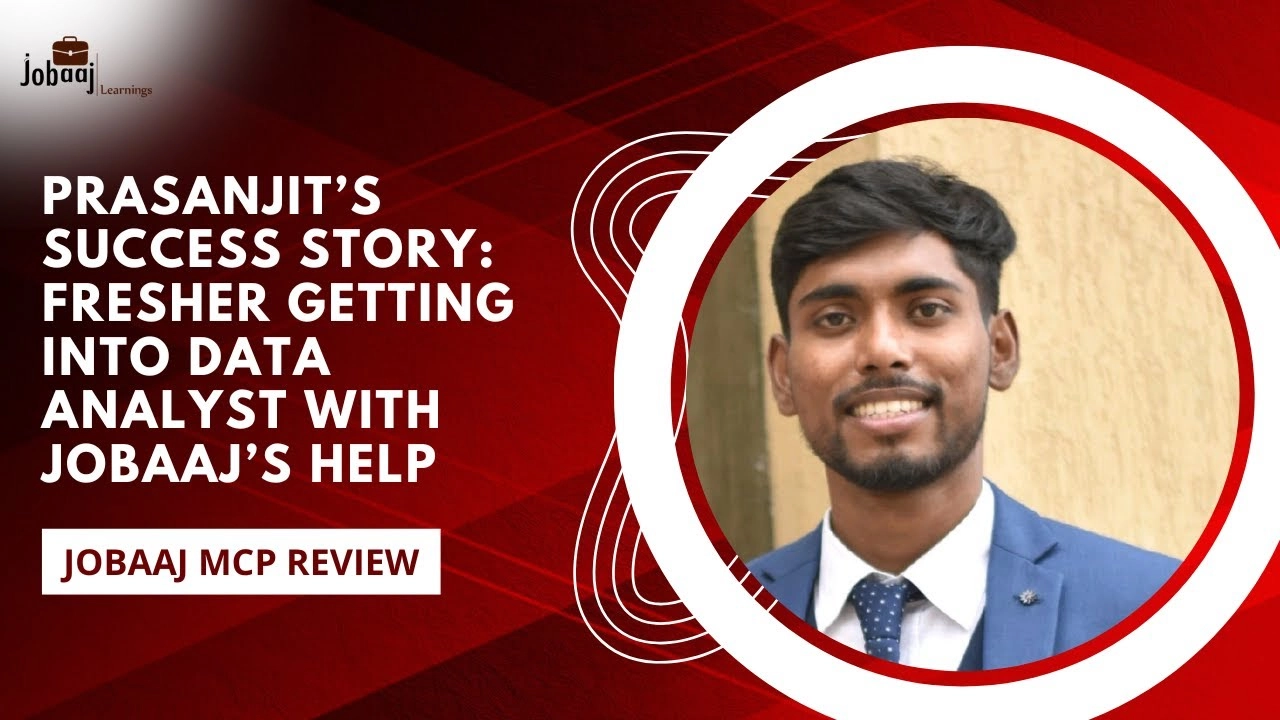
"I would recommend them to thoroughly check the program and see if it aligns with their expectations. If expectations are too high, they might face disappointment." — Prasanjit
Prasanjit is a B.Tech engineering graduate who found Jobaaj Learnings through a Google search for consulting courses, shortlisted a few providers, and enrolled in the Management Consulting Program. He was placed — but not in consulting. Because his prior experience was in a technical analyst role, he was shortlisted mainly for data analyst positions, and after six or seven interviews he took a data analytics job in Bangalore.
If you are searching “is Jobaaj Learnings genuine”, “is Jobaaj real or fake” or “will the course get me the role I want”, this is the most usefully cautious review in the series. Prasanjit rates the course and placement team 10/10, rates communication 9/10 and says it could be improved, asks for a chat or call channel for student queries, and warns prospective students directly about setting expectations too high. Read it alongside the other conversations in our Interview Series and the wider feedback on the reviews page.
Key Takeaways: Prasanjit's Jobaaj Learnings Review
- Profile: B.Tech engineering graduate with prior experience in a technical analyst role.
- How he chose: a Google search for consulting courses, then shortlisting several providers before deciding.
- He aimed for management consulting and was placed in data analytics instead — because his existing profile is what shortlists were built on.
- Six or seven interviews before he was selected.
- Outcome: a data analyst role in Bangalore, analysing sales data and allocating tasks across the team. Employer and salary not stated.
- Ratings: 10/10 for the course and placement team, 9/10 for communication and connection — which he says could be improved.
- His concrete suggestion: a chat or call option so students can get answers to queries easily.
- His warning to prospective students: check the programme against your expectations, because expectations set too high lead to disappointment.
- What he values most: being taught how to search, apply and interview — not just being handed opportunities.
Who Is Prasanjit? Engineering, Then Technical Analysis
Prasanjit is a B.Tech graduate whose prior work was in a technical analyst role. That detail matters more than it first appears, because it is what determined where he ended up.
His route to the programme was methodical rather than impulsive:
"I was searching for consulting-type courses where I could update myself. I was going through Google search, and Jobaaj Learnings appeared as a choice. I shortlisted a few companies, and eventually, I decided on Jobaaj."
He compared options before committing — which, given his later advice about checking a programme against your expectations, is consistent with how he thinks.
He Trained for Consulting and Was Placed in Analytics
This is the central fact of Prasanjit's account, and it is not hidden in his answers — he states it plainly:
"Actually, I initially aimed for management consulting, but my job placement turned out to be in the data analytics sector. My past experience was in a technical analyst role, so when I applied for jobs through the Jobaaj placement team, I was primarily shortlisted for data analyst positions."
Three things follow from that, and they are worth being explicit about:
- He enrolled to move into consulting. That was the goal.
- The market shortlisted him on his existing profile, not on his new training. A technical analyst background pulled him towards analyst roles.
- He took the role he could get, after six or seven interviews.
Six or Seven Interviews
Prasanjit gives a figure most reviews leave out: “I gave around six to seven interviews, and finally, I was selected for the data analyst role.”
That sits between the extremes recorded elsewhere in this series — Uma Maheshwari was selected on her first interview, Kanishk Goyal applied to 100–150 companies for one offer. Six or seven interviews is a realistic middle, and closer to the three-to-five figure the interviewers themselves cite as typical.
What He Rates 10/10 — and What He Rates 9
Asked for a rating, Prasanjit does something unusual: he splits it.
| What | His rating |
|---|---|
| Placement team | 10/10 |
| Course quality | 10/10 |
| Communication and connection | 9/10 — “it could be improved” |
And he attaches a specific fix rather than a vague complaint:
"One suggestion I have for Jobaaj is to provide a chat or call option for students, so they can easily get answers to their queries."
Worth cross-referencing with Arpit Trivedi elsewhere in this series, whose single criticism was support responses taking three to four days. Two students, independently, pointing at the responsiveness of student support.
His Warning About Expectations
Asked how he would recommend the programme, Prasanjit's answer opens with a caution rather than a pitch:
"I would recommend them to thoroughly check the program and see if it aligns with their expectations. If expectations are too high, they might face disappointment."
Coming from someone who trained for consulting and was placed in analytics, that is not an abstract warning. It is the lesson of his own experience, offered to the next person.
What the Placement Team Actually Did
Despite the expectation gap, Prasanjit's assessment of the placement support is strongly positive — and specific about why:
"The placement team was excellent. They not only helped me find a job but also taught me how to search and apply for jobs, and how to appear for interviews."
He names Swati and Vishakha. Note the distinction he draws: he values being taught the skills as much as being handed the opportunities — job search technique, application method, interview technique. Those transfer to his next job change; a single introduction does not.
On the mentorship side, he names Nandini as supportive throughout, and says the placement group felt “highly professional... everything felt very corporate.”
The Role: Data Analysis and Task Allocation
Prasanjit's day-to-day, in his own description:
- Analysing data received from the sales team
- Allocating tasks to different team members
He is based in Bangalore. The employer is not named and no salary is disclosed.
The second responsibility is worth noting — task allocation is a coordination function, not pure analysis, which means the role has some of the breadth he was originally looking for even though the title does not say consulting.
Pros and Cons, Based on Prasanjit's Account
What worked:
- Course content he rates 10/10, which he says he practised and applied extensively after class
- A named mentor who guided him through the journey
- A placement team he rates 10/10 — and who taught him transferable job-search skills
- A professional, corporate-feeling placement process
- An analytics role in Bangalore after six or seven interviews
What he flagged:
- Communication and connection: 9/10, could be improved. His only rating below full marks.
- No easy query channel. His concrete suggestion is a chat or call option for students.
- The outcome wasn't the goal. He trained for consulting and was placed in data analytics.
- Expectations need managing. His own warning, unprompted.
- Six or seven interviews before an offer.
- Employer and salary not disclosed.
Data Analyst Interview Questions and Model Answers
How do you handle large datasets and ensure accuracy?
Model answer: Clean and preprocess before anything else — analysis on dirty data is confidently wrong. SQL to filter and aggregate down to the metrics that matter, then cross-check the result through a second method before reporting it. For anything repeating, automate it, because manual repetition is where inconsistency creeps in.
Which analysis tools are you most comfortable with?
Model answer: Excel, SQL and Python. Excel for quick exploration and putting something in front of a stakeholder fast; SQL for querying anything at database scale; Python where the analysis needs statistical methods or the task is too repetitive to do by hand.
Describe a challenging data problem you solved.
Model answer: Cleaning and analysing incomplete data from a sales team — missing values, duplicates and outliers throughout. I imputed where defensible, removed duplicates, and handled the outliers explicitly rather than silently. The analysis that followed changed how the team prioritised, which is the only real test of whether the cleaning was worth doing.
How do you prioritise across multiple data projects?
Model answer: By deadline and by how much the insight actually changes a decision — work nobody will act on can wait behind work that unblocks someone. Break the large pieces into steps with their own time allocation, and keep the team informed so expectations track reality.
What's the biggest challenge facing data analysts today?
Model answer: The growth in volume and complexity of data outpacing the tooling most teams actually use. The response is stronger cleaning discipline, more automation, and keeping current with the analytical tools — including where machine learning genuinely helps rather than where it is fashionable.
How do you make sure your analysis aligns with business goals?
Model answer: Start with the stakeholders and their objectives, not with the dataset. Shape the analysis around what they are trying to change — sales, cost, process efficiency — and review findings with them as you go, so what lands is actionable rather than merely interesting.
Prasanjit's Advice If You're Considering Jobaaj Learnings
- Check the programme against your expectations first. His words, and his own experience is the reason he says it.
- Understand that your existing profile drives shortlists. His technical analyst background pulled him towards analyst roles regardless of what he trained for.
- Practise after class. He describes spending a lot of time applying what he learned, not just attending.
- Expect around six or seven interviews. That was his path to an offer.
- Ask about the support channel before enrolling. He rates communication 9/10 and wants a chat or call option — ask what exists today.
- Value the transferable skills. What he rates highest is being taught how to search, apply and interview.
Full Podcast Transcript
The complete conversation, unedited.
Podcaster: So, Prasanjit, my name is Harshit, and in this call, I wanted to know a quick feedback about your experience with Jobaaj. From the time you took the course till you were placed in your current company. So, first of all, how did you come across Jobaaj Learnings? Where did you find us?
Prasanjit: Okay, so first of all, I was searching for consulting-type courses where I could update myself. I was going through Google search, and Jobaaj Learnings appeared as a choice. I shortlisted a few companies, and eventually, I decided on Jobaaj and pursued the course until I got placed.
Podcaster: That's great! Could you also share a little about your educational background?
Prasanjit: Yes, I am a Bachelor of Technology student, and I completed my engineering from a university.
Podcaster: Awesome! Now, talking about the Jobaaj Learnings course, how would you describe the overall learning experience, especially the mentorship and live classes?
Prasanjit: The Jobaaj Learnings courses were really helpful. After attending the classes, I spent a lot of time practicing and applying what I learned. My mentor, Nandini, was very supportive, guiding me through the entire journey. She helped me a lot. After joining the placement group, the team was highly professional, and everything felt very corporate.
Podcaster: That's wonderful. Now, your current profile is in data analytics, but what motivated you to choose this domain?
Prasanjit: Actually, I initially aimed for management consulting, but my job placement turned out to be in the data analytics sector. My past experience was in a technical analyst role, so when I applied for jobs through the Jobaaj placement team, I was primarily shortlisted for data analyst positions. I gave around six to seven interviews, and finally, I was selected for the data analyst role.
Podcaster: Got it! So, what does your current job involve? What are the daily tasks you perform?
Prasanjit: Currently, my role involves analyzing data that I receive from the sales team. I analyze this data and also allocate the required tasks to different team members.
Podcaster: And where are you located right now?
Prasanjit: I am currently based in Bangalore.
Podcaster: Nice! Now, if someone were to ask you about Jobaaj Learnings, especially for those looking to enter management consulting or data product management, how would you recommend it to them?
Prasanjit: I would recommend them to thoroughly check the program and see if it aligns with their expectations. If expectations are too high, they might face disappointment. One suggestion I have for Jobaaj is to provide a chat or call option for students, so they can easily get answers to their queries. But overall, the placement team did a fantastic job, and the experience was really helpful.
Podcaster: So, your overall experience with the placement team was positive?
Prasanjit: Yes, absolutely! The placement team was excellent. They not only helped me find a job but also taught me how to search and apply for jobs, and how to appear for interviews. Special mention to Swati and Vishakha from the placement team — they were really helpful.
Podcaster: That's great to hear! If you had to rate Jobaaj Learnings on a scale of 1 to 10, considering everything — from the placement team to the course quality — how would you rate it?
Prasanjit: I would rate the placement team and the course a 10. However, I would rate the communication and connection aspect a 9, as it could be improved.
Frequently Asked Questions
Is Jobaaj Learnings genuine, or is it fake?
This page documents one recorded case: Prasanjit, a B.Tech graduate with technical analyst experience, who took the Management Consulting Program and was placed in a data analytics role in Bangalore after six or seven interviews. He rates the course and placement team 10/10, communication 9/10, and warns prospective students about setting expectations too high. Employer and salary are not stated. See the wider review set on the reviews page.
Will a consulting course get me a consulting job?
Not necessarily. Prasanjit enrolled aiming for management consulting and was shortlisted mainly for data analyst roles, because his prior experience was in technical analysis. Another candidate in this series describes a similar outcome. Ask directly how the placement team matches roles to your existing profile.
What did he criticise?
Communication and connection, which he rated 9/10 rather than 10. His specific suggestion was a chat or call option so students can get answers to queries easily.
How many interviews did it take him?
Six or seven before he was selected.
What did the placement team do?
Beyond finding him opportunities, they taught him how to search for jobs, how to apply, and how to conduct himself in interviews — which he values because those skills carry into future job changes.
Should I set high expectations before enrolling?
His answer is to check the programme carefully against what you actually want, because expectations set too high lead to disappointment. That is his advice from experience, not a marketing line.
Join 5,00,000+ Subscribers
Be a part of our ever growing community.
Related reads

Akash's Jobaaj Learnings Review: From Legal Associate to Market Research Associate in Gurgaon

Aayush's Jobaaj Learnings Review: From BBA Graduate to Graduate Consultant at Arcadis






