Categories














/content/learnings/assets/header/ManagementConsulting.svg)
/content/learnings/assets/header/InvestmentBanking.svg)



























/content/learnings/assets/header/programs/1.png)
/content/learnings/assets/header/programs/4.png)

In the world of databases, primary keys and foreign keys are two of the most fundamental concepts that help ensure data integrity and establish meaningful relationships between different sets of data. If you're new to databases or looking to brush up on the basics, understanding the role of these keys is crucial for designing relational databases that are efficient, reliable, and scalable.
Exploring a career in Data and Business Analytics? Apply Now!
In this blog, we’ll explore what primary keys and foreign keys are, how they work, and why they are essential in building a robust database structure.
What is a Primary Key?
A primary key is a unique identifier for a record in a database table. It ensures that each record within a table can be uniquely identified and accessed. Without a primary key, it would be difficult to manage records because there would be no guaranteed way to distinguish between them.
Key Characteristics of Primary Keys:
- Uniqueness: A primary key must contain unique values for each record. No two rows in the table can have the same primary key value.
- Non-null: Every record must have a value for the primary key. It cannot be null, as it serves as the unique identifier for the record.
- Immutable: Once a primary key is set for a record, it should not change. Changing primary key values could cause issues with relationships and data integrity.
Example: In a table of employees, the EmployeeID could be a primary key, ensuring that each employee can be uniquely identified. For example:
- EmployeeID: 101, Name: John Doe, Department: HR
- EmployeeID: 102, Name: Jane Smith, Department: IT
In this case, EmployeeID serves as the primary key.
What is a Foreign Key?
A foreign key is a field (or a combination of fields) in one table that uniquely identifies a row of another table. Foreign keys are used to establish and enforce a link between two tables. They are essential for maintaining referential integrity in a database, ensuring that relationships between records in related tables remain consistent.
Key Characteristics of Foreign Keys:
- References Primary Key: A foreign key in one table refers to the primary key in another table.
- Allows Duplicates: Unlike primary keys, foreign keys can have duplicate values. This is because the foreign key represents a relationship between many records in one table and a single record in another.
- Can Be Null: Foreign keys can contain null values, indicating that a record in the table does not have a relationship to a record in the referenced table.
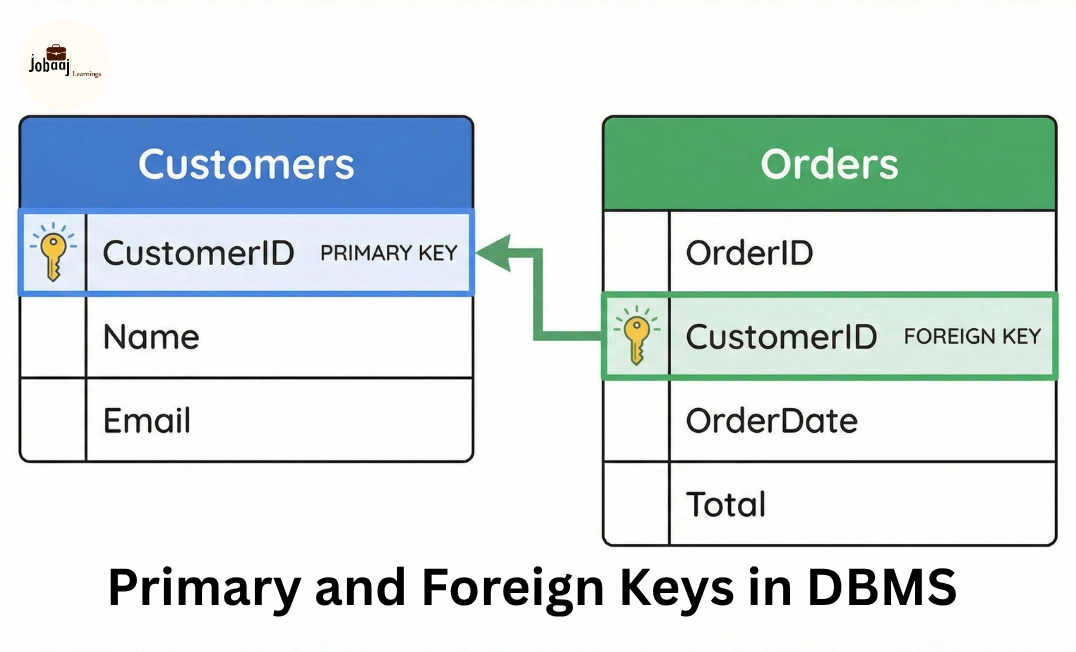
Example: In an order table, a foreign key might reference the CustomerID in a customers table:
- CustomerID (Primary Key) in the Customers table.
- CustomerID (Foreign Key) in the Orders table.
Here, the foreign key CustomerID in the Orders table links each order to a specific customer in the Customers table.
Key Differences Between Primary Key and Foreign Key
|
Aspect |
Primary Key |
Foreign Key |
|
Definition |
Uniquely identifies each record in a table. |
Links a record in one table to a record in another. |
|
Uniqueness |
Must be unique for each record. |
Can have duplicate values in the table. |
|
Nullability |
Cannot be null. |
Can be null, indicating no relationship. |
|
Location |
Exists in the table that stores the main data (parent table). |
Exists in the referencing table (child table). |
|
Purpose |
Ensures each record is unique. |
Establishes and enforces relationships between tables. |
|
Example |
EmployeeID in the Employees table. |
CustomerID in the Orders table. |
Why Are Primary Keys and Foreign Keys Important?
Both primary keys and foreign keys are critical for maintaining data integrity and ensuring reliable relationships between different entities in a database. Here's why they matter:
- Ensures Data Integrity: A primary key ensures that there are no duplicate records in a table. The foreign key ensures that data in related tables stays consistent and is not orphaned.
- Establishes Relationships: Foreign keys create a link between tables, allowing data from multiple tables to be retrieved and combined in meaningful ways.
- Improves Query Performance: With the use of primary keys and foreign keys, database queries become more efficient as they allow easy access to related data across tables.
- Facilitates Data Normalization: By separating data into different tables and using foreign keys to establish relationships, you reduce data redundancy and improve database efficiency.
Best Practices for Using Primary and Foreign Keys
1. Ensure Uniqueness for Primary Keys
When defining primary keys, make sure that the column used is both unique and non-null. In many cases, this will be an auto-incrementing number or UUID to guarantee uniqueness.
2. Use Foreign Keys to Enforce Referential Integrity
Always ensure that foreign keys properly reference the primary key of the related table. For example, use cascading updates or deletes when appropriate to ensure that changes in the parent table reflect in the child table.
3. Index Foreign Keys for Better Performance
Indexing foreign keys can drastically improve query performance, especially when performing JOIN operations between large tables. This can reduce lookup time and make retrieving related records faster.
Conclusion
Both primary keys and foreign keys are essential components of relational database design. Primary keys ensure that each record within a table is unique, while foreign keys establish relationships between different tables, ensuring that your data remains consistent and properly linked. By understanding the differences between them and how to use them effectively, you can build efficient, scalable, and reliable databases.
In database design, leveraging both types of keys not only enhances data integrity but also supports efficient query processing, making it easier to access related data and optimize performance. Understanding and implementing primary and foreign keys properly is crucial for any database management system (DBMS).
Aspiring for a career in Data and Business Analytics? Begin your journey with a Data and Business Analytics Certificate from Jobaaj Learnings.
Frequently asked questions
What is the difference between a primary key and a foreign key?
A primary key uniquely identifies each record in a database table, while a foreign key links a record in one table to a record in another, creating a relationship between the two tables.
Can a foreign key be null?
Yes, a foreign key can be null, indicating that the record does not have an associated value from the referenced table.
Can a table have more than one foreign key?
Yes, a table can have multiple foreign keys. Each foreign key can reference a primary key in a different table, establishing multiple relationships between tables.
Why are primary and foreign keys important in database design?
Primary keys ensure uniqueness within a table, while foreign keys maintain referential integrity between related tables. Both are crucial for data consistency and for optimizing database queries.
Can a foreign key reference multiple columns?
Yes, a foreign key can reference multiple columns in the parent table, forming a composite key. This is useful when the relationship between tables involves more than one column.

Join 5,00,000+ Subscribers
Be a part of our ever growing community.