Categories








































Harsh Sharma Jobaaj Learnings Review: From CFA Level. 2 to Asset Management Analyst at Klyvora

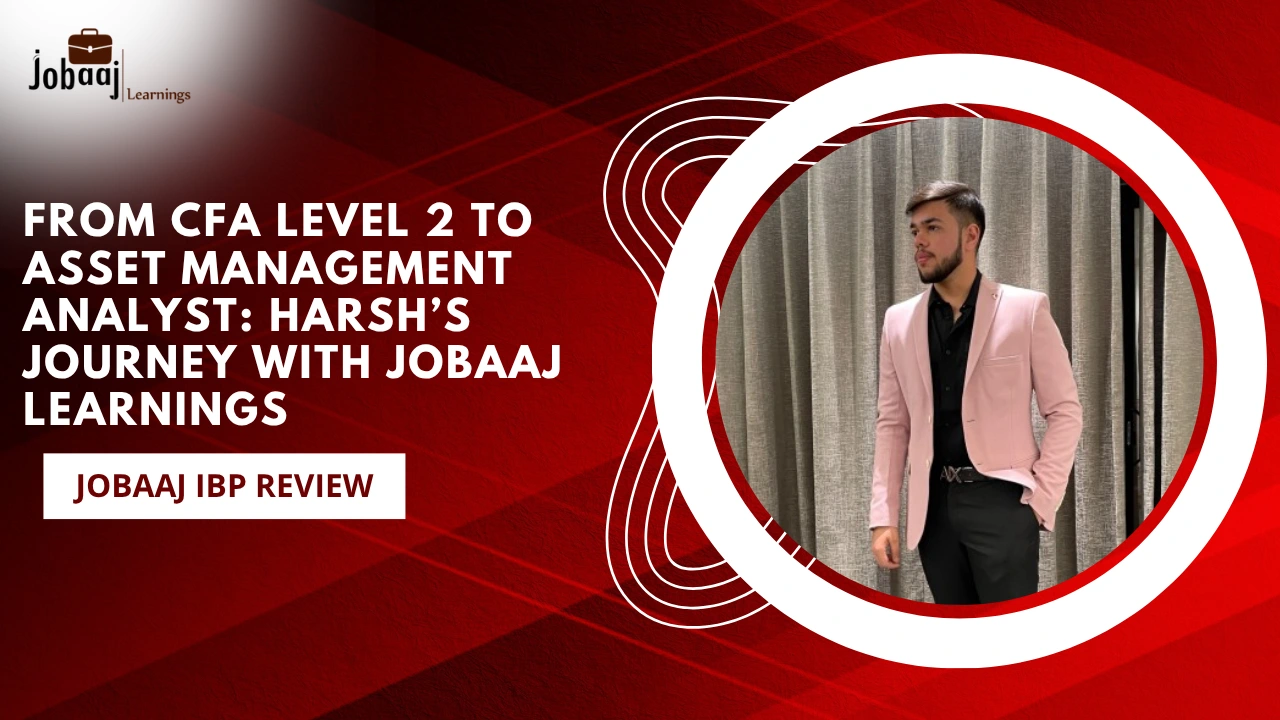
The financial modeling lectures are really good. It helped me a lot because I learned a lot of shortcuts while making the project... And most importantly, the Excel lectures were really good. It helped me also in my interview process." — Harsh Sharma, who rated Jobaaj Learnings 8/10 in this conversation
Harsh Sharma is a BCom (Honours) graduate from St. Xavier's College, Kolkata. He cleared his CFA Level 2 exam in January, interned at Nuvama Wealth, and had built a research report and a financial model on a private company that required an ARR-based valuation before joining Jobaaj Learnings' Investment Banking Program. He was still mid-way through the programme's assignments when he was placed. He is now an Asset Management Analyst at Klyvora Group, a real estate investment firm headquartered in Chicago.
If you have searched "is Jobaaj real or fake", "is Jobaaj Learnings genuine" or "is Jobaaj Learnings worth it", treat this page as one data point, not a verdict. It is a recorded, on-camera conversation with one placed student. What it puts on record is checkable: a named company (Klyvora Group), a named role (Asset Management Analyst), a named placement coordinator (Vishaka), a three-stage interview process described in detail, and a rating that came with a specific criticism. What a single review cannot tell you is what happened to students who did not get placed, or what the outcome rate across the whole cohort looks like. Read this alongside the full set of student feedback on the Jobaaj Learnings reviews page and the other conversations in our Interview Series before you decide.
Key Takeaways: Harsh Sharma's Jobaaj Learnings Review
- Profile: BCom (Hons) from St. Xavier's College, Kolkata; CFA Level 2 cleared in January; internship at Nuvama Wealth; self-built research report and an ARR-based valuation model for a private company.
- Before Jobaaj: had been waiting around seven months for a breakthrough, with several earlier interviews that did not convert.
- Placed mid-process: he had completed only the Gillette India share/research report assignment when the opportunity came; the coordinator reached him before he had gone to the placement team.
- Outcome: Asset Management Analyst at Klyvora Group — remote, US shift (starts 6:30, eight hours), HQ in Chicago with an India office in Mumbai.
- Process: three stages — a 50-question, 15-minute aptitude test; an HR round with technical questions on property valuation and cap rates; a final managerial round with technical and Excel questions.
- Preparation: no formal strategy. Ran mock HR-round interviews with an AI tool (Claude), noted where he got stuck, then practised aloud. CFA Level 2 covered the technical vocabulary.
- What he used from the programme: financial modeling lectures (Excel shortcuts), the Excel lectures, and the advanced modeling module (M&A and LBO), which he described as comprehensive and difficult.
- His rating: 8 out of 10. The deduction was for the user interface, which he said could be better. He also skipped parts of the lectures that repeated CFA content. Coordination: described as smooth; handled by Vishaka from start to finish.
Who Is Harsh Sharma? His Background Before Jobaaj Learnings
In his own words, Harsh's profile at the time of the interview looked like this:
- Degree: BCom (Honours), St. Xavier's College, Kolkata.
- Certification: CFA Level 2, cleared in the January sitting.
- Work experience: an internship at Nuvama Wealth.
- Projects: a research report on a listed company and a financial model for a private company that required an ARR-based valuation.
- Programme: Jobaaj Learnings' Investment Banking Program, where he had completed the Gillette India share report / research report assignment at the time of placement.
This is a stronger starting profile than most freshers in this series. He already had the CFA vocabulary, a wealth-management internship and two self-built projects. What he did not have was a converted offer.
The Job Hunt Before Jobaaj: Seven Months Without a Breakthrough
Harsh opened the conversation by saying he had been "waiting for like past seven months to get a breakthrough." He also mentioned having sat several interviews before this one — which, in his telling, did not lead to an offer but did teach him how to prepare and how to stay confident.
The gap he describes is not a skills gap. By the time he interviewed at Klyvora Group, he had CFA Level 2, modeling projects and an internship. The seven months were about getting into and through a process that ended in an offer.
The Outcome: Asset Management Analyst at Klyvora Group
Harsh is placed at Klyvora Group as an Asset Management Analyst. The facts he stated about the role:
- Company: Klyvora Group, headquartered in Chicago, with an India office in Mumbai.
- Work model: currently remote.
- Shift: US hours, starting at 6:30, eight hours long. He said he had already factored this into his daily schedule.
- Training: roughly three months, covering model-building and how to interact with US clients.
- Day-to-day work, as per the JD: forecasting, valuation and research — working with rent-roll data to support the firm, which acts as a general partner deploying client capital into property. The analyst's job is the back-end calculation on which property to buy, why, and at what value.
The podcast was recorded on his joining day, so he had not yet started work; everything above comes from the JD and his onboarding conversations.
What Jobaaj Learnings Actually Did, According to Harsh
Stripping out the thank-yous, these are the concrete things Harsh attributes to the programme and the placement team:
- Placed him before he finished the programme. He was a mid-process candidate — one assignment done — when Vishaka contacted him directly. Everything ran through her.
- Same-day movement between stages. He submitted the aptitude test, got a call from Vishaka the same day that he had cleared it, and had his HR round that same day.
- Financial modeling lectures. He credits these for the Excel shortcuts he picked up while building his project.
- Excel lectures. He went back to the lectures on the major functions used in daily finance specifically because he expected to be asked to demonstrate something in the interview. He was, in fact, asked an Excel function question in the final round.
- Advanced modeling (M&A and LBO). He called this module comprehensive and said it was difficult for him to build in Excel even with a CFA Level 2 background. He said he still refers back to it.
- Coordination. Described as smooth; he said he did not need to stress about anything.
What he did not credit Jobaaj with: his interview preparation method. That was his own, using an AI tool and prior interview experience (see below).
Inside the Klyvora Group Interview Process
Harsh described three stages, two of which happened on the same day.
| Stage | Format | What was asked |
|---|---|---|
| 1. Aptitude test | Online link from HR; about 50 MCQs in 15 minutes | Logical reasoning, quantitative aptitude and verbal ability |
| 2. HR round (same day) | Call, mix of HR and technical | Tell me about yourself; how do you value a property; which cap rate would you choose when disposing of a property; are you comfortable working US shifts |
| 3. Managerial round (final) | Interview with technical and Excel questions | Why real estate over stocks and other asset classes; tell me about yourself; would you use INDEX MATCH or XLOOKUP; he asked them what the day-to-day work would look like |
Two things stand out. First, the pace: 50 questions in 15 minutes is roughly 18 seconds per question, so the aptitude stage is a speed filter, not a knowledge test. Second, the technical questioning began in the HR round, not after it — the cap-rate question came from HR, before he ever reached the hiring manager.
How Harsh Prepared: Mock Interviews With an AI Tool
Asked about his preparation strategy, Harsh said he did not have one and had not followed the frequently-asked-questions route. What he actually did:
- Used prior interviews as practice. Earlier, unsuccessful interviews taught him how to prepare and how to present himself with confidence.
- Ran mock HR rounds with an AI tool. He asked Claude to act as an HR-round expert and interview him. The tool framed questions; he answered them.
- Logged sticking points. Wherever he got stuck, he made a note — "I'm getting stuck here, I need to fix this" — and then practised those answers aloud.
- Relied on CFA Level 2 for technical vocabulary. His view was that he already knew the terms; what mattered was saying them with confidence.
Real Estate Asset Management Interview Questions to Prepare For
These are the questions Harsh reported being asked at Klyvora Group, with a reference answer for each.
How do you value a property?
Model answer: The three standard approaches are the income approach, the sales-comparison approach and the cost approach. For an income-producing asset the income approach dominates: take net operating income (gross rental income less vacancy and operating expenses) and divide it by a market capitalisation rate — Value = NOI ÷ Cap Rate. Cross-check against recent comparable sales on a per-square-foot or per-unit basis, and against replacement cost for newer assets.
Which cap rate would you choose when disposing of a property?
Model answer (as Harsh gave it): Cap rate and value move inversely. When buying for a client, argue for a higher cap rate so the implied value comes down. When disposing, argue for a lower cap rate so the implied value is higher. In the interview he added that the figure should be at the higher end of the range when acquiring.
Why real estate over stocks and other asset classes?
Model answer: Real estate offers contractual cash flow from leases, a tangible asset that can be actively managed to increase value, the ability to use leverage at the asset level, and returns that historically have lower correlation with public equities. The trade-offs are illiquidity, higher transaction costs and concentration risk, which is why it sits alongside stocks in a portfolio rather than replacing them.
Would you use INDEX MATCH or XLOOKUP?
Model answer: XLOOKUP is the simpler modern choice: one function, looks left or right, has a built-in "if not found" argument and defaults to exact match. INDEX MATCH is worth knowing because it works in every Excel version, handles two-way lookups cleanly with two MATCH calls, and is what you will find in older models you inherit. The right answer in an interview is to explain both and say which one the firm's existing models use.
Are you comfortable working US shifts?
Model answer: Answer directly, and show that you have thought about it practically. Harsh's answer was that he had already factored the shift into his daily schedule.
Tell me about yourself.
Model answer: Degree, certification, internship, projects, and why this role — in under a minute. Harsh was asked this in both the HR round and the managerial round, so it is worth having a version that works twice.
Pros and Cons, Based on Harsh's Account
What he said worked:
- The financial modeling lectures, particularly for Excel shortcuts learned while building the project.
- The Excel lectures on core finance functions, which he revisited before the interview and which were directly relevant to a question he was asked.
- The advanced modeling module (M&A and LBO), which he called comprehensive and still refers to.
- The lectures' explanations of terms, which he described as calm and explanatory.
- Coordination through a single named contact, which he called smooth.
- Being placed while still mid-way through the programme.
What he said could be better:
- The user interface. This was his stated reason for rating the platform 8 rather than higher. The podcast host responded that the UI is being worked on.
- Repetition for candidates with a CFA background. He skipped parts of the lectures because they covered material he already knew from CFA Level 2. He was explicit that this applies to him, not to students without that background.
Harsh's Tips If You're Considering Jobaaj Learnings
Harsh said he felt too young to give advice, so what follows is drawn from what he described doing rather than what he prescribed.
- Watch the Excel lectures before an interview, not just during the course. He went back to the ones on major daily-finance functions specifically in case he was asked to demonstrate something. He was.
- Practise the HR round out loud. His mock-interview loop was: get an AI tool to play HR, answer, note where you stall, fix it, repeat aloud.
- Treat earlier rejections as rehearsal. He attributed his confidence to having sat interviews that did not go his way.
- Expect technical questions from HR. The cap-rate question came in the HR round, not the managerial one.
- Prepare for a speed-based aptitude test. Fifty questions in fifteen minutes leaves no time to work anything out slowly.
- Do not wait to finish the programme before engaging with placements. He was contacted after one assignment.
Full Podcast Transcript
The conversation, lightly edited for readability.
Harsh: I've been waiting for the past seven months to get a breakthrough, so definitely, thank you for this. And yes, I'm feeling good. What else can I say?
Podcaster: That's great to hear. Before we start, can you tell us about yourself — your educational background and everything?
Harsh: Sure. I'm a BCom Honours graduate from St. Xavier's College, Kolkata. Along with that, I cleared my CFA Level 2 examination in January. I have internship experience at Nuvama Wealth, and I've built a few projects — a research report on a company, and a financial model on a private company which required an ARR-based valuation.
Podcaster: In which company are you placed, and in what role?
Harsh: I'm placed with Klyvora Group as an asset management analyst.
Podcaster: I got to know from the placement team that you were a mid-process candidate — you hadn't reached the placement team yet. Is that right?
Harsh: Vishaka ma'am contacted me, so everything was done through her.
Podcaster: How many assignments had you completed?
Harsh: I was done with the Gillette India share report — the research report on Gillette.
Podcaster: Can you take us through the interview process — how many rounds there were?
Harsh: The first was an aptitude test. I got a link from the HR. It was logical reasoning, quant and verbal ability — MCQs, around 50 questions in 15 minutes. I submitted it the same day and got a call from Vishaka ma'am that I'd cleared and would have an HR round. The HR round was the same day. There were questions like "tell me about yourself," and a few technical ones — how do you value a property, what cap rate would you choose when you dispose of a property. If I'm buying a property for my client, I'd opt for a higher cap rate so the value comes down; when disposing, I'd choose a lower cap rate so the value is higher — at the higher end, to be precise. She also asked whether I was comfortable working US shifts. I said yes, I had already factored it into my daily schedule. Then I was selected for the final round, the managerial round. Technical questions were asked — why do you choose real estate over stocks, tell me about yourself, what do you do. A few Excel-based questions too, like would you choose INDEX MATCH or XLOOKUP. I also asked them what my day-to-day work would look like. The overall process was really smooth. I'd like to thank Vishaka ma'am, the HR at Klyvora Group, and Jobaaj Group.
Podcaster: So you'll be working US shift timings?
Harsh: Yes. It starts from 6:30 and is an eight-hour shift.
Podcaster: Is it on-site or remote?
Harsh: It's remote currently. The office is headquartered in Chicago, and the India office is in Mumbai.
Podcaster: What are your roles and responsibilities?
Harsh: Today is my joining date, so I haven't started yet. As per the JD, I'll be in a training period for around three months. They'll train me on building models and how to interact with US clients. The work involves forecasting, valuation and research — you have data for rent rolls. They're general partners who deploy their clients' money into purchasing the most valuable property out there. We do the back-end calculations on what to buy and why, to make sure the client gets the best at the best value.
Podcaster: How did you prepare for the interview process? Did you follow any strategy, or only the frequently asked questions?
Harsh: To be honest, I didn't follow any strategy. I'd had a few interviews previously, which helped me gain experience — how to prepare, how to be confident. For the technical and behavioural questions, we have so many AI tools now, so I asked Claude to take my interview as an HR-round expert. It framed the questions and I answered. Wherever I felt stuck, I made notes — I'm getting stuck here, I need to fix this — and then practised speaking. For technical questions, I'd cleared CFA Level 2, so I had decent knowledge of the terms. Anything I said needed to be said with confidence.
Podcaster: Any recommendation for students who are mid-process or still learning?
Harsh: To be honest, I'm very young to give a suggestion. From my experience, the financial modeling lectures are really good. They helped me a lot because I learned a lot of shortcuts while making the project. The terms and explanations were good too. And most importantly, the Excel lectures were really good — they helped me in my interview process. I had doubts about whether the interviewer would ask me to show something, so I went through a few important Excel lectures on the major functions used in daily finance.
Podcaster: And the lectures and live sessions overall — how did you find them?
Harsh: As I said, I've cleared CFA Level 2, so I know a few terms, and I skipped a few parts because they'd be repetitive for me — not for other students. What I liked most was the financial modeling part, and the advanced modeling, which involved M&A and an LBO model. That was really comprehensive and was even difficult for me to build in Excel. Hats off to the person teaching it. I still look at the lectures sometimes.
Podcaster: How was the coordination with the placement team and the programme coordinator?
Harsh: It was smooth. Vishaka ma'am handled it very well, and I didn't need to stress about anything.
Podcaster: If I ask you to rate Jobaaj Learnings on a scale of 1 to 10 — academics, placement support, coordination, everything?
Harsh: I'd rate around 8. I felt the user interface could be better. The video lectures are good — very explanatory, very calmly explained. I vouch for them.
Podcaster: We're actually working on the UI. That's it from my side — it was nice talking with you, and have a bright future ahead.
Harsh: Thank you. Have a good day.
Frequently asked questions
Is Jobaaj Learnings genuine, or is it fake?
This page documents one verifiable case: Harsh Sharma, a BCom graduate with CFA Level 2, placed as an Asset Management Analyst at Klyvora Group, with the coordinator named and the interview process described on camera. He also rated the platform 8/10 and named the user interface as the shortfall. That is evidence of a real placement and a real, mixed review — not proof of a placement rate. Weigh it against the full review set on the reviews page.
Can you get placed before finishing the Jobaaj Learnings programme?
Harsh did. He had completed one assignment — the Gillette India research report — when the placement coordinator contacted him. He described himself as a mid-process candidate.
What is the interview process at Klyvora Group?
As Harsh described it: a 50-question, 15-minute online aptitude test (logical, quant, verbal); an HR round the same day that included technical questions on property valuation and cap rates plus a US-shift check; and a final managerial round with technical questions (real estate vs stocks) and an Excel question (INDEX MATCH vs XLOOKUP).
What does an Asset Management Analyst at Klyvora Group do?
Per the JD Harsh described: about three months of training on model-building and US client interaction, followed by forecasting, valuation and research work on rent-roll data to support property acquisition decisions for the firm's clients. The role is remote, on US hours starting at 6:30 for eight hours.
Why did Harsh rate Jobaaj Learnings 8 out of 10?
He said the video lectures were good and that he vouched for them, but that the platform's user interface could be better. The host said the UI is being worked on.
Is the Investment Banking Program worth it if you already have CFA Level 2?
Harsh's account: some lecture content overlapped with CFA and he skipped it, but the financial modeling, Excel and advanced modeling (M&A/LBO) modules were the parts he used and still refers to. One student's view is a starting point for your research, not a substitute for it. Compare more accounts in the Interview Series.
Join 5,00,000+ Subscribers
Be a part of our ever growing community.
Related reads
Ankit's Jobaaj Learnings Review: From Inventory to Remote Financial Controller at Blue Polaris
Vedant Jobaaj Learnings Review: From CFA Level 1 to Associate Analyst at CareEdge Advisory