Categories








































Vedant Jobaaj Learnings Review: From CFA Level 1 to Associate Analyst at CareEdge Advisory

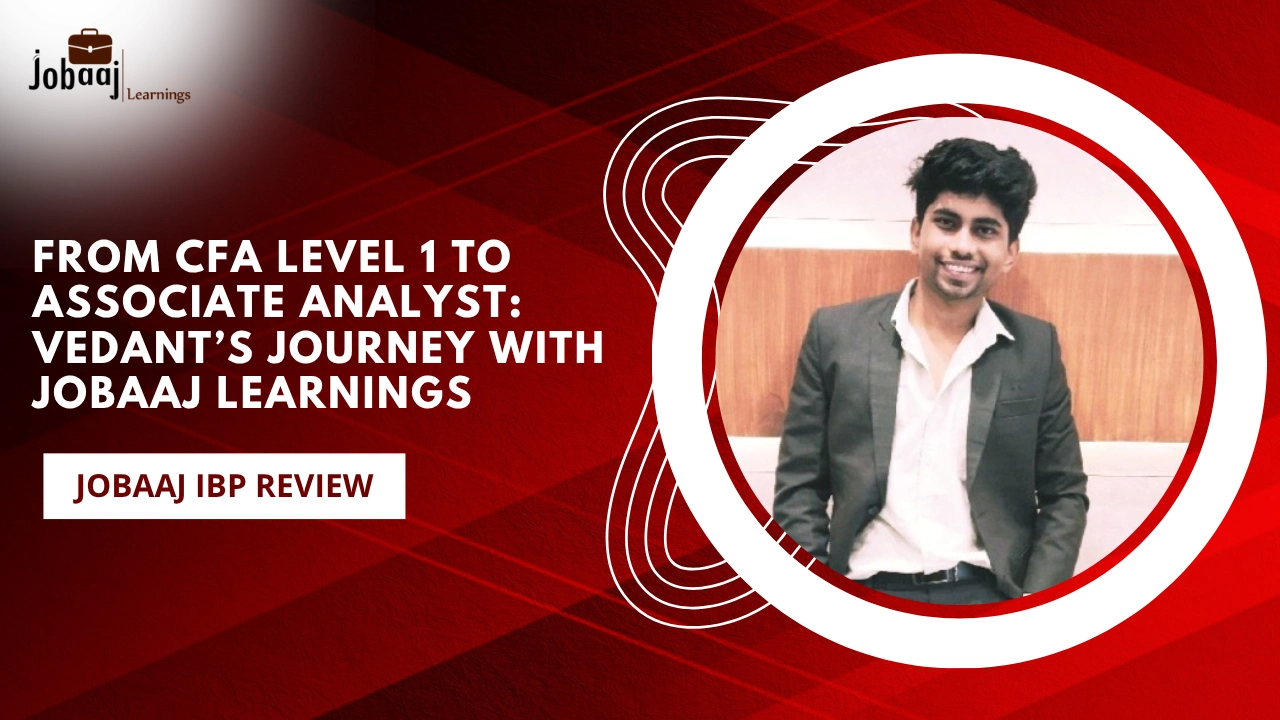
"She was very helpful in sending a lot of openings related to finance, and also telling me — learn this, be updated, improve your CV, it should be ATS-friendly. It was a great experience." — Vedant, who rated Jobaaj Learnings 8/10 in this conversation and asked for the course content to be made harder
Vedant graduated in 2025 with a BMS (Finance) from Pillai College. He has cleared CFA Level 1 and sat for Level 2 in November. Before enrolling in Jobaaj Learnings' Investment Banking Program, he had done an internship and built projects on corporate governance analysis and financial analysis, with a stated interest in equity markets. He is now an Associate Analyst at CareEdge Advisory, where he works across seven to eight sectors and contributes to the industry reports the firm publishes for DRHP filings. He joined two weeks before this conversation was recorded.
If you have searched "is Jobaaj real or fake", "is Jobaaj Learnings genuine" or "is Jobaaj Learnings worth it", treat this page as one data point, not a verdict. It is a recorded, on-camera conversation with one placed student. What it puts on record is checkable: a named company (CareEdge Advisory), a named role (Associate Analyst), a named placement coordinator (Vishakha), a three-round interview process, and a rating that came with a direct criticism of the course content. Read this alongside the full set of student feedback on the Jobaaj Learnings reviews page and the other conversations in our Interview Series before you decide.
Key Takeaways: Vedant's Jobaaj Learnings Review
- Profile: BMS (Finance), Pillai College, class of 2025; CFA Level 1 cleared, Level 2 attempted in November; one internship; projects on corporate governance and financial analysis.
- Before this offer: two interviews in total. The first was for a business analyst role that did not match his CV, and he was not selected.
- Outcome: Associate Analyst at CareEdge Advisory, covering seven to eight sectors and working on DRHP industry reports. Joined two weeks before recording.
- Process: three rounds — a finance knowledge assessment, a round with two directors focused on situational and practical questions, and a round with the lead analyst he would report to.
- Preparation: no formal strategy. Read the Economic Times, followed market podcasts on YouTube, built his own investment theses and formed his own opinions.
- Placement support named: Vishakha sent finance openings regularly, told him what to learn next, and pushed him to keep his CV updated and ATS-friendly.
- Live sessions: attended only two or three (wealth management and basic financial ratios) because of CV preparation; called those helpful.
- His rating: 8 out of 10 (he first said "around seven, around eight").
- Reported problems: course content is too Excel-focused and needs improvement; the assignment bar is much higher than the content prepares you for, so most candidates cannot clear it. The host said the feedback would be passed to the manager.
Who Is Vedant? His Background Before Jobaaj Learnings
In his own words, Vedant's profile at the point of interviewing looked like this:
- Degree: BMS (Finance), Pillai College, graduated 2025.
- Certification: CFA Level 1 cleared; Level 2 attempted in the November window.
- Projects: corporate governance analysis and financial analysis.
- Interest: equity markets.
- Work experience: an internship — which he himself discounts. His view: "in the actual corporate world, internships are not that relevant. The job experience is countable."
- Why he enrolled: placement and upskilling, in that order.
He is a 2025 graduate, so the gap between finishing college and this offer is at most a year. He did not state a month count.
The Job Hunt Before Jobaaj: Two Interviews, One Rejection
Vedant had given only two interviews when this was recorded. The first was for a business analyst role — a profile, he said, that did not match what was on his CV. He was not selected. The second was CareEdge Advisory.
Asked whether the first interview was more data or business than finance, he described the CareEdge role by contrast: not core equity research, but sector-focused and "directly relevant to the core finance career" — a foundation to start from.
The Outcome: Associate Analyst at CareEdge Advisory
Vedant is placed at CareEdge Advisory — the advisory division of the CareEdge group — as an Associate Analyst. What he stated about the role:
- Coverage: multiple sectors, seven to eight at a time.
- DRHP work: alongside sector coverage, the team produces the industry reports that are published as part of DRHP (draft red herring prospectus) filings.
- Status: had joined two weeks before the recording.
He described it as a sector-research seat rather than an equity-research one, and as the right starting point for a core finance career.
What Jobaaj Learnings Actually Did, According to Vedant
Stripping out the general remarks, these are the concrete things Vedant attributes to the placement team and the programme:
- A steady flow of finance openings. Vishakha sent him openings related to finance on a regular basis.
- Direction on what to learn. She told him which topics to pick up next, and to stay updated.
- CV work. He was pushed to improve his CV and make it ATS-friendly. He said CV preparation was the main reason he attended few live sessions.
- Live sessions he did attend. Two or three, on wealth management and basic financial ratios. He called them very helpful.
What he did not credit Jobaaj with: his interview preparation. Asked about strategy, his first answer was that there is no strategy — Vishakha is there to help, but "from your side your effort should be 100%."
Inside the CareEdge Advisory Interview Process
Vedant described three rounds.
| Stage | Who | What it tested |
|---|---|---|
| 1. Assessment test | Online | Basic finance knowledge — whether the theory you have learned so far actually holds up |
| 2. Director round | Two directors | The shift from theory to practice: your projects, and situational questions — "in this situation, what would you do?" — not textbook material |
| 3. Lead analyst round | The lead analyst he would work under | Final round with the immediate reporting line; the offer decision follows |
The structure worth noting: theory is filtered first, then two directors test whether you can apply it, and the person you would actually report to gets the final say. He was not asked textbook questions in round two; he was asked what he would do in real situations.
How Vedant Prepared: Markets, Not Question Banks
Vedant did not follow a question bank or a fixed plan. What he described doing:
- Read the Economic Times daily to understand what the markets were doing.
- Followed market podcasts on YouTube.
- Built his own investment theses. His point was that having and holding an opinion matters more than knowing the answer.
- Put in the effort himself. He was explicit that the coordinator helps, but the candidate's own effort has to be total.
This lines up with the interview he described: a director round built on situational awareness rewards someone who has been watching real markets and forming views.
Sector Research Interview Questions to Prepare For
Vedant did not list specific questions, only the shape of each round. The questions below follow that shape — theory first, then applied and situational — for a sector-research seat like this one.
Walk me through a project on your CV.
Model answer: State the question the project set out to answer, the data you used, the method, and the conclusion — in that order. For a corporate governance analysis: which company, which governance parameters you scored (board independence, related-party transactions, promoter pledging, audit quality), what you found, and what you would have flagged to an investor. Round two at CareEdge was built on this: whatever projects you have, be ready to defend them.
A sector you cover just had a sudden regulatory change. What do you do first?
Model answer: Read the primary source — the circular or notification itself, not the news summary. Map which companies in your coverage are affected and how (revenue, cost, capex, timeline). Quantify a first-order impact, note what you still don't know, and flag it upward with a view. Situational questions like this test process and judgement, not a memorised answer.
How would you size a sector's market for a DRHP industry report?
Model answer: Triangulate top-down and bottom-up. Top-down from government or industry-body data (production, consumption, trade); bottom-up from the listed players' reported revenues and their estimated market share. State your assumptions, reconcile the two, and be clear about the data vintage. A DRHP report is a regulatory document, so every number needs a citable source.
Which financial ratios would you look at first for a company in an unfamiliar sector?
Model answer: Start with the ones that describe the business model: gross and operating margin (pricing power and cost structure), working-capital days (cash conversion), return on capital employed (capital intensity), and net debt to EBITDA (balance-sheet risk). Then compare each against sector peers, because a "good" ratio only means something relative to the industry.
What is your view on a stock or sector right now, and why?
Model answer: Pick one you actually follow. Give the thesis in three parts — what the market believes, where you differ, and what would prove you wrong. Vedant's own preparation was building investment theses; this is the question that preparation is for.
You have an internship but no full-time experience. Why should we hire you over someone with a year on the job?
Model answer: Don't oversell the internship — Vedant's own view is that hiring managers discount them. Point instead to certification (CFA Level 1, Level 2 attempted), completed projects, and evidence that you follow markets on your own time.
Pros and Cons, Based on Vedant's Account
What he said worked:
- A named coordinator who sent finance openings regularly and told him what to learn next.
- CV support, specifically on making it ATS-friendly.
- The two or three live sessions he attended (wealth management, basic financial ratios), which he called very helpful.
- He described the overall placement experience as great.
What he said could be better:
- Course content needs a total improvement. His words, and he laughed as he said it, but he did not walk it back.
- Too Excel-focused. He felt the content leaned heavily on Excel.
- Assignment bar is far above the content. The bare-minimum level of the assignments is very high, and in his view most candidates cannot clear them. His fix: make the content as complex as the tests, so the two are at par.
- He attended few live sessions. That was his choice (CV preparation took priority), but it means his view of the teaching is based on a small sample.
The host's response on record: the content feedback would be passed to the manager, and she noted that most candidates say everything was fine when asked for improvements, so this was the kind of feedback they actually need.
Vedant's Tips If You're Considering Jobaaj Learnings
- Your effort has to be 100%. The coordinator sends openings and direction; the preparation is yours.
- Read the Economic Times and watch the real market. His preparation was market awareness, not question lists — and the director round was situational.
- Build and hold your own investment thesis. Having an opinion matters more than having the answer.
- If you want modelling roles, build multiple projects. Not one.
- Get clarity on the target role first, then curate your strategy. His one rejection was for a role that did not match his CV.
- Keep your CV ATS-friendly and current. This was the most concrete thing the placement team pushed him on.
- Expect the assignments to be harder than the lectures. His main criticism — plan for it.
Full Podcast Transcript
The conversation, lightly edited for readability.
Podcaster: Thank you so much, Vedant, for joining this podcast and sharing your insights with us. Congratulations on getting placed. How are you feeling?
Vedant: It's a great feeling. I can't express it.
Podcaster: That's great to hear. Before getting started, can you tell us about yourself and what you've done so far?
Vedant: I graduated in 2025 from Pillai College with a BMS in Finance. I've cleared CFA Level 1 and appeared for CFA Level 2 in November. I've done a few projects on corporate governance analysis and financial analysis. I'm interested in equity markets.
Podcaster: And in what role are you placed right now?
Vedant: I'm working as an associate analyst. We work on multiple sectors — seven, eight sectors — and side by side we also work on the DRHP segment, where the industry reports are published from our side.
Podcaster: In which company?
Vedant: CareEdge Advisory division.
Podcaster: Can you walk us through the interview process — how many rounds, what kind of questions?
Vedant: There were around three rounds. The first was an assessment test. It tests your basic knowledge of finance — whether you're really capable of the theoretical knowledge you've learned so far. The second round was with two directors, and that's where it shifts from theoretical to practical — whatever projects you have. The questions aren't related to your textbooks; they're real-life situations, situational awareness — in this situation, what would you do. After that, the third round is with whom you'll be working — the lead analyst. After those three rounds, whether you get the offer letter depends.
Podcaster: So you've already joined the company?
Vedant: Yes, it's been two weeks.
Podcaster: How many interviews have you given so far?
Vedant: Around two. The other one was for a business analyst role, which was a different role from the profile I had on my CV. Unfortunately I wasn't selected there, but I got the opportunity here.
Podcaster: So the first one was more about data or business, not finance?
Vedant: This one isn't core equity research, but it's more about sectors, and it's directly relevant to a core finance career. It's a great foundation to start from.
Podcaster: You're a complete fresher, right? Any internship before this?
Vedant: Yes, I did an internship. But in the actual corporate world, internships are not that relevant. Job experience is what counts — from my point of view.
Podcaster: Can you tell our candidates what your strategy was for interview preparation?
Vedant: There's nothing like a strategy. Vishakha ma'am is there and she's helping you, and from your side, your effort should be 100%. If you're into finance, start reading the Economic Times, understand the markets. There are multiple podcasts on YouTube. Create your own investment thesis. Keeping your own opinion is more important.
Podcaster: If I ask you to give a suggestion to candidates preparing for the IB field, equity market roles?
Vedant: Keep your curiosity alive and watch the real market. If you want to go into financial modelling, create multiple projects. First have clarity about what you have to do, then curate your strategy accordingly.
Podcaster: Let's talk about the Jobaaj placement team. How did they help you get placed?
Vedant: She was very helpful in sending a lot of openings related to finance, and also telling me — learn this, be updated, improve your CV, it should be ATS-friendly. It was a great experience.
Podcaster: And the live sessions you were given at enrolment — how did you like them?
Vedant: To be honest, I didn't attend too many because of my CV prep. I did attend two or three, related to wealth management and basic financial ratios, and they were very helpful.
Podcaster: So basically you were here for placement?
Vedant: Placement and upskilling.
Podcaster: If I ask you to rate Jobaaj Learnings on a scale of 1 to 10, based on everything — counsellor, placement team, coordinator?
Vedant: Around seven, around eight. Eight out of 10.
Podcaster: Any suggestion for improvement?
Vedant: Total content improvement is required. The content is more Excel-focused. And the assignments they take — the bare-minimum level is very high. Most candidates can't clear it. If the content is made a little more complex, at par with the tests you're taking, it will be helpful for students.
Podcaster: Got it. I'll deliver it to the manager and they'll handle it. I appreciate that you said it, because most candidates just say "no ma'am, everything was fine," but we actually need suggestions for improvement. That's it from my side. Thank you so much for joining and sharing your insights. We as the Jobaaj family wish you all the best for your future.
Vedant: Thank you. Bye.
Frequently asked questions
Is Jobaaj Learnings genuine, or is it fake?
This page documents one verifiable case: Vedant, a 2025 BMS (Finance) graduate with CFA Level 1, placed as an Associate Analyst at CareEdge Advisory, with the coordinator named and the process described on camera. He rated the platform 8/10 and said the course content needs improvement. That is evidence of a real placement and a candid review — not proof of a placement rate. Weigh it against the full review set on the reviews page.
What does an Associate Analyst at CareEdge Advisory do?
As Vedant described it: sector coverage across seven to eight sectors, plus work on the industry reports CareEdge publishes for DRHP filings. He characterised it as sector research rather than core equity research.
What is the interview process at CareEdge Advisory?
Three rounds: an assessment test on basic finance theory; a round with two directors built on your projects and situational questions; and a final round with the lead analyst you would report to.
Why did Vedant rate Jobaaj Learnings 8 out of 10?
He credited the placement team for regular openings, direction on what to learn, and CV support, and called the live sessions he attended helpful. He deducted for the course content: too Excel-focused, and with assignments pitched far above what the content prepares you for.
Do you need CFA to get placed through Jobaaj Learnings?
Vedant had CFA Level 1 and had attempted Level 2. Other students in this series were placed without any CFA level, so it is one input among several rather than a requirement. What he emphasised more was following live markets and having his own investment views.
Is the Investment Banking Program worth it if you mainly want placement support?
Vedant enrolled for placement first and upskilling second, attended only two or three live sessions, and was placed. His account is favourable on the placement side and critical on the content side. One student's view is a starting point for your research, not a substitute for it. Compare more accounts in the Interview Series.
Join 5,00,000+ Subscribers
Be a part of our ever growing community.
Related reads
Ankit's Jobaaj Learnings Review: From Inventory to Remote Financial Controller at Blue Polaris
Harsh Sharma Jobaaj Learnings Review: From CFA Level. 2 to Asset Management Analyst at Klyvora